
>
General Surgery

Private General Surgery

From hernia repair to gallbladder removal surgery, get the care you need without waiting years.

Surgency helps you find accredited private general surgeons in cities like Vancouver, BC, Calgary, AB, Toronto, ON, Montréal, QC.

Private male general surgeon consulting with prospective female patient

What is Surgency?

At Surgency, we do two things: empower & educate.

We give patients and caregivers clear information about private healthcare options—and make it easy to find, research, and contact accredited Canadian surgeons.

If you’re learning about your options, explore our procedure guides below. If you’re ready to speak with someone, browse surgeons directly.

Credit card mockup

Common General Surgeries Offered Privately in Canada

Why consider private general surgery?

Canadians might consider private general surgery when ongoing pain, lumps, hernias, or gallbladder attacks are running their life and the public wait list is months or years. Delays can mean more ER visits, missed work, cancelled trips, and constant worry about things getting worse.

Private general surgery offers faster access to vetted Canadian surgeons for procedures like hernia repair, gallbladder removal, soft‑tissue tumour excision, and other abdominal operations. You can compare clinics, review credentials, and get clear timelines for assessment and surgery. For many people, choosing a private option is about regaining comfort and function sooner, while putting less strain on an already stretched public healthcare system.

Surgency is your guide—not a clinic—connecting you with out-of-province options through accredited, licensed clinics and surgeons. We help you compare options, costs, qualifications and provide you with the resources you need to make a confident, informed decisions.

Private Canadian General Surgery Surgeons

Accepting 🇨🇦 patients from all provinces
QC
MD, MSc, FRCSC, FACS
Christian Zalai
Surgeon location icon
Montréal, QC
English, French
Sees adult patients

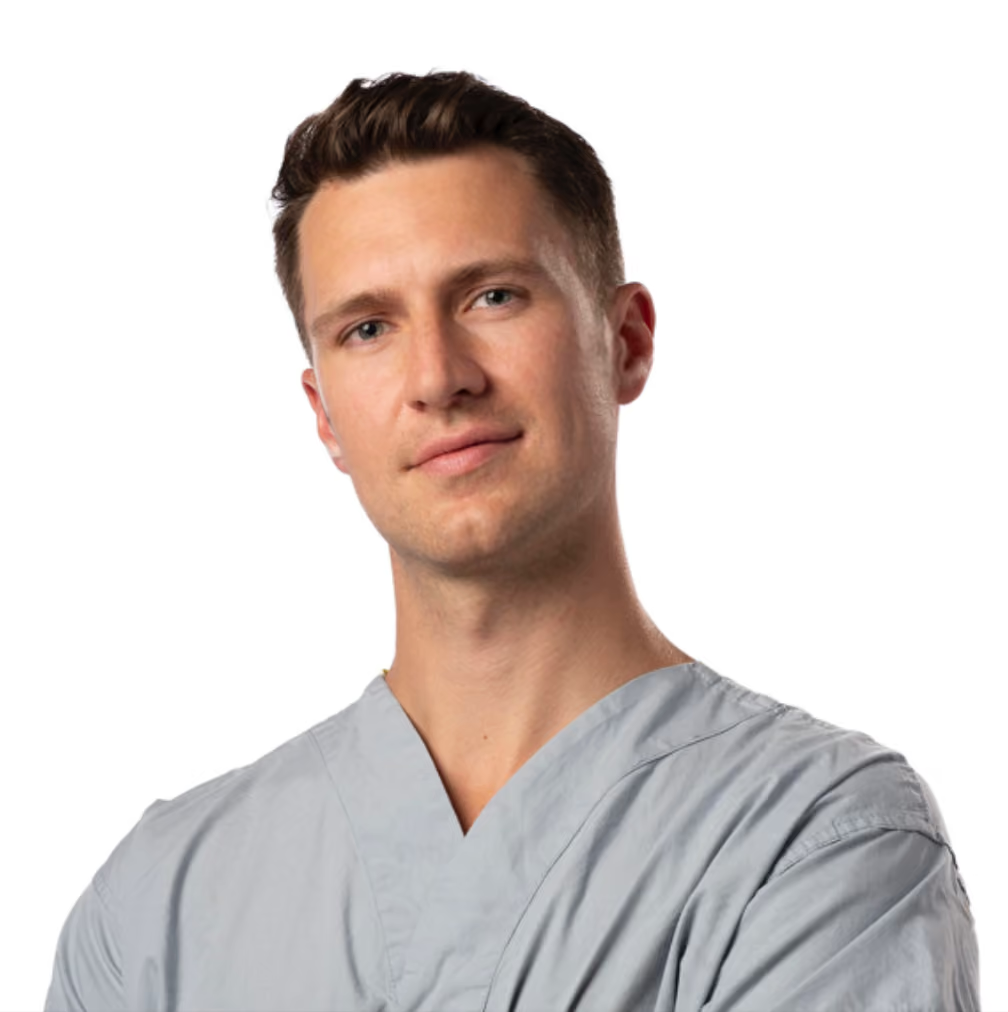
Double board-certified colorectal and general surgeon with advanced minimally invasive fellowship training, and 14 years of experience.

Procedural Expertise:
Accepting 🇨🇦 patients
Cannot treat BC residents
BC
MD, FRCSC
Nathan How
Surgeon location icon
Kamloops, BC
English
Sees adult patients

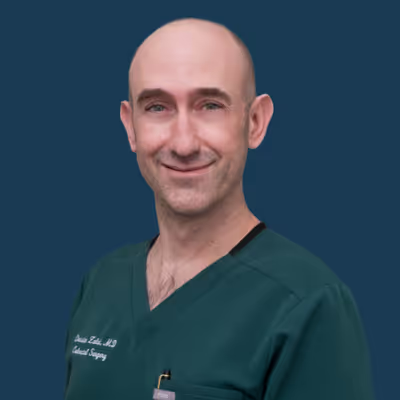
FRCSC-certified general surgeon specializing in minimally invasive and mesh-free hernia surgery, with additional focus on anal reconstruction/ rejuvenation.

Procedural Expertise:
Accepting 🇨🇦 patients from all provinces
QC
MD, FRCSC
Simon Bergman
Surgeon location icon
Montréal, QC
English, French
Sees adult patients

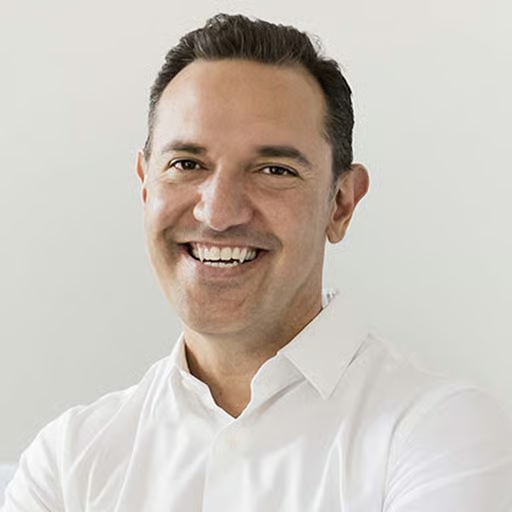
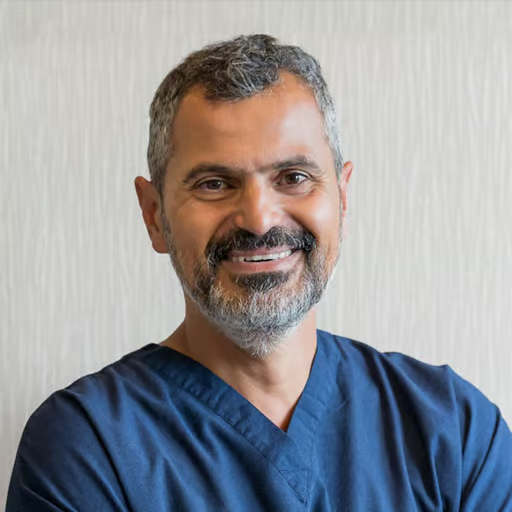
A leading expert in minimally invasive general surgery specializing in advanced laparoscopic techniques for safe, rapid-recovery procedures for hernias & gallbladder disease.
Procedural Expertise:
Accepting 🇨🇦 patients from all provinces
QC
Cassandre Benay, surgeon profile picture
MD, MSc, FRCSC
Cassandre Benay
Surgeon location icon
Montréal, QC
English, French
Sees adult patients

Highly specialized endocrine & general surgeon with a focus on minimally invasive management of thyroid and parathyroid disorders, prioritizing rapid recovery and minimal scarring for his patients.

Procedural Expertise:
Accepting 🇨🇦 patients from all provinces
QC
Gerry Polyhronopoulos surgeon profile picture
MD, FRCSC
Gerry Polyhronopoulos
Surgeon location icon
Montréal, QC
English, French
Sees adult patients

A versatile general surgeon known for his approachable bedside manner and technical efficiency with 14 years of experience.

Procedural Expertise:
Accepting 🇨🇦 patients
Cannot treat BC residents
BC
Dr. Jannah Wilson surgeon profile picture
MD, FRCSC
Jannah Wilson
Surgeon location icon
Vancouver, BC
English
Sees adult patients

Experienced general surgeon focused on minimally invasive (laparoscopic) techniques, advanced endoscopy, and oncoplastic breast surgery.

Procedural Expertise:
Accepting 🇨🇦 patients from all provinces
QC
Naim Otaky surgeon profile picture
MD, FRCSC
Naim Otaky
Surgeon location icon
Montreal, QC
English, French
Sees adult patients

Breast and thyroid specialist, combining diagnostic precision with surgical compassion, guiding thousands of women through breast cancer diagnosis and treatment for over 23 years.
Procedural Expertise:

How to choose a private general surgeon & clinic

Choosing your surgeon and clinic is one of the primary benefits of the private route. In general surgery, the key to a successful outcome isn't just the procedure itself, but the surgeon's judgment on whether to operate, their proficiency in minimally invasive techniques, and how they manage your post-operative recovery.

What to look for

Experience and sub-specialization

"General" surgery is a broad field. You want a surgeon who performs your specific procedure routinely, not just occasionally. Ask about:

  • Annual volume: How many of these specific procedures (e.g., laparoscopic cholecystectomies, inguinal hernia repairs) do they perform annually? High volume is strongly linked to lower recurrence and complication rates.
  • Technique expertise: Are they proficient in laparoscopic (keyhole) surgery? This approach generally results in less pain and faster recovery than open surgery.
  • Conversion rates: Ask how often they have to "convert" from a laparoscopic approach to an open incision during surgery. A lower rate often suggests higher technical skill.

Credentials and training

  • Verification: Confirm licensure with the relevant provincial college (e.g., CPSO in Ontario, CPSBC in BC, CPSA in Alberta).
  • Certification: Look for the FRCSC designation (Fellow of the Royal College of Surgeons of Canada).
  • Fellowship: Ideally, look for additional training relevant to your condition, such as Minimally Invasive Surgery (MIS), Colorectal, or Hepatobiliary fellowships.
  • Note: all Surgency-listed surgeons have verified Canadian licensure, provincial licensure, and FRCSC-certification (or equivalent Board certification).

Decision philosophy: “Tailored approach”

A quality surgeon should explain, in plain language:

  • Watchful waiting: Is surgery actually necessary right now? (e.g., for a small, asymptomatic hernia or gallstones without attacks).
  • Mesh strategy: For hernias, do they use mesh? If so, why, what kind, and what are the risks vs. benefits of non-mesh repair?
  • Anatomy vs. Technology: Why are they choosing a specific approach (Open vs. Laparoscopic) for your specific body type and history?

Outcomes and safety

Request surgeon-specific or clinic-level data regarding:

  • Infection rates: Surgical site infections should be extremely low.
  • Recurrence rates: Specifically for hernias—how often does the problem come back after they fix it?
  • Specific complications: For gallbladder surgery, ask about bile duct injury rates. For bowel procedures, ask about leak rates.
  • ERAS protocols: Do they use "Enhanced Recovery After Surgery" pathways (e.g., early feeding, minimizing narcotics) to speed up your return to normal function?

Imaging and planning

  • Diagnostic clarity: Have they reviewed your Ultrasound or CT scans personally?
  • Physical exam: A hands-on exam is critical, especially for hernias, to determine the size of the defect and tissue quality, which dictates the surgical plan.
  • Pre-op optimization: Do they verify that you are medically optimized (e.g., blood thinners managed, diabetes controlled) to reduce bleeding and infection risk?

Facility accreditation & anesthesia plan

  • Accreditation: Ensure the surgical center is accredited (e.g., CAAASF or Accreditation Canada).
  • Anesthesia: General anesthesia is common for abdominal work, but some procedures (like small hernias) can be done with sedation and local freeze. Discuss what is best for you.

Recovery and travel integration

Since general surgery often impacts your core strength and digestion, you need a clear plan before traveling home:

  • Immediate post-op: What are the dietary restrictions immediately after surgery (especially for gallbladder or bowel procedures)?
  • Activity restrictions: Explicit instructions on lifting limits (e.g., "nothing heavier than 10lbs for 4 weeks") to prevent hernia recurrence.
  • Wound care: Instructions for incision care, showering, and signs of infection to watch for once you are home.

Questions to ask during your consultation

Surgeon and surgery plan

  • How many of these specific procedures do you perform annually?
  • Will you be performing this laparoscopically? What is the chance you will need to make a larger open incision?
  • (For Hernias): Will you use mesh? What type? What are the long-term risks associated with it?
  • (For Gallbladders): What are the risks of digestive issues post-surgery?

Recovery and aftercare

  • When can I lift heavy objects, exercise, or return to physical labor?
  • Are there specific foods I need to avoid, and for how long?
  • What is the pain management plan? Will I need narcotics, or is this managed with over-the-counter medication?
  • If I am traveling, how many days must I stay in town before it is safe to travel?

Costs and logistics

  • Is the quote "all-inclusive" (surgeon, anesthesia, facility fee, pathology labs for tissue analysis)?
  • What financial responsibility do I have if a complication requires a hospital transfer or re-operation?
  • What is the emergency transfer plan in the unlikely event of a major complication?

Why can't I find a private general surgeon near me?

Access to private general surgery (hernias, gallbladders) is heavily restricted by provincial laws designed to protect the public single-payer system. Generally, provinces do not permit surgeons to charge a patient within that same province directly for a 'medically necessary' surgery covered by the public health plan.

However, surgeons are allowed to treat patients privately for 'medically necessary' if they come from out-of-province. So most Canadians seeking private general surgery must travel to a province other than their own.

Once exception is that if you are looking to have a minor, benign cyst / lipoma removed, then you might be able to see a private surgeon within your province.

Provincial Breakdown

Quebec

Quebec is the most developed, open market for private general surgery in Canada.

Following the 2005 Chaoult Supreme Court ruling, Quebec allows surgeons to become "Non-Participating Professionals." These doctors completely opt out of the public system and take zero public money, allowing them to legally charge patients directly at fair market rates. Quebec has the most robust network of private clinics and acts as the primary hub for out-of-province patients in Canada.

Alberta

Alberta has high surgical capacity, but it is legally complicated for locals to access it—though this is likely changing with Bill 11, which allows surgeons to dual practice.

Alberta uses "Chartered Surgical Facilities" largely to handle Workers' Compensation (WCB) cases and federal contracts (RCMP). While these facilities have the infrastructure for hernias and gallbladders, current laws restrict access from  Albertans. 

Private surgeons can see patients from out-of-province, and opted-out surgeons can treat Albertans by leasing time from chartered facilities.

British Columbia

Strict regulations make it difficult to find a surgeon who can treat BC residents privately.

The BC Medicare Protection Act heavily fines clinics that charge patients for medically necessary services, and recent court battles have reinforced these restrictions. While clinics exist to serve WCB and out-of-province patients, very few surgeons have fully "opted out" to treat BC residents, making private general surgery for locals nearly nonexistent.

Ontario 

Ontario allows surgeons to opt out—in theory—but its financially infeasible so there are no opted-out surgeons.

The Commitment to the Future of Medicare Act (CFMA) makes charging for insured services onerous, and the College of Physicians and Surgeons requires private facilities to meet hospital-level standards that are too expensive for most private clinics to maintain. 

Result: Private clinics in Ontario mostly perform minor, non-hospital procedures (lumps, bumps, endoscopy). For a major hernia repair or gallbladder removal, an Ontario resident has no legal option to pay privately within the province.

Saskatchewan

The public system "buys up" the private capacity.

Saskatchewan pioneered the "Privately Delivered, Publicly Funded" model. The government pays private clinics to perform surgeries to keep public wait times down. Because the clinics are busy with government contracts, there is very little direct-to-consumer time available for private surgery. 

So private surgery is available, but limited.

Manitoba & The Atlantic Provinces

Populations are generally too small to sustain high-overhead private surgical facilities. Patients in these provinces almost exclusively travel to Quebec, Alberta, Ontario, or BC.

Will a private general surgeon have my best interests in mind? What about the profit motive?

Canadian private general surgeons must prioritize your health over profit. 

In Canada, every surgeon is legally bound by the Canadian Medical Association (CMA) Code of Ethics and Professionalism, which explicitly mandates acting in the patient’s best interest regardless of practice setting.

They are strictly licensed and audited by their provincial College of Physicians and Surgeons (e.g., CPSO, CPSA, CMQ). Recommending unnecessary surgery for profit risks license revocation and massive malpractice lawsuits.

The standard of care is identical to the public system, dictated by clinical guidelines from the Canadian Association of General Surgeons (CAGS). Furthermore, private clinics must pass rigorous Non-Hospital Medical and Surgical Facilities Accreditation Programs (NHMSFAP) to legally operate.

Is private general surgery legal in Canada?

Yes, private general surgery is legal in Canada, but it is heavily restricted by provincial laws designed to protect the public single-payer system.

Here is how the legality works in practice:

  • Under the spirit of the Canada Health Act and strict provincial health acts, it is effectively illegal for a surgeon to charge a patient directly for a "medically necessary" surgery (like a hernia repair, gallbladder removal, or appendectomy) if that patient is a resident of the same province.
  • Provincial health laws only cover their own residents. It is perfectly legal for a private clinic in Alberta or Quebec to sell a hernia repair to a resident of British Columbia or Ontario. This is why most Canadians seeking private general surgery must cross provincial borders to become "private-pay" patients.
  • The exception to this rule is surgeons who elect to opt-out of the public system and practice wholly in the private system. These surgeons can see patients from their own province, but these surgeons are relatively rare.
  • If a procedure is deemed "cosmetic" or not medically necessary by the public system—such as removing a benign lipoma, an asymptomatic cyst, or a skin tag—it is completely legal to pay a private surgeon to do it within your own province.
  • It is fully legal for certain third parties—such as Workers' Compensation Boards (WCB), the RCMP, the military, or professional sports teams—to purchase private surgery for individuals in any province to get them back to work faster.

For a more in-depth overview, please read How Private Surgery Works in Canada.

How much does general surgery cost?

The cost of private general surgery in Canada varies widely depending on the complexity of the procedure, the type of anesthesia required, and the facility's location.

For minor, outpatient procedures performed under local anesthesia—such as removing a benign cyst or lipoma—costs typically range from $1,000 to $4,000.

For more complex abdominal surgeries requiring general anesthesia and a full operating room team—such as a laparoscopic hernia repair or a gallbladder removal (cholecystectomy)—you can expect to pay anywhere from $6,000 to $14,000+.

For more granular pricing info, visit our Cost Comparison guide or the Procedure Guide for the specific procedure you are interested in.