

From sinus surgery to tonsil removal, get the ENT care you need without waiting months or years. Surgency helps you find accredited ear, nose, and throat specialists in major cities across Canada, such as Vancouver, Calgary, Toronto & Montréal.

.png)
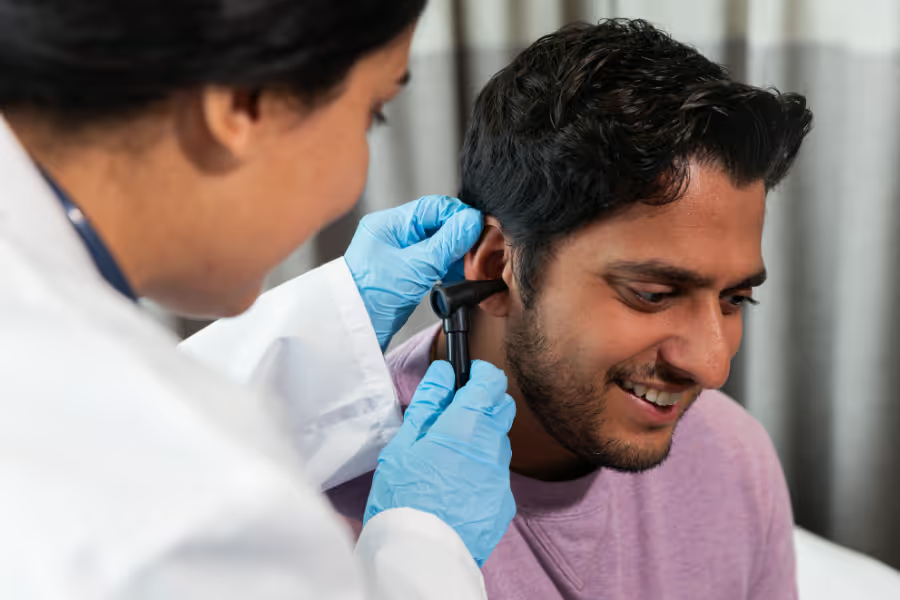
ENT wait times in Canada can extend 12+ months—time that can mean ongoing symptoms, repeated infections, worsening sleep (like from enlarged tonsils or nasal blockage), and a harder recovery if problems progress. Private surgery can offer a safe path to faster care for non-emergency ENT procedures, helping reduce delays, protect long-term health, and get you back to normal life sooner.
Surgency is your guide—not a clinic—helping you find surgical care (often out-of-province) through accredited, licensed clinics and surgeons. We help you compare options, costs, and qualifications, and provide the resources you need to make confident, informed decisions.
A global authority in sleep and nasal surgery with 18+ years of experience, specializing on nasal and sinus complaints, rhinoplasty, endoscopic sinus surgery, snoring and sleep apnea.
Choosing your surgeon and clinic is one of the primary benefits of the private route. In ENT (Ear, Nose, and Throat) surgery, the conditions often affect the most fundamental aspects of daily life — breathing, sleeping, hearing, swallowing, and speaking. The anatomy is intricate and tightly packed, meaning millimetres matter. The key to a successful outcome is finding a surgeon with precise technical skill, deep familiarity with the specific condition, and a clear plan for preserving the delicate structures involved.
ENT (Otolaryngology – Head & Neck Surgery) is a broad field. A surgeon who primarily manages sinus disease may not be the ideal choice for a complex ear reconstruction, and vice versa. Ask about:
A quality ENT surgeon should explain, in plain language:
Request surgeon-specific or clinic-level data regarding:
Recovery from ENT surgery varies widely depending on the procedure, but several considerations are unique to this specialty:
Access to private ENT (Ear, Nose, and Throat) surgery—specifically sinus surgery, tonsillectomies, and septoplasties—is heavily restricted by provincial laws designed to protect the public single-payer system. Generally, provinces do not permit surgeons to charge a patient within that same province directly for a 'medically necessary' surgery covered by the public health plan.
However, surgeons are allowed to treat patients privately for 'medically necessary' surgery if they come from out-of-province. So most Canadians seeking purely medical ENT surgery (like polyp removal or chronic sinusitis treatment) must travel.
One exception is septorhinoplasty. Because the nose is both a functional organ (breathing) and an aesthetic feature (appearance), many private surgeons can operate on local residents by fixing the medical issue (deviated septum) while simultaneously changing the shape of the nose (cosmetic/uninsured).
Quebec is the most developed, open market for private ENT surgery in Canada.
Following the 2005 Chaoult Supreme Court ruling, Quebec allows surgeons to become "Non-Participating Professionals." These doctors completely opt out of the public system.
Alberta has high surgical capacity, but access is often tied to cosmetic or WCB cases.
Alberta uses "Chartered Surgical Facilities" largely to handle Workers' Compensation (WCB) cases.
Strict regulations make it difficult to find a surgeon who can treat BC residents privately for purely medical conditions.
The BC Medicare Protection Act heavily fines clinics that charge patients for medically necessary services.
Ontario allows surgeons to opt out—in theory—but iThe Commitment to the Future of Medicare Act (CFMA) restricts charging for insured services.
The public system "buys up" the private capacity.
Saskatchewan pioneered the "Privately Delivered, Publicly Funded" model. The government pays private clinics to perform ENT procedures (tubes, tonsils, septoplasties) to keep public wait times down. Because the clinics are busy with government contracts, there is very little direct-to-consumer inventory available.
Populations are generally too small to sustain high-overhead private surgical facilities. Patients in these provinces almost exclusively travel to Quebec, Alberta, Ontario, or BC for private ENT care.
Canadian private ENT surgeons must prioritize your health over profit.
In Canada, every surgeon is legally bound by the Canadian Medical Association (CMA) Code of Ethics and Professionalism, which explicitly mandates acting in the patient’s best interest regardless of practice setting.
They are strictly licensed and audited by their provincial College of Physicians and Surgeons (e.g., CPSO, CPSA, CMQ). Recommending unnecessary surgery for profit risks license revocation and massive malpractice lawsuits.
The standard of care is identical to the public system, dictated by clinical guidelines from the Canadian Association of General Surgeons (CAGS). Furthermore, private clinics must pass rigorous Non-Hospital Medical and Surgical Facilities Accreditation Programs (NHMSFAP) to legally operate.
Yes, private ENT (Ear, Nose & Throat) surgery is legal in Canada, but it is heavily restricted by provincial laws designed to protect the public single-payer system.
Here is how the legality works in practice:
For a more in-depth overview, please read How Private Surgery Works in Canada.
The cost of private ENT surgery in Canada varies widely depending on the complexity of the procedure, whether it is cosmetic vs. purely medical, the type of anesthesia required, and the facility’s location.
For minor, outpatient procedures—such as turbinate reduction, minor snoring procedures, or simple ear procedures—costs typically range from $2,000 to $6,000.
For more complex surgeries requiring general anesthesia and endoscopic equipment—such as functional endoscopic sinus surgery (FESS), septoplasty/septorhinoplasty, or tonsillectomy—you can expect to pay anywhere from $6,000 to $20,000+.
For more granular pricing info, visit our Cost Comparison guide or the Procedure Guide for the specific procedure you are interested in.