
>
Imaging

Private Imaging

From MRI scans to prostate or breast screenings, get the imaging and diagnostic care you need, faster.

Surgency offers transparency on pricing, and connects you to accredited imaging clinics across Canada.

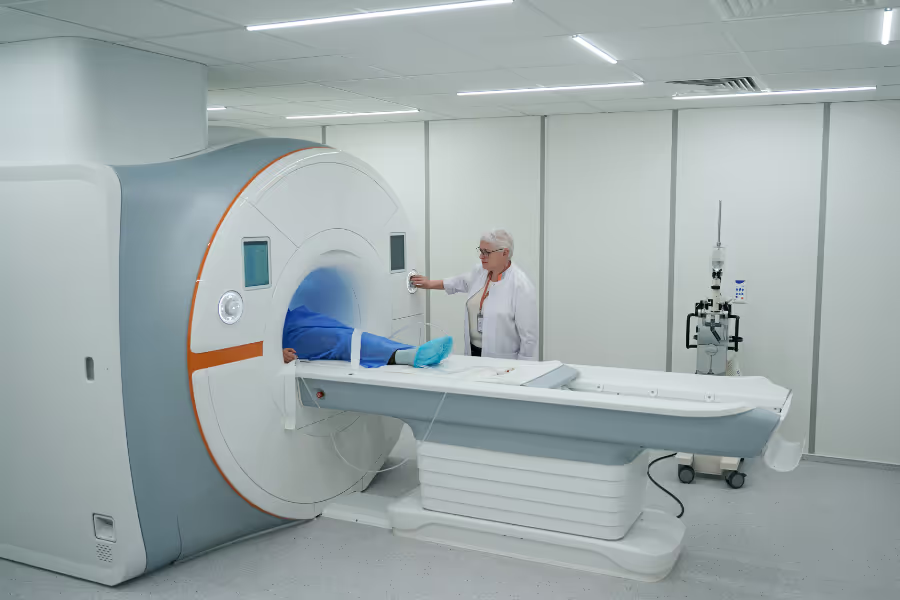
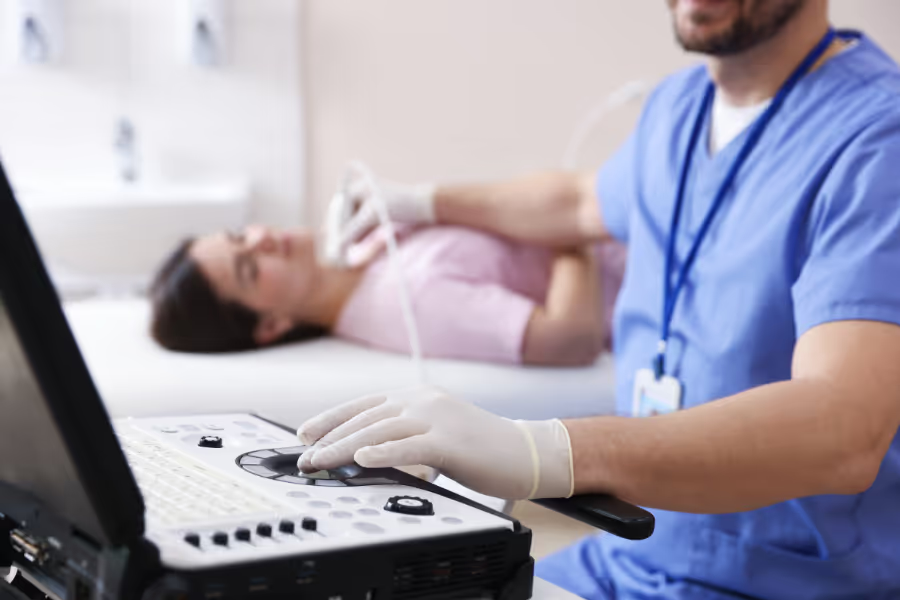
Private MRI being used on a patient in blue scrubs

What is Surgency?

At Surgency, we do two things: empower & educate.

We give patients and caregivers clear information about private healthcare options—and make it easy to find, research, and contact accredited Canadian surgeons.

If you’re learning about your options, explore our procedure guides below. If you’re ready to speak with someone, browse surgeons directly.

Credit card mockup

Screenings Offered Privately in Canada

Why consider private imaging & diagnostics?

Canadians might consider private imaging and diagnostics when you’re stuck waiting months for an MRI, CT, or ultrasound, and symptoms are affecting your life. Long delays can mean slower diagnosis, delayed treatment, and more time living with pain, worry, or limited function.

Private imaging offers faster access to quality Canadian clinics for MRI, CT, ultrasound, and X-ray, often with clear timelines and direct scheduling. You can compare clinics, review credentials, and understand pricing upfront. For many people, choosing private imaging is about getting answers sooner and moving forward with a plan while putting less strain on the public healthcare system.

Surgency is your guide—not a clinic—helping you find options through accredited, licensed imaging centres. We help you compare options, costs, qualifications, and provide the resources you need to make confident, informed decisions.

Private Canadian Imaging Surgeons

Accepting 🇨🇦 patients from all provinces
QC
VM Med Radiology Center
Surgeon location icon
Montréal, QC
English, French
Sees adult patients

One of Canada’s premier imaging facilities, offering rapid access to state-of-the-art MRI, CT, Ultrasound & 3D Mammography. Hospital-grade technology, sub-specialized radiologists & rapid turnaround times.

Procedural Expertise:
Accepting 🇨🇦 patients from all provinces
ON
Whole Body MRI
Surgeon location icon
Toronto, ON
English
Sees adult patients

Premier preventative imaging centre. Scans are performed by CMRITO-registered technologists and interpreted by Canadian board-certified (FRCPC) radiologists.

Procedural Expertise:

How to choose a private imaging centre

Choosing a private imaging centre is often driven by the need for speed or the desire for a proactive health check. However, not all machines and radiologists are equal. The key to a valuable scan is ensuring you have the right technology for your specific body part and, crucially, a sub-specialized radiologist interpreting the images.

Screening vs. Diagnostic Imaging

It is vital to understand which category you fall into, as the goals and risks differ:

  • Diagnostic Imaging: You have a symptom (e.g., knee pain, headaches, lump).
    • Goal: To answer a specific clinical question so your doctor can treat you.
    • Requirement: Always requires a referral from a physician.
    • Focus: You need the highest resolution possible for that specific area.
  • Screening Imaging: You feel healthy but want to detect issues early (e.g., Whole Body MRI, CT Heart Calcium Score, Virtual Colonoscopy).
    • Goal: "Peace of mind" or early detection of silent diseases (cancer, aneurysms).
    • Risk: The "Incidentaloma"—finding a harmless nodule that leads to unnecessary anxiety, biopsies, and further radiation.
    • Focus: You need a centre with a protocol for handling "grey area" findings so you aren't left anxious with no follow-up plan.

What to look for

Technology and Hardware Specs The quality of the image dictates the accuracy of the diagnosis.

  • MRI Strength: For orthopedic (joints) or neurological (brain/spine) issues, look for a 3 Tesla (3T) magnet. It provides significantly higher detail than the standard 1.5T machines found in many older clinics.
  • CT Slice Count: For heart or lung scans, look for "64-slice" or higher (128, 256). Higher slice counts mean faster scans (less motion blur) and thinner images (better detail).
  • Bore Size (Claustrophobia): If you are anxious, ask for a "Wide Bore" MRI (70cm+). Avoid "Open" MRIs unless absolutely necessary, as they often have much lower magnetic strength and image quality.

Radiologist Sub-specialization The machine takes the picture, but the Radiologist provides the answer.

  • The "Reader" matters: You do not want a general radiologist reading a complex brain MRI. You want a Neuroradiologist. For a torn meniscus, you want a Musculoskeletal (MSK) Radiologist.
  • Remote reading: Many clinics outsource reading. Ask specifically if the radiologist reading your scan is sub-specialized in your area of concern.

Safety and Accreditation

  • Radiation Safety (CT/X-ray): Does the clinic use "Low Dose" protocols? This is critical for screening scans (like heart scans) to minimize cancer risk from the test itself.
  • Accreditation: Ensure the facility is accredited by the relevant provincial body (e.g., DAP in BC) or the Canadian Association of Radiologists (CAR).

Follow-up and Integration

  • Image Access: Will you get a CD/USB and a digital portal link? You need digital access to easily share images with surgeons later.
  • The "Hand-off": If a screening scan finds a suspicious mass, does the clinic have a pathway to refer you back to the public system for immediate biopsy/treatment, or do they just hand you a report and say "good luck"?

Questions to ask before booking

Equipment and Capabilities

  • Is your MRI machine a 1.5T or a 3T magnet? (Insist on 3T for brain/spine/joints).
  • (If claustrophobic): Is this a "Wide Bore" machine? What is the diameter?
  • (For Ultrasound): Do you have ability to do elastography (liver stiffness) or just standard imaging?

The Radiologist and Report

  • Who is reading my scan? Is it a sub-specialist in this specific body part?
  • How fast is the turnaround time for the report? (Standard is 24-48 hours; can I pay for expedited?)
  • Will the report use clear language I can understand, or just medical jargon?

Costs and "Hidden" Fees

  • Does the price include contrast dye (gadolinium/iodine) if the radiologist decides it is needed during the scan?
  • Is there an extra fee for the physical copy of the images (CD/USB)?
  • (For Screening): If you find something incidental that needs a focused follow-up scan, is that discounted?

Safety and Comfort

  • (For CT): What dose reduction software do you use to minimize radiation?
  • Can I listen to my own music or have a family member in the room (for MRI)?
  • What happens if I have a panic attack and can't finish the scan? Do I still pay the full amount?

Where can I find a private imaging centre near me?

Unlike private surgery, access to private imaging (MRI, CT, Ultrasound) is significantly easier and more widespread across Canada. While surgery usually requires travel, many Canadians can access private imaging within their own province, provided you navigate the regulatory distinction between "Diagnostic" and "Screening."

Diagnostic vs. Screening

Understanding this difference is the key to knowing if you can legally pay for a scan within your home province.

1. Diagnostic Imaging (Medically Necessary)

  • Definition: You have a specific symptom (e.g., knee pain, migraines, a lump). A doctor orders a scan to investigate that specific problem.
  • The Law: Because this is "medically necessary," it is covered by the provincial health plan. Therefore, in strict provinces (like BC and Ontario), it is illegal for a clinic to charge a local resident for this scan. You must wait in the public queue.

2. Screening Imaging (Preventative / Elective)

  • Definition: You have no symptoms, but you want a scan for peace of mind (e.g., a "Whole Body MRI" to look for hidden cancer, or a "Virtual Colonoscopy").
  • The Law: Because you are asymptomatic, the public system considers this "medically unnecessary." Therefore, it is legal for private clinics to sell these scans to anyone, including local residents.
  • Many patients with vague symptoms (like general fatigue) use "Screening" packages to bypass the public waitlist, effectively paying $1,500+ for a "Whole Body" scan to get the answer they couldn't get from a specific diagnostic referral.

Provincial Breakdown

Quebec

Quebec is the most open market for private imaging in Canada.

  • There is no distinction needed here. If you have a requisition from a doctor (private or public) for an MRI, CT, or Ultrasound, you can walk into a private clinic (like Imagix or Biron), pay cash/credit, and get it done within 24–48 hours.

Saskatchewan

Saskatchewan is unique in Canadian private healthcare due to the MRI Facilities Licensing Act.

  • Saskatchewan is the only province that explicitly allows private clinics to sell an MRI to a patient on the condition that the clinic also provides a free scan to a patient on the public waitlist (a 1:1 ratio).

Alberta

Alberta has a massive private infrastructure that operates as a hybrid.

  • Most "private" clinics are actually contracted by the government to deliver public scans.
  • Generally, an Albertan cannot pay for a medically necessary Diagnostic MRI (e.g., for a torn ACL). However, clinics freely sell Screening scans (Whole Body, Heart Calcium Scores). Furthermore, "Third Party" payers (WCB, Employers, Lawyers) can buy diagnostic scans immediately.
  • Patients from BC and Saskatchewan flood into Alberta to pay for diagnostic scans that are restricted in their home provinces.

British Columbia

Strict enforcement restricts "Diagnostic" sales to locals.

  • Under the Medicare Protection Act, clinics are heavily fined for selling medically necessary MRIs to BC residents.
  • If your knee hurts, you cannot legally buy an MRI in Vancouver. You must be a "Third Party" (WCB, RCMP, Pro Athlete).
  • Locals can pay for "Screening" (Preventative) MRIs. Consequently, many clinics market "Health Assessments" that include imaging.

Ontario

A massive market for "Third Party" scans, but restrictive for individuals.

  • Ontario has many private MRI machines, but they are licensed as IHFs. They primarily serve the WSIB (Workers' Comp) and heavy industry.
  • An Ontario resident generally cannot pay for a hospital-grade diagnostic MRI for back pain.
  • "Preventative" clinics operate outside the IHF restrictions by offering non-diagnostic "Screening" services. You can pay $2,000+ for a health check-up scan, but you cannot pay $800 for a specific diagnostic lumbar spine MRI.

Manitoba & The Atlantic Provinces

  • Nova Scotia: Recently, private clinics have opened, offering "Screening" and "Third Party" scans. They are increasingly offering services to the general public under the umbrella of "preventative health."
  • Manitoba: Access is extremely limited for self-pay; most patients travel to Saskatchewan (for the legal 2-for-1 MRI).

Will a private imaging surgeon have my best interests in mind? What about the profit motive?

Yes, private imaging centres must prioritize your health over profit. Radiologists interpreting your scans are legally bound by the Canadian Medical Association (CMA) Code of Ethics and Professionalism, while the technologists performing the scans adhere to the Canadian Association of Medical Radiation Technologists (CAMRT) Code of Ethics.

They are strictly licensed and audited by their provincial College of Physicians and Surgeons (e.g., CPSO, CPSA, CMQ). The standard of care and imaging protocols are identical to public hospitals, dictated by the Canadian Association of Radiologists (CAR) guidelines. Recommending medically unnecessary scans or providing substandard reporting risks severe disciplinary action and license revocation.

Additionally, private clinics must pass rigorous, mandatory provincial Diagnostic Accreditation Programs (e.g., DAP in BC, CPSA in Alberta) to legally operate, ensuring strict equipment safety and quality control.

Is private imaging legal in Canada?

Yes, private imaging is legal in Canada, but it is regulated differently than private surgery, and the key issue is whether the scan is treated as diagnostic (insured) or screening (uninsured).

Here is how the legality works in practice:

  • Diagnostic imaging (medically necessary) is often restricted for in-province residents. Under the spirit of the Canada Health Act and provincial health insurance laws, if an MRI/CT/ultrasound is deemed “medically necessary” (ordered to investigate symptoms), it is typically an insured service. In many provinces, clinics cannot legally charge a resident of that same province out-of-pocket for an insured diagnostic scan (this is treated as extra-billing).
  • Out-of-province patients can often pay privately. Provincial insurance plans only cover their own residents. In practice, many clinics can legally sell diagnostic scans to patients who are not covered by that province’s plan, which is why Canadians sometimes travel to another province (or the U.S.) for faster MRI/CT access.
  • Screening imaging is usually legal to buy locally. Screening means you are asymptomatic and want imaging for prevention or reassurance (e.g., whole-body MRI, executive health imaging, coronary calcium scoring, some preventive ultrasounds). Because these are typically not publicly insured, clinics can generally charge local residents directly.
  • Third-party payers are broadly permitted. It is fully legal for certain third parties—such as Workers’ Compensation Boards (WCB/WorkSafe/WSIB), auto insurers, employers, lawyers (med-legal), the RCMP/military, or professional sports teams—to purchase imaging privately to expedite return-to-work decisions or support claims.

How much does imaging cost?

The cost of private imaging in Canada varies widely depending on the modality (MRI, CT, or Ultrasound), whether contrast dye is required, the number of body parts scanned, and the facility's location.

For basic, routine imaging—such as a standard diagnostic ultrasound or a private X-ray—costs typically range from $200 to $500.

For more advanced, high-resolution scans—such as a single-part diagnostic MRI (like a knee or spine), a CT scan, or a comprehensive preventative Whole Body MRI—you can expect to pay anywhere from $750 to $4,000+.

For more granular pricing info, visit our Cost Comparison guide or the procedure guide for the specific procedure you are interested in.