Avis concernant la traduction: cette page a été traduite à l'aide de AI. Elle peut contenir des erreurs de traduction. La version anglaise de cette page fait foi. Signaler une erreur de traduction.



.png)
The information on this website is intended for informational purposes only and is not a substitute for medical, legal, or financial advice. Always consult a health provider, legal counsel, or financial professional if you have questions or concerns. The use of the information on this website does not create a physician-patient relationship between Surgency and you.
Surgency is a free resource for Canadian patients and caregivers. Private pathways Canadian physician in the public system to help you find the right surgeon for your needs.

As a family doctor in the public system, I believe transparency is a form of care. I created Surgency to help my patients struggling on long waitlists who wanted to understand all their options for timely medical attention.
Surgency is a free resource designed to empower and educate—helping you understand private pathways and find accredited surgeons within Canada. I hope Surgency brings you clarity.
Dr. Sean Haffey

An MRI (magnetic resonance imaging) is a scan that uses a powerful magnet and radio waves to create detailed pictures of the inside of your body—without radiation. It’s especially useful for looking at soft tissues like muscles, ligaments, discs, cartilage, the brain, spinal cord, and internal organs.
A private MRI means you book the scan at an accredited, fee‑for‑service imaging clinic instead of waiting for a publicly funded appointment. The scan itself is the same type of test. The main difference is timing and convenience—private clinics often offer faster scheduling, extended hours, and clearer appointment timelines.
Canadians might consider a private MRI when public wait times stretch weeks to months, and symptoms—pain, numbness, unexplained headaches, or a suspicious finding—are affecting daily life, work, or peace of mind. Long delays can mean slower diagnosis, delayed treatment decisions, and more time living with uncertainty or worsening symptoms.
Think of the difference like your Maps app vs. Street View.
Like looking at a whole city from a satellite—you can see big things like major landmarks or obvious problems. It's a general "is everything okay?" check when you feel healthy but want to look under the hood for hidden issues like early cancer or aneurysms.
Key features:
Like using Street View on one specific house—you zoom in with high detail to see exactly what's wrong because you already know where to look.
Key features:
Choose Preventative (Screening) MRI if:
Choose Diagnostic MRI if:
Most Canadians seeking private MRI need diagnostic scans because they have a specific symptom or concern that requires detailed imaging to move forward with care.
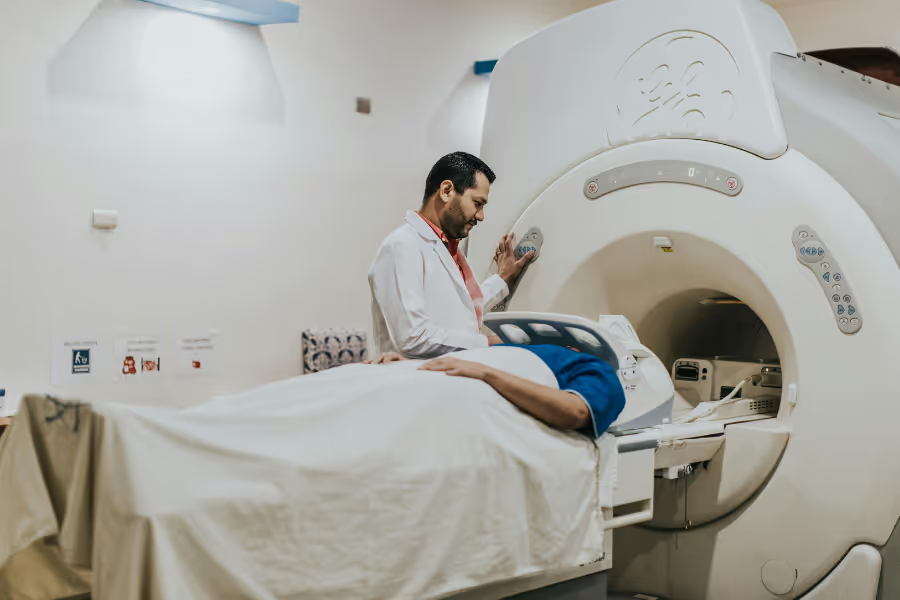
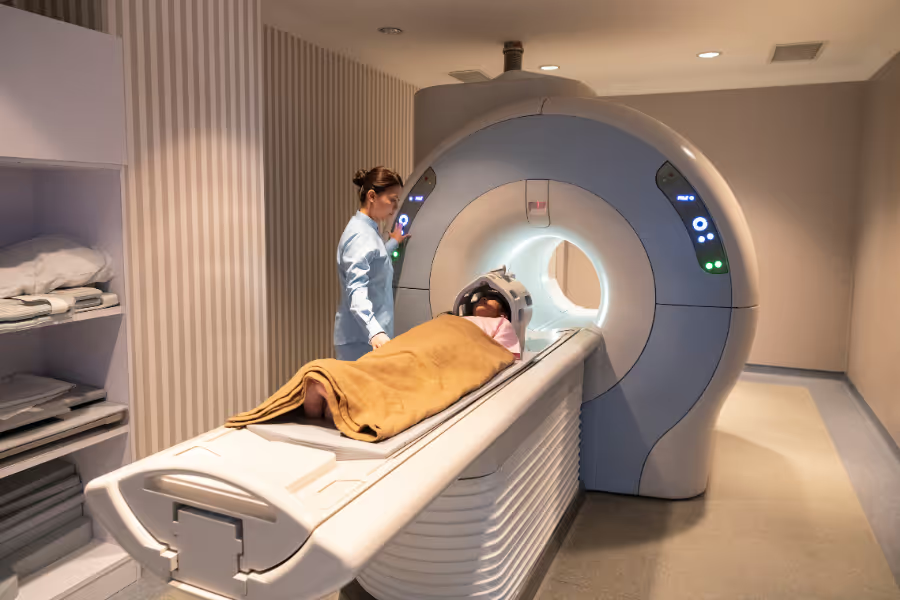
Most MRI scans take 20–60 minutes (sometimes longer for complex studies). You’ll be asked to arrive early to complete forms and a safety screening.
Pricing varies by province, clinic, body part, and whether contrast is used.
Costs tend to be higher for:
Not all clinics are equal. Quality and safety matter.
A diagnostic MRI is often a good test when your provider needs detailed images of soft tissues or nerves, or when X‑rays and ultrasound don’t fully explain your symptoms.
It might be right for you if:
An MRI might not be the best first test if:
Yes and no—you can reach out to any of the private surgeons listed on Surgency without a referral. Their intake teams are happy to answer questions, explain what they treat, share pricing ranges, and walk you through next steps.
However, to book a formal consultation with the surgeon, you'll typically need a referral from your family doctor or nurse practitioner. Don't have one? Many of the clinics can help coordinate a virtual GP appointment to get the referral paperwork sorted. All surgeons listed on Surgency offer virtual initial consultations, so you don't need to travel until you and the surgeon have agreed on a plan.
Before your consultation, expect the clinic to request relevant medical records and recent diagnostic imaging (X-ray, MRI, CT, ultrasound, lab work, etc.). Having these ready speeds up the process and lets the surgeon give you specific guidance on your very first call.
What happens next depends on why you had the MRI. A screening MRI is a broad “check everything” scan, while a diagnostic MRI is a high‑detail scan of one specific area.
Surgency is free for patients, funded for by surgeons.
Surgeons—who meet our listing criteria—pay a flat fee to list on the Surgency platform. To maintain objectivity, there are no commissions, referral fees, nor any ranking or recommending one surgeon over another.
Surgency is patient-first. Our goal is to make the process of finding a private surgeon as simple as possible. You choose who to contact. Learn more in our Advertising Policy.
MRI is considered very safe, but there are still risks to understand.
If you have any implanted device (pacemaker, cochlear implant, aneurysm clip), always confirm MRI compatibility before booking.
Preparation depends on the body area and whether contrast is planned.
If you still have questions, then feel free to contact us directly.
.avif)




Diagnostic and screening imaging network providing MRI, CT, ultrasound, DEXA, fluoroscopy / GI studies, X-ray, paediatric imaging. 20 locations across Edmonton & Calgary.

State-of-the-art private 3T MRI facility offering rapid-access diagnostic & screening MRI scans with short waitlists. Cutting-edge technology, patient comfort focus, and fast reporting for precise results.

One of Canada’s premier imaging facilities, offering rapid access to state-of-the-art MRI, CT, Ultrasound & 3D Mammography. Hospital-grade technology, sub-specialized radiologists & rapid turnaround times.