
Private Gynecology

From fibroid treatment to pelvic organ prolapse procedures, get the gynecology care you need, faster.

Surgency offers transparency on gynecologist costs, and helps you find  accredited gynecologists across Canada.
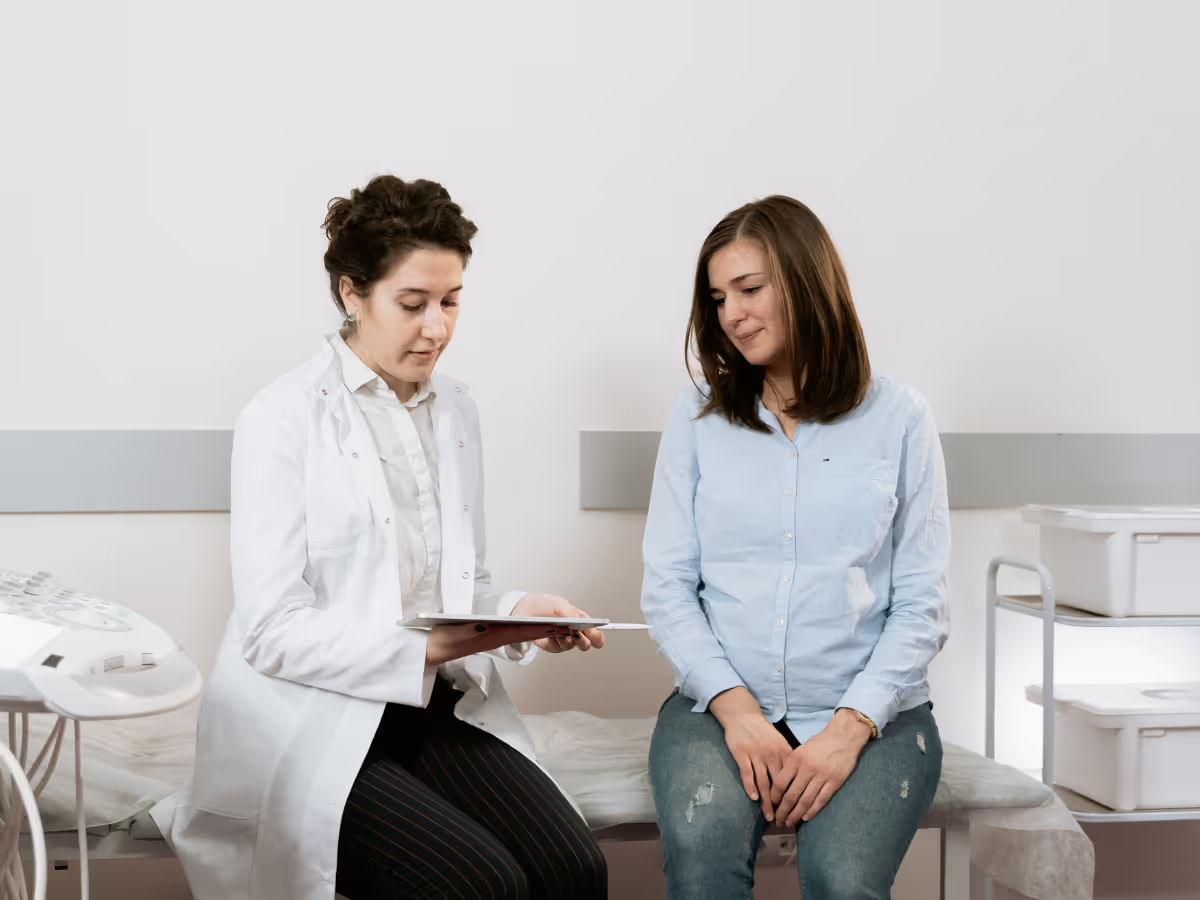
Chirurgienne privée en gynécologie en consultation avec une patiente potentielle sur une table d'examen médical

Qu'est-ce que Surgency ?

Chez Surgency, nous avons deux missions : informer et outiller.

Nous offrons aux patients et à leurs proches des informations claires sur les options de soins de santé privés, et nous facilitons la recherche, l'analyse et la prise de contact avec des chirurgiens canadiens accrédités.

Si vous souhaitez en savoir plus sur vos options, consultez nos guides de procédures ci-dessous. Si vous êtes prêt à parler à quelqu'un, parcourez directement la liste des chirurgiens.

Maquette de carte de crédit

Common Gynecological Procedures Available Privately

Why consider private gynecology surgery?

Canadians might consider private gynecology options when bleeding, pelvic pain, or fibroid symptoms are running your life, and the public wait list is months—or years. Long delays can mean worsening anemia, more pain, missed work or school, and a constant “waiting to cope” feeling.

Private gynecology surgery offers faster access to quality care for hysteroscopy, fibroid treatment, endometriosis procedures, and minimally invasive options when appropriate. You can compare clinics, review credentials, and get clear timelines for care. For many people, choosing a private option is about protecting health, energy, and quality of life while putting less strain on the public healthcare system.

Surgency is your guide—not a clinic—connecting you with out-of-province options through accredited, licensed clinics and surgeons. We help you compare options, costs, qualifications, and provide the resources you need to make confident, informed decisions.


Private Canadian Gynecology Surgeons

Accepte les patients de toutes les provinces, y compris l'Alberta
Alberta
MD, FRCSC
Magnus Murphy
Icône de localisation du chirurgien
Calgary, AB
Anglais
Accepte les patients adultes

Urogynécologue possédant 30 ans d'expérience en leadership clinique et médical, et reconnu comme un chirurgien hautement expérimenté ayant enseigné la chirurgie urogynécologique à des résidents et des boursiers.

Expertise chirurgicale :
Accepte les patients qui résident à l'extérieur du Manitoba.
MB
Sara Hosseini, photo de profil temporaire
Boshra (Sara) Hosseini
Icône de localisation du chirurgien
Winnipeg, MB
Anglais
Accepte les patients adultes

Gynécologue privée à Winnipeg (MB). Effectue des chirurgies de l'endométriose, le retrait des trompes de Fallope (« salpingectomie ») et le retrait des ovaires (« oophorectomie »).

Expertise chirurgicale :
Accepte les patients qui résident à l'extérieur du Québec
QC
MD, PhD, FRCSC
Lysanne Campeau
Icône de localisation du chirurgien
Montréal, QC
Anglais, Français
Accepte les patients adultes

Urologue de premier plan spécialisée en médecine pelvienne féminine et chirurgie reconstructive. Ses domaines d'expertise comprennent le prolapsus des organes pelviens, l'incontinence urinaire (masculine et féminine), les troubles mictionnels et l'HBP.

Expertise chirurgicale :

How to choose a private gynecology surgeon & clinic

Choosing your surgeon and clinic is one of the primary benefits of the private route. In gynecology, the key to a successful outcome isn't just the procedure itself, but the surgeon's specialized focus on surgical solutions (rather than obstetrics) and their ability to preserve fertility and hormonal function when appropriate.

Ce qu'il faut rechercher

Expérience et sous-spécialisation

Gynecology is often paired with Obstetrics (delivering babies). For surgery, you want a surgeon who dedicates a significant portion of their practice to operative gynecology. Ask about:

  • Annual volume: How many of these specific procedures (e.g., laparoscopic hysterectomy, myomectomy, endometriosis excision) do they perform annually? High surgical volume is linked to lower complication rates and shorter recovery times.
  • Technique expertise: Are they Fellowship-trained in MIGS (Minimally Invasive Gynecologic Surgery)? This expertise often means they can handle complex cases laparoscopically that others might do via large open incisions.
  • Condition focus: If you have endometriosis, ask specifically about their experience with "excision" (cutting it out) versus "ablation" (burning it off), as excision generally offers better long-term relief.

Qualifications et formation

  • Vérification : Confirmez votre permis auprès du collège provincial concerné (par exemple, CPSO en Ontario, CPSBC en Colombie-Britannique, CPSA en Alberta).
  • Certification: Look for the FRCSC designation (Fellow of the Royal College of Surgeons of Canada) in Obstetrics and Gynecology.
  • Fellowship: Ideally, look for additional training such as Minimally Invasive Surgery (MIGS), Urogynecology (for prolapse/incontinence), or Gynecologic Oncology.
  • Note : tous les chirurgiens inscrits à Surgency ont une licence canadienne vérifiée, une licence provinciale et une certification FRCSC (ou une certification équivalente du conseil).

Decision philosophy: “Organ preservation vs. Symptom relief”

Un chirurgien de qualité devrait expliquer, en termes simples :

  • Uterine preservation: For fibroids, do they offer myomectomy (removing just the fibroid) to preserve fertility, or do they jump straight to hysterectomy?
  • Ovarian strategy: If you are undergoing a hysterectomy, will they leave the ovaries to prevent early menopause? What are the risks vs. benefits for your age group?
  • Least invasive approach: Why are they choosing a specific method (Vaginal, Laparoscopic, or Open) for your anatomy?

Résultats et sécurité

Demandez des données spécifiques au chirurgien ou au niveau clinique concernant :

  • Organ injury rates: How often do unintentional injuries to the bladder, ureters, or bowel occur in their hands?
  • Conversion rates: How often do they have to switch from a laparoscopic (keyhole) approach to a large open incision during surgery?
  • Re-operation rates: Especially for endometriosis or prolapse—how often do symptoms return requiring a second surgery?

Imagerie et planification

  • Diagnostic clarity: Have they reviewed your Transvaginal Ultrasound or Pelvic MRI personally?
  • Physical exam: A proper pelvic exam is often necessary to map out fibroids or assess uterine mobility before surgery.
  • Pre-op optimization: Do they check for anemia (low iron) due to heavy bleeding and treat it before surgery to ensure a safer recovery?

Plan d’accréditation des installations et d’anesthésie

  • Accreditation: Ensure the surgical center is accredited (e.g., CAAASF or Accreditation Canada).
  • Anesthesia: Discuss the plan. While General Anesthesia is standard for laparoscopy, some vaginal procedures can be done with spinal anesthesia and sedation.

Intégration de la récupération et des déplacements

Pelvic surgery carries specific risks for travellers, such as DVT (blood clots):

  • Clot prevention: What is the plan to prevent blood clots if you are flying or driving long distances home? (e.g., blood thinners, compression stockings).
  • Catheter plan: Will you wake up with a catheter? If so, when is it removed (usually same-day or next morning)?
  • Hormonal changes: If ovaries are removed, is there a plan for immediate Hormone Replacement Therapy (HRT)?

Questions à poser lors de votre consultation

Chirurgien et plan chirurgical

  • Combien de ces procédures spécifiques effectuez-vous chaque année?
  • (For Endometriosis): Do you perform excision or ablation?
  • (For Fibroids): How do you remove the tissue? Do you use a containment bag (to prevent spreading tissue)?
  • What is the risk of converting to an open abdominal incision in my specific case?

Rétablissement et suivi postopératoire

  • When can I drive, exercise, and lift heavy objects?
  • When can I resume sexual activity? (Crucial for hysterectomy or vaginal repairs).
  • What kind of pain management is used?
  • If I am traveling, how many days must I stay locally before it is safe to travel?

Coûts et logistique

  • Is the quote "all-inclusive" (surgeon, anesthesia, facility fee, and pathology labs for tissue analysis)?
  • Are there extra costs for specific devices (e.g., adhesion barriers or mesh for prolapse)?
  • What is the emergency transfer plan in the unlikely event of a bowel or bladder injury?

I'm looking for a private gynecology surgeon near me

 Access to private gynecology surgery (hysterectomy, myomectomy, excision for endometriosis) is perhaps the most restricted field in Canadian private healthcare. Generally, provinces do not permit surgeons to charge a patient within that same province directly for a 'medically necessary' surgery covered by the public health plan.

However, surgeons are allowed to treat patients privately for 'medically necessary' surgery if they come from out-of-province. Consequently, most Canadians seeking private gynecological care must travel.

Why Private Gynecology is Uniquely Difficult to Access

Unlike orthopedics or urology, private gynecology faces four specific barriers that make finding a clinic even harder:

  1. The "Ovary vs. Testicle" Pay Gap: The business case for a private clinic relies on the fees a surgeon can charge. Historically, gynecological surgeries are "undervalued" in the public fee schedule compared to male-focused urology (e.g., a testicular torsion often pays more than an ovarian torsion, despite the latter's complexity). Because the public "benchmark" price is low, it is harder for private clinics to justify the premium pricing needed to cover their massive overhead.
  2. The "Level 3" Facility Barrier: Orthopedic surgeries have moved to "Ambulatory" (day-surgery) models that fit into Level 2 private clinics. However, major gyn surgery (like deep endometriosis or large fibroid removal) often carries a higher risk of bowel or bladder involvement. This requires a Level 3 Surgical Facility with ICU capacity and 24/7 hospital-grade backup. Building a private Level 3 hospital is incredibly expensive, so most private clinics remain Level 2—capable of labiaplasty, but not hysterectomies.

Répartition provinciale

Québec

Quebec is the most developed, open market for private gynecological surgery in Canada.

Following the 2005 Chaoult Supreme Court ruling, Quebec allows surgeons to become "Non-Participating Professionals." These doctors completely opt out of the public system and take zero public money, allowing them to legally charge patients directly at fair market rates—including Quebecois. Quebec has the most robust network of private clinics and acts as the primary hub for out-of-province patients seeking advanced excision surgery for endometriosis.

Alberta

L’Alberta a une grande capacité chirurgicale, mais y accéder est juridiquement complexe pour les habitants locaux.

Alberta uses "Chartered Surgical Facilities" largely to handle Workers' Compensation (WCB) cases. While these facilities have the infrastructure, the regulations make it difficult for Albertans to pay out-of-pocket for major gyn procedures.

However, private surgeons (such as those specializing in endometriosis excision) can see patients from out-of-province. This has made Alberta a destination for patients from BC and Ontario seeking specialized excision that they cannot access timely in their home province.

Colombie-Britannique

Les règlements stricts rendent difficile la recherche d’un chirurgien capable de traiter en privé les résidents de la Colombie-Britannique pour des conditions médicales.

The BC Medicare Protection Act heavily fines clinics that charge patients for medically necessary services, and recent court battles (Cambie Case) have reinforced these restrictions. While private clinics exist, they focus almost exclusively on Cosmetic Gynecology (Labiaplasty, Vaginoplasty) which is not insured. Finding a private surgeon for a medical hysterectomy or fibroid removal is nearly impossible for a BC resident.

Ontario

Ontario allows surgeons to opt out—in theory—but it is financially infeasible, so there are effectively no opted-out surgeons for major gynecological work.

The Commitment to the Future of Medicare Act (CFMA) makes charging for insured services onerous. Furthermore, the College of Physicians and Surgeons requires private facilities to meet hospital-level standards. Because of the "Level 3" facility requirements mentioned above, almost no private clinics in Ontario are equipped for major gyn surgery.

Private clinics in Ontario mostly focus on "Lifestyle" treatments (MonaLisa Touch, cosmetic procedures). For a standard medical procedure like a hysterectomy or myomectomy, an Ontario resident has no legal option to pay privately within the province.

Saskatchewan

Le système public « achète » la capacité privée.

Saskatchewan pioneered the "Privately Delivered, Publicly Funded" model. The government pays private clinics to perform surgeries to keep public wait times down. Because the clinics are busy with government contracts, there is very little direct-to-consumer time available for private surgery.

Manitoba et les provinces atlantiques

Populations are generally too small to sustain high-overhead private surgical facilities. Patients in these provinces almost exclusively travel to Quebec, Alberta, Ontario, or BC..

Will a private gynecology surgeon have my best interests in mind? What about the profit motive?

Canadian private gynecology surgeons must prioritize your health over profit. 

Au Canada, chaque chirurgien est légalement lié par le Code d’éthique et de professionnalisme de l’Association médicale canadienne (AMC), qui exige explicitement d’agir dans le meilleur intérêt du patient, peu importe le milieu de pratique.

Ils sont strictement autorisés et audités par leur Collège provincial des médecins et chirurgiens (par exemple, CPSO, CPSA, CMQ). Recommander une chirurgie inutile à des fins lucratives risque la révocation de la licence et d’énormes poursuites pour faute professionnelle.

La norme de soins est identique à celle du système public, dictée par les lignes directrices cliniques de l’Association canadienne des chirurgiens généraux (CAGS). De plus, les cliniques privées doivent réussir des programmes rigoureux d’accréditation des établissements médicaux et chirurgicaux non hospitaliers (NHMSFAP) pour fonctionner légalement.

Is private gynecology surgery legal in Canada?

Yes, private gynecology surgery is legal in Canada, but it is heavily restricted by provincial laws designed to protect the public single-payer system.

Voici comment la légalité fonctionne en pratique :

  • Under the spirit of the Canada Health Act and strict provincial health acts, it is effectively illegal for a surgeon to charge a patient directly for a "medically necessary" surgery (like a hysterectomy, myomectomy for fibroids, or endometriosis excision) if that patient is a resident of the same province.
  • Provincial health laws only cover their own residents. It is perfectly legal for a private clinic in Alberta or Quebec to sell an endometriosis excision to a resident of British Columbia or Ontario. This is why most Canadians seeking private gynecological surgery must cross provincial borders to become "private-pay" patients.
  • L’exception à cette règle concerne les chirurgiens qui choisissent de se retirer du système public et exercent entièrement dans le système privé. Ces chirurgiens peuvent voir des patients de leur propre province, mais ils sont relativement rares.
  • If a procedure is deemed "cosmetic" or not medically necessary by the public system—such as a labiaplasty, vaginoplasty, or uninsured laser therapies for vaginal atrophy (like MonaLisa Touch)—it is completely legal to pay a private surgeon to do it within your own province.
  • Il est tout à fait légal pour certains tiers — comme les Conseils d'indemnisation des travailleurs (WCB), la GRC, l'armée ou les équipes sportives professionnelles — d'acheter une chirurgie privée pour des personnes dans n'importe quelle province afin de les remettre au travail plus rapidement.

Pour un aperçu plus approfondi, veuillez lire Comment fonctionne la chirurgie privée au Canada.

How much does gynecology surgery cost?

The cost of private gynecology surgery in Canada varies widely depending on the complexity of the procedure, the type of anesthesia required, and the facility's location.

For minor, outpatient procedures—such as a diagnostic hysteroscopy, laser therapy for vaginal atrophy, or a labiaplasty—costs typically range from $2,000 to $6,000.

For more complex pelvic surgeries requiring general anesthesia, advanced laparoscopic tools, and a full operating room team—such as a hysterectomy, myomectomy for fibroids, or deep endometriosis excision—you can expect to pay anywhere from $10,000 to $30,000+.

For more granular pricing info, visit our Cost Comparison guide or the Procedure Guide for the specific procedure you are interested in.​