


Private Bankart Repair Surgery

Costs, aftercare considerations, procedure steps. Learn about Bankart surgery, and find the right surgeon that fits your needs below, serving Canadians in major cities like Vancouver, British Columbia; Calgary, Alberta; Toronto, Ontario; and Montréal, Québec.
Le fondateur de Surgency, le Dr Sean Haffey, souriant
Révisé et approuvé par le Dr Sean Haffey
Maquette de carte de crédit

À titre informatif seulement, ne constitue pas un avis médical ou juridique. Veuillez consulter votre médecin ou votre chirurgien.

Comment fonctionne Surgency

Icône indiquant le lieu de l'intervention chirurgicale

Décidez où aller

La chirurgie privée au Canada nécessite généralement de voyager hors de sa province. La première étape consiste donc à décider où.
Icône indiquant la recherche sur la plateforme

Rechercher par spécialité

Notre application facilite la recherche de chirurgiens par spécialité et par emplacement.
Icône indiquant l'envoi d'une demande de consultation sécurisée au chirurgien

Planifiez une consultation

Prenez rendez-vous pour une consultation directement sur Surgency. C'est sécurisé, confidentiel et rapide.

What is Bankart surgery?

Bankart surgery is an operation to fix a shoulder that keeps popping out to the front (anterior instability). When a shoulder dislocates, the labrum—a rubbery rim around the socket (glenoid)—can tear off the front-bottom area.

That specific tear is called a Bankart lesion. Without that rim, the ball (humeral head) doesn’t sit securely and can slip out again. In a Bankart repair, the surgeon reattaches the torn labrum to the edge of the socket using small anchors and sutures. The anchors act like tiny wall plugs set into the bone; the sutures pull the labrum back into its proper position, recreating the bumper that keeps the ball centered. Often, the joint’s capsule (the sleeve around the shoulder) is tightened at the same time to restore stability.

Most Bankart surgeries are done arthroscopically—through small incisions with a camera and specialized tools—though some cases use an open approach. The goal is simple: rebuild the front “bumper” and tighten the soft tissues so the shoulder stops slipping and can handle everyday use and sports without feeling loose.
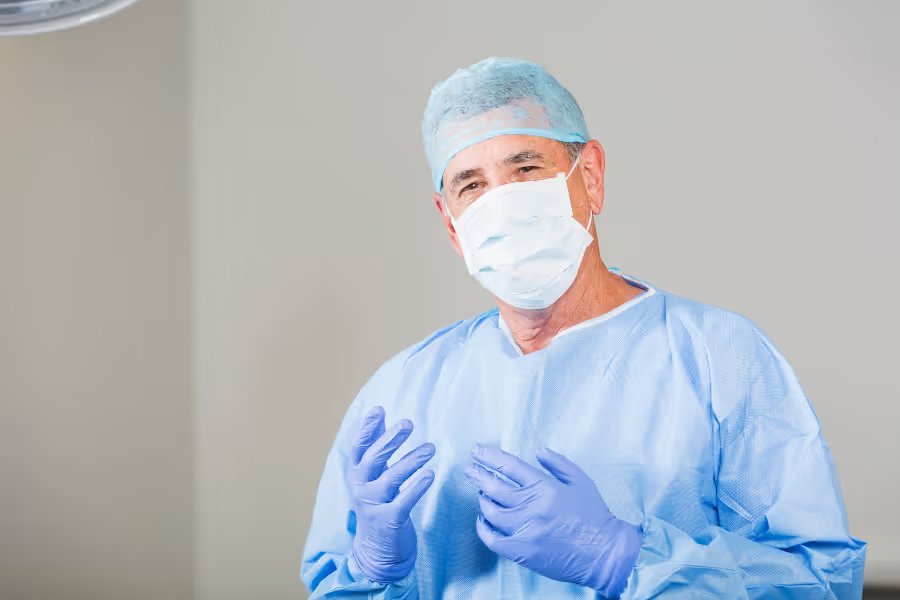
Why do people get Bankart surgery done privately?

Délais d'attente plus courts

  • Shoulder instability often sidelines work and sport.
  • Private centres can schedule consultation and surgery sooner, reducing time with recurrent dislocations, night pain, and activity limits.

Choix et contrôle

  • Choose a surgeon with Bankart repair experience (arthroscopic/open, capsular shift).
  • Plan surgery around school, competitive seasons, or work commitments.

Tranquillité d'esprit

  • Know exactly who will operate, when it will happen, and the detailed plan (anchor type/number, capsular tightening, rehab milestones).
  • Clear timelines ease anxiety and help families, coaches, and employers coordinate support.

Prévenir une détérioration supplémentaire

  • Function and quality of life: Limits months of pain, apprehension, and “giving-way” that restrict lifting, sport, and sleep.
  • Joint health: Repeated dislocations can damage cartilage and bone (Hill-Sachs, glenoid bone loss); timely stabilization can curb cumulative damage.
  • Surgical complexity: Ongoing episodes may require more complex procedures later (bone grafts like Latarjet).
  • Mental load: Shortens time living with uncertainty, restricted activities, and fear of the next dislocation.
Maquette de tableau de bord
Pourquoi choisir Surgency

Pour les Canadiens qui souhaitent une chirurgie en quelques semaines, et non en quelques mois

Surgency est une ressource gratuite, offerte par un médecin canadien du système public, pour vous aider à trouver le bon chirurgien selon vos besoins.

How do I get a private Bankart surgery in Canada?

  1. Confirmez votre diagnostic. La plupart des patients commencent par consulter un médecin de famille ou un spécialiste qui confirme que la chirurgie est conseillée. Un chirurgien privé peut également confirmer le diagnostic si nécessaire.
  2. Faites des recherches.
    • Vous pouvez trouver des chirurgiens à Vancouver, en Colombie-Britannique; Calgary, en Alberta; Toronto, en Ontario; et Montréal, au Québec sur notre application, et consulter leurs qualifications ainsi que les tarifs.
  3. Planifiez une consultation initiale. La plupart des chirurgiens proposent des consultations en clinique et en ligne.
    • Les consultations sont généralement fixées en quelques jours ou quelques semaines.
    • Remarque : prévoyez des frais de consultation entre 150 $ et 350 $.
    • Nous vous recommandons de prendre 2 à 4 consultations avec différents chirurgiens afin de mieux comprendre vos options.
  4. Consultation. Le chirurgien examinera votre état, vos symptômes et tout traitement ou diagnostic antérieur, comme des radiographies ou des IRM.
  5. Après la consultation. Le chirurgien examinera ensuite votre dossier et vous proposera des options chirurgicales (et non chirurgicales) en fonction de vos besoins; il passera en revue les risques et les résultats attendus; et présentera les options de tarification et de planification.
  6. Planifiez la date de votre chirurgie. Une fois que vous aurez confirmé la procédure et le paiement, la clinique fixera la date de votre chirurgie – généralement dans un délai de quelques semaines.

Bankart surgery steps: what to expect

Surgery takes about 60–90 minutes for most arthroscopic Bankart repairs. Plan on several hours for check-in, anesthesia, and wake-up before going home.

Étapes de base

  • Enregistrement et planification
    • You meet the team, review imaging, and the surgeon marks the shoulder.
  • Anesthésie
    • You go to sleep (general anesthesia). Many patients also get a nerve block to keep the arm numb afterward.
  • Positionnement et préparation
    • You’re positioned safely (beach-chair or lateral). The skin is cleaned and draped sterile.
  • Camera in
    • Small poke-hole incisions are made. A pencil-thin camera (arthroscope) goes into the joint to see the torn labrum.
  • Clean and prepare
    • The torn edge of the labrum and the socket rim are gently cleaned so the tissue can reattach.
  • Anchors placed
    • Tiny anchors are inserted into the front-bottom rim of the socket. Each anchor has sutures attached.
  • Reattach the labrum
    • Sutures are passed through the labrum and tied, pulling it back to the bone to recreate the “bumper.” The capsule may be tightened (capsular shift) for extra stability.
  • Final check and close
    • The surgeon tests stability and motion, then closes the small incisions and applies a dressing and sling.
  • Wake-up and instructions
    • You recover, get simple at-home instructions (sling use and early movement), and usually go home the same day.

What can I expect from the Bankart surgery recovery process?

Your exact plan comes from your surgeon and can vary. Take rehab seriously—the more consistent you are, the better your outcome.

What to expect after Bankart surgery (shoulder instability repair)

Semaine 1

  • Reality check: soreness, swelling, stiffness, tough sleep.
  • Goals: control pain/swelling, protect the repair, start safe motion.
  • Activities: wear the sling as directed, ice, keep the incision clean/dry, move fingers/wrist/elbow, gentle pendulums if cleared. A helper is useful for meals/meds/shirts.

Semaines 2 à 4

  • Toujours gênant, mais en amélioration.
  • Goals: gradually restore pain-free range of motion (ROM) within limits; stay safe in the sling.
  • Activities: regular physio; passive to assisted ROM (forward elevation and external rotation to set limits); scapular setting; light tasks at waist level. No lifting or sudden reaches.

Semaines 5 à 12

  • La phase de travail.
  • Goals: near-full ROM by ~8–10 weeks (per protocol); begin strength.
  • Activities: wean from sling (as cleared); rotator cuff and scapular strengthening, posture work, gentle resistance bands; controlled use below shoulder height.

Weeks 13–24

  • Building strength and confidence.
  • Goals: full ROM, better strength/endurance, stable shoulder with everyday use.
  • Activities: progress resistance, closed-chain work (wall/plank variations), coordination and sport-prep drills (no contact yet).

Months 6–9

  • Return-to-sport phase (timing varies).
  • Goals: power, endurance, and trust in the shoulder.
  • Activities: sport-specific drills; gradual return to overhead work or contact only when cleared.

Des signaux d’alarme à tout moment

  • Fever, increasing redness/drainage, calf pain/swelling, chest pain/shortness of breath, new numbness/weakness, or a feeling of re-dislocation—contact your care team.

How much does private Bankart surgery cost in Canada?

Bankart replacement is a major surgery. Private clinics in Canada typically charge $8,000 to $17,000.

In the United States, the average cost is CA$26,000.

Les coûts varient énormément selon l’emplacement, l’expérience du chirurgien, le type d’établissement, la portée des traitements potentiels, la complexité du problème et les services inclus (certaines cliniques offrent tout compris, tandis que d’autres facturent séparément l’anesthésie, les soins de suivi, etc.).

Ce qui est inclus

  • Frais de chirurgien (et assistant si utilisé) et anesthésiste/anesthésie générale
  • Frais d’établissement (temps en salle d’opération, soins infirmiers, fournitures, équipement)
  • Standard arthroscopic anchors/implants if part of the bundle
  • Récupération immédiate post-opératoire et suivis précoces de routine
  • Initial shoulder sling and standard dressings (varies by clinic)

Ce qui n’est généralement pas inclus

  • Imagerie préopératoire (radiographies, IRM/CT), analyses de laboratoire et consultations spécialistes supplémentaires
  • Voyage et hébergement (si la chirurgie est hors province ou province)
  • Physiothérapie à long terme après la ou les premières séances
  • Médicaments sur ordonnance après la sortie
  • Implants spécialisés ou personnalisés au-delà du bundle standard

Options d'assurance et de financement

  • Assurance maladie privée : Certains régimes peuvent couvrir une partie des coûts, comme les frais d'hospitalisation. Il est important de vérifier directement votre police d'assurance.
  • Plans de financement : De nombreuses cliniques proposent des options de paiement mensuel pour vous aider à étaler les coûts. Apprenez-en davantage sur vos options de financement ici.
  • Crédit d'impôt pour frais médicaux (CIFM): Il s'agit d'un crédit non remboursable qui réduit vos impôts lorsque vous payez de votre poche des dépenses médicales admissibles. Apprenez-en davantage sur la façon de demander le CIFM pour les chirurgies privées.

Choisir un chirurgien et une clinique

Choosing your surgeon is one of the benefits of going the private route. Here’s what to consider and the key questions to bring to your consultation.

Ce qu'il faut rechercher

  • Expérience et volume d'interventions
    • Ask how many shoulder instability surgeries they perform per year and the mix: arthroscopic Bankart, open Bankart, remplissage, Latarjet, revisions, contact vs overhead athletes.
  • Qualifications et formation
    • Confirmez leur permis d'exercice auprès de l'ordre provincial des médecins (par exemple, le Collège des médecins et chirurgiens de l'Ontario, le Collège des médecins et chirurgiens de la Colombie-Britannique, le Collège des médecins et chirurgiens de l'Alberta).
    • Look for FRCSC-certified orthopaedic surgeons with fellowship training inshoulder/elbow or sports medicine and specific instability expertise.
  • Sécurité
    • Request 12–24 month data: infection, nerve complications, postoperative stiffness, recurrent instability/re-dislocation, unplanned return to OR, readmissions.
    • Ask for recurrence and return-to-sport (RTS) rates stratified by risk profile (age <25, collision/contact sports, hyperlaxity, bone loss).
  • Technique et anesthésie
    • How they assess glenoid and humeral head bone loss (on-track/off-track). When do they add remplissage or switch to Latarjet?
    • Anchor type and number, capsular plication strategy, management of ALPSA/HAGL lesions, biceps pathology (tenodesis vs leave), plan for engaging Hill-Sachs lesions.
  • Accréditation de l'établissement
  • Intégration de la réadaptation
    • Accès à de la physiothérapie spécialisée dans l’épaule, un protocole clair à plusieurs phases, et une communication avec votre thérapeute local si vous voyagez.

Questions to ask during your Bankart surgery consultation

Chirurgien et plan chirurgical

  • How many arthroscopic Bankart repairs (and revisions) do you perform yearly? What are your recurrence and RTS rates in the last 12–24 months?
  • Based on my imaging, am I an on-track or off-track lesion? Do I need remplissage or a bone-block procedure instead of Bankart?
  • How many anchors do you typically use and where? Will you perform capsular shift/plication? How do you address ALPSA/HAGL if present?
  • What are your rates of stiffness, nerve injury, infection, and re-operation?
  • Anesthesia plan (interscalene block + sedation vs general) and multimodal pain strategy.
  • Is this same-day outpatient? Any chance of overnight stay?

Rétablissement et suivi postopératoire

  • Timeline to: sling wean, full ROM goals, start strengthening, non-contact training, return to contact/overhead sports.
  • Early movement precautions (ER/abduction limits) and duration.
  • Physiotherapy: frequency/duration; do you provide a written protocol and milestones? Will you coordinate with my local PT?
  • Red flags that should prompt a call/ER visit (fever, drainage, calf pain/swelling, shortness of breath, numbness/weakness).
  • Qui est mon contact post-opératoire (téléphone direct/courriel)? Temps de réponse typique? Combien de suivis sont inclus et quand?

Coûts et logistique

  • What exactly is included in my quote (surgeon, anesthesiologist, facility fees, anchors/implants, nerve block, sling, immediate post-op care, scheduled follow-ups)?
  • What could add cost (extra anchors beyond a standard bundle, remplissage, biceps procedures, unexpected imaging, longer OR time, complications/re-operations)?
  • How do you handle consent and pricing if intra-op findings require additional procedures (e.g., remplissage) or conversion to bone-block?
  • If I’m traveling from another province, which follow-ups can be virtual? Will I receive the operative note, arthroscopy images, and the rehab plan for my local care team?

Bankart surgery frequently asked questions

How do I know if Bankart surgery is right for me?

Bankart surgery repairs the torn labrum in the front of your shoulder after dislocation. The labrum is like a rubber gasket that helps keep the ball in the socket.

Cette intervention pourrait vous convenir si

  • Your shoulder keeps popping out or feels like it’s about to (instability), especially with sports or overhead moves
  • You’ve tried rest, physio/strengthening, and activity changes, but it still feels unstable or painful
  • An exam and imaging (MRI or MRI-arthrogram, sometimes CT) show a Bankart tear or matching damage

Common reasons people get a Bankart repair

  • Repeated shoulder dislocations, or a first dislocation with ongoing looseness in young/active people
  • Painful catching or slipping when you raise your arm or throw
  • You can’t get back to sport or daily activities because you’re worried it will pop out again

When a Bankart repair might not be right

  • Significant socket (glenoid) bone loss or a large engaging Hill-Sachs dent — may need remplissage or bone-block (e.g., Latarjet)
  • Main issue is stiffness, rotator cuff tear, or generalized laxity without a true labrum tear
  • You haven’t completed a solid rehab program yet, or there’s an active infection/medical issue

Signe que vous pourriez être un candidat

  • Clear dislocation event and ongoing instability despite good physio
  • Positive instability tests with a sports shoulder specialist
  • MRI shows a Bankart tear that fits your symptoms, especially if you’re young and play contact/overhead sports

Ai-je besoin d'une référence?

No, you do not need a referral for private Bankart surgery in Canada. You can book a consultation directly with a surgeon, and they will review your condition, symptoms, and any previous treatments or diagnostics.

How do I prepare for Bankart surgery?

Your surgeon will tailor instructions based on your shoulder, sport, and any added procedures (e.g., remplissage).

Préparation et optimisation de la santé

  • Pre-surgery exercises: “Quiet shoulder” focus—reduce pain/swelling, gentle ROM as tolerated, activate rotator cuff/scapular stabilizers without provoking instability; work on posture, core, and lower body.
  • Quit nicotine: Stop 4+ weeks before surgery—nicotine raises infection/stiffness risk and slows healing.
  • Weight, sleep, nutrition: Balanced diet with adequate protein, good sleep, and hydration.
  • Medications: Share all meds/supplements. You may need to pause blood thinners, certain NSAIDs, and some herbal supplements—only with your surgeon’s approval.
  • Imaging and planning: Ensure MRI/CT and on-/off-track assessment are complete; clarify if remplissage or other procedures are planned.

Préparation à domicile

  • One-armed setup: You’ll be in a sling with limited use. Place essentials (phone/charger, water, meds, tissues) at waist/chest height.
  • Safety first: Remove tripping hazards (cords, sliding rugs, clutter). Keep walkways clear, especially for nighttime bathroom trips.
  • Bathroom: Consider a shower chair and non-slip mat. Use pump soaps and a detachable showerhead. Stage towels and clothes within easy reach.
  • Comfort station: Set up pillows to support elbow/wrist, ice/cold packs, and a small side table. A recliner can help in week 1.
  • Clothing: Loose, front-opening tops (zip/button) and elastic-waist bottoms; slip-on shoes.

Soutien et logistique

  • A helper: Arrange a ride home and someone to stay for 24–48 hours; have a backup contact.
  • Work/school/chores: Plan time off. Desk/school may resume in a few days with a light schedule; manual work takes longer. Line up help for cooking, cleaning, childcare, and pets.
  • Driving: Do not drive while in a sling, on pain meds, or with a numb arm after a nerve block. Arrange transportation.

Préparation le jour de la chirurgie

  • Fasting: Follow anesthesia instructions exactly (no food after cutoff; clear fluids as allowed).
  • Skin prep: Use antiseptic wash (e.g., chlorhexidine) the night before and morning of surgery. Do not shave the shoulder/axilla.
  • What to bring: Photo ID, medication list, a front-opening top, and your sling if pre-issued.
  • Jewelry/nails: Remove necklaces/bracelets/watches on the operative side. Keep at least one fingernail free of heavy polish.

Prévention de la douleur, de l’enflure et des caillots

  • Pain plan: Many receive an interscalene nerve block (8–24 hours of numbness). Fill prescriptions ahead; have acetaminophen ± NSAIDs (if approved). Take the first dose before the block wears off.
  • Nausea/constipation: Request anti-nausea meds if prone. Keep stool softeners/fiber on hand.
  • Swelling control: Ice as directed, support the elbow, avoid letting the arm dangle. Gentle hand/wrist/elbow motion (as allowed) helps circulation.
  • DVT prevention: Risk is low; keep legs moving and take short walks as able.

Pratique post-opératoire

  • One-handed routines: Practice dressing, bathing, meal prep, and phone/computer use with the non-operative hand.
  • Sleep setup: Trial sleeping in a recliner or propped on your back/side with pillows supporting the operative arm.
  • Car practice: Rehearse getting in/out using your non-operative arm and core, keeping the operative arm close to your body.

What are the risks if I delay or don't get Bankart surgery?

Your own situation depends on pain level, shoulder stability, imaging (labrum tear size, bone loss, Hill-Sachs), your sport/position, and how well non-surgical care works. Discuss specifics with your surgeon.

Main risks of delaying or not having Bankart surgery (when symptoms are significant/persistent)

  • Progressive pain and instability
    • Ongoing pain, soreness after activity, and a constant “about to slip out” feeling.
    • More time spent avoiding overhead motions, lifts, or contact because it feels unsafe.
  • Recurrent dislocations and more joint damage
    • Repeated dislocations/subluxations can chip cartilage and create bone loss on the socket (glenoid) and dents on the ball (Hill-Sachs).
    • Each episode can make the shoulder looser and the tear bigger, raising the chance of future dislocations.
  • Harder return to sport and performance loss
    • Fear of re-dislocation limits throwing, tackling, and overhead skills.
    • Coaches may limit your role; you may need to skip seasons or switch positions.
  • Stiffness and muscle imbalance
    • Guarding leads to tightness in some muscles and weakness in rotator cuff/scapular stabilizers; mechanics get worse.
  • Nerve irritation or catching
    • Loose tissue or bony changes can cause “catching,” clicking, or nerve-like symptoms with certain motions.
  • More complex surgery later
    • Ongoing bone loss or large/“engaging” Hill-Sachs may require extra procedures (remplissage) or bone-block (e.g., Latarjet), which are more complex.
  • Mental load and quality-of-life hit
    • Anxiety about the next dislocation, skipping activities you enjoy, sleep disruption, and frustration.

Quand l'observation attentive peut être raisonnable

  • Symptoms are mild, no true instability episodes, and sport/daily life are okay.
  • Non-operative care helps: focused physio (rotator cuff/scapula control), posture and kinetic-chain strength, technique tweaks, activity modification.
  • Imaging shows a Bankart tear without significant bone loss; no progressive “giving-way.”

Quand il ne faut pas tarder

  • Recurrent dislocations/subluxations or a clear “giving-way” feeling during daily tasks or sport.
  • Worsening performance or fear that changes how you play/practice.
  • Imaging shows bone loss or an “off-track” lesion (higher re-dislocation risk).
  • You’ve done good physio and activity changes but still feel unstable.

What are the risks involved with Bankart surgery?

Your individual risk depends on your health, shoulder anatomy, tear size, bone loss (glenoid or humeral head), surgical technique (Bankart alone, Bankart + remplissage, or bone-block), and how well you follow sling rules and rehab. Discuss your specific risks with your surgeon.

Courants et généralement temporaires

  • Douleur, gonflement, ecchymoses; raideur et troubles du sommeil au début
  • Nausées dues à l'anesthésie; constipation due aux analgésiques.
  • Temporary numbness around small incisions or from the nerve block
  • Soreness in the biceps/front of the shoulder when motion restarts

Moins courants

  • Blood clots (DVT/PE) — uncommon for shoulder surgery but possible; early walking and prevention help
  • Infection (skin/portal; deeper joint infection is more serious)
  • Wound healing problems or hematoma (blood collecting under the skin)
  • Nerve irritation/injury (axillary, musculocutaneous, suprascapular, or small skin nerves) causing numbness/weakness — usually temporary, sometimes longer
  • Persistent stiffness or loss of motion (esp. external rotation) if scar tissue forms or rehab is delayed/overdone
  • Recurrent instability or re-dislocation, higher with significant bone loss or early return to contact sports
  • Hardware/anchor irritation or reaction (rare), sometimes needing removal
  • Syndrome de douleur régionale complexe (SDRC) — condition de douleur/sensibilité peu commune

Procedure-specific risks

  • Bankart repair alone: higher recurrence risk with engaging Hill-Sachs or notable glenoid bone loss
  • Bankart + remplissage: lowers recurrence in “off-track” lesions; may slightly limit external rotation in some athletes
  • Bone-block procedures (e.g., Latarjet) for bone loss: added risks include graft nonunion, nerve irritation around coracoid transfer, and hardware issues

Rare mais important

  • Deep joint infection requiring additional surgery and antibiotics
  • Lasting nerve problems with weakness or numbness
  • Ongoing pain, catching, or limited motion if cartilage damage/arthritis is present
  • Failure of repair (anchors/sutures) requiring revision surgery
  • Shoulder stiffness that doesn’t fully resolve
  • Thromboembolie veineuse malgré la prévention

Comment réduire les risques

  • Follow pre-op instructions (stop nicotine, manage meds, antiseptic wash)
  • Wear the sling exactly as directed; avoid abduction/external rotation early
  • Start approved passive/assisted motion on schedule; don’t push ROM or strength too fast
  • Gardez les plaies propres et sèches; surveillez l'apparition de rougeurs, d'écoulements ou de fièvre
  • Return to contact/overhead sports only after meeting strength, motion, and stability milestones

Signaux d’alerte à appeler

  • Fever, chills, increasing redness, warmth, bad odour, or drainage from the incision
  • Sudden “pop” with new instability or deformity
  • Severe pain not controlled by meds; new numbness/weakness in the arm/hand
  • Calf pain/swelling or shortness of breath (possible clot)

J'ai encore des questions

Si vous avez encore des questions, n'hésitez pas à nous contacter directement.
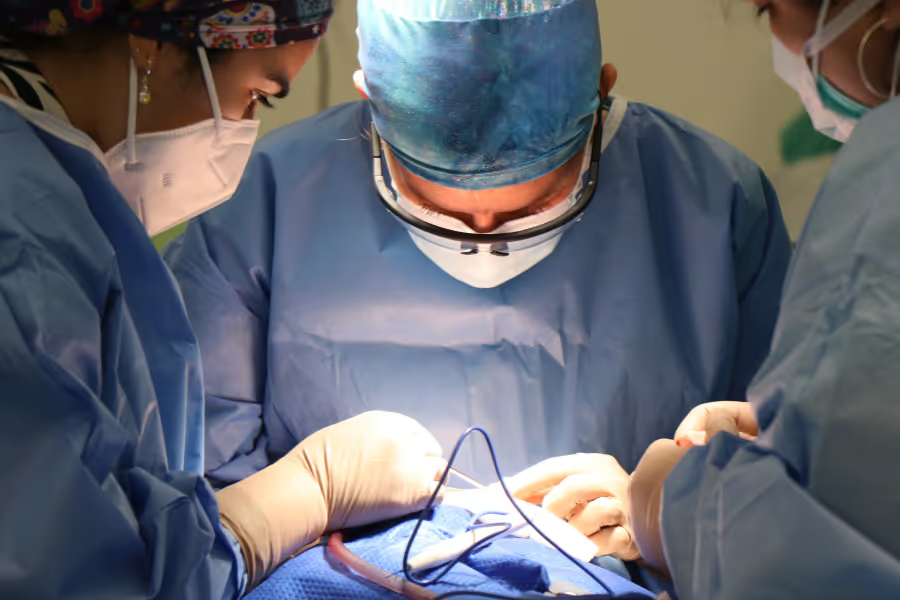
Vous cherchez un chirurgien de l’épaule?

Parcourez les chirurgiens de l’épaule vérifiés à travers le Canada. Comparez les prix, les qualifications, les emplacements.

PARCOURIR LES CHIRURGIENS

Browse Accredited Private Surgeons for Bankart Repair Surgery

Les chirurgiens de Surgency sont vérifiés :

✓ Diplôme de médecine reconnu
✓ Permis d'exercice canadien (LMCC)
✓ Permis d'exercice médical provincial actif
✓ Certification du conseil (FRCSC/ABMS)
C.-B.
Accepte les patients de l'extérieur de la C.-B.
Abeer Syal
MD, FRCSC
Icône de localisation du chirurgien
Vancouver, C.-B.
Anglais, hindi, pendjabi
Accepte les patients adultes

Chirurgien orthopédiste ayant une formation postdoctorale—16 ans d'expérience—spécialisé en médecine sportive et en préservation articulaire, avec une expertise en reconstruction du genou et de l'épaule.
QC
Accepte les patients qui résident à l'extérieur du Québec
Dani Massie
MD, FRCSC
Icône de localisation du chirurgien
Montréal, QC
Anglais, Français
Accepte les patients adultes

Chirurgien orthopédiste expérimenté, reconnu pour son approche axée sur le patient et sa polyvalence technique, allant de la réparation des tissus mous (médecine sportive) aux remplacements articulaires complets (genou, épaule, hanche).
QC
Accepte les patients qui résident à l'extérieur du Québec
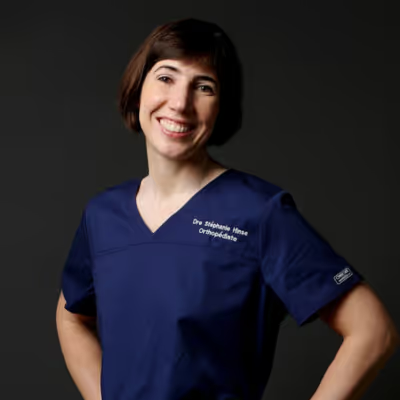
Stéphanie Hinse
MD, FRCSC
Icône de localisation du chirurgien
Montréal, QC
Anglais, Français
Accepte les patients adultes

Chirurgienne orthopédique ayant complété trois bourses de perfectionnement, avec une formation internationale et une expertise spécialisée en chirurgie du coude et de l'épaule, exerçant principalement à Montréal (QC).
Alberta
Accepte les patients de toutes les provinces
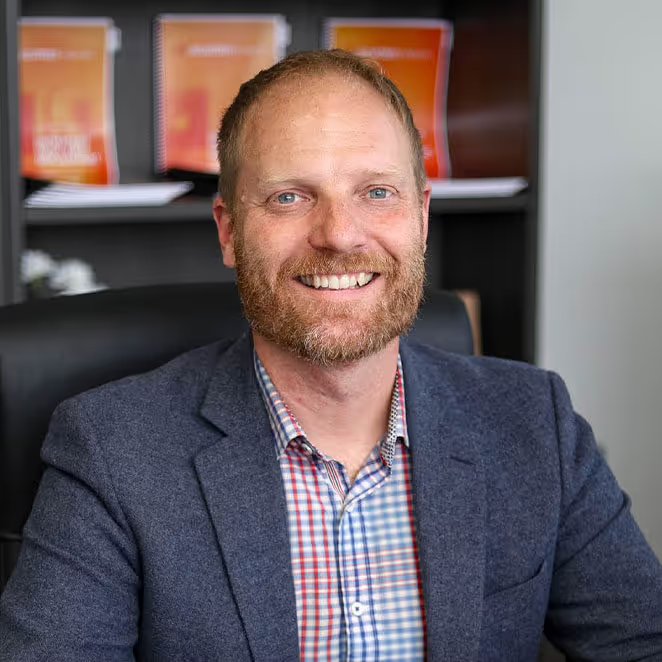
Jesse Slade-Shantz
MD, FRCSC
Icône de localisation du chirurgien
Vancouver, BC; Kelowna, BC; Calgary, AB; Edmonton, AB
Anglais
Accepte les patients adultes

Chirurgien orthopédiste comptant 14 ans d'expérience, spécialisé dans les chirurgies arthroscopiques et ouvertes de l'épaule, du genou, du coude et des affections liées au sport.