
Private Bunion Surgery

While many bunions are not an issue, surgery can become necessary. Find the right surgeon that fits your needs below, serving Canadians in major cities like Vancouver, British Columbia; Edmonton, Alberta; Toronto, Ontario; and Montréal, Québec.
Le fondateur de Surgency, le Dr Sean Haffey, souriant
Révisé et approuvé par le Dr Sean Haffey
Maquette de carte de crédit

À titre informatif seulement, ne constitue pas un avis médical ou juridique. Veuillez consulter votre médecin ou votre chirurgien.

Comment fonctionne Surgency

Icône indiquant le lieu de l'intervention chirurgicale

Décidez où aller

La chirurgie privée au Canada nécessite généralement de voyager hors de sa province. La première étape consiste donc à décider où.
Icône indiquant la recherche sur la plateforme

Rechercher par spécialité

Notre application facilite la recherche de chirurgiens par spécialité et par emplacement.
Icône indiquant l'envoi d'une demande de consultation sécurisée au chirurgien

Planifiez une consultation

Prenez rendez-vous pour une consultation directement sur Surgency. C'est sécurisé, confidentiel et rapide.

What is bunion surgery?

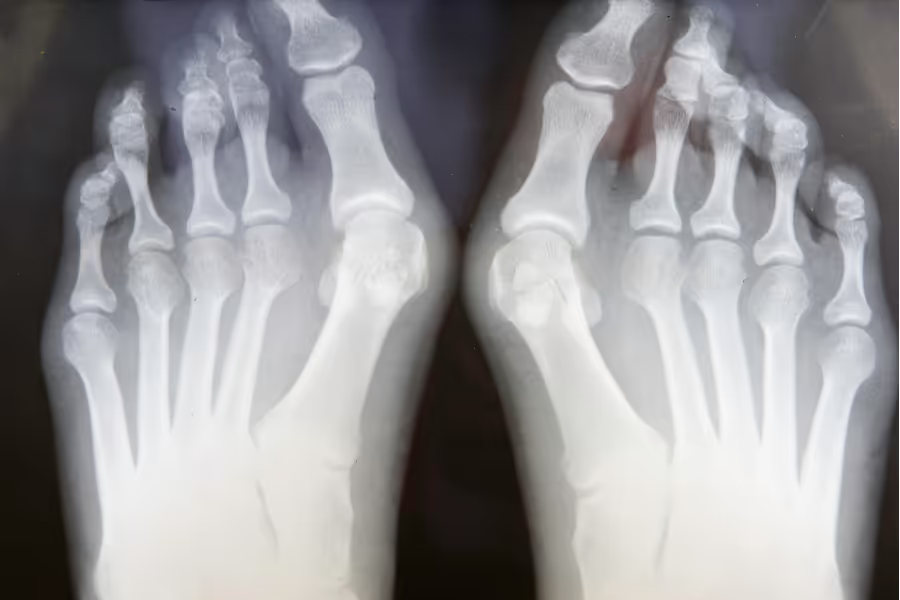
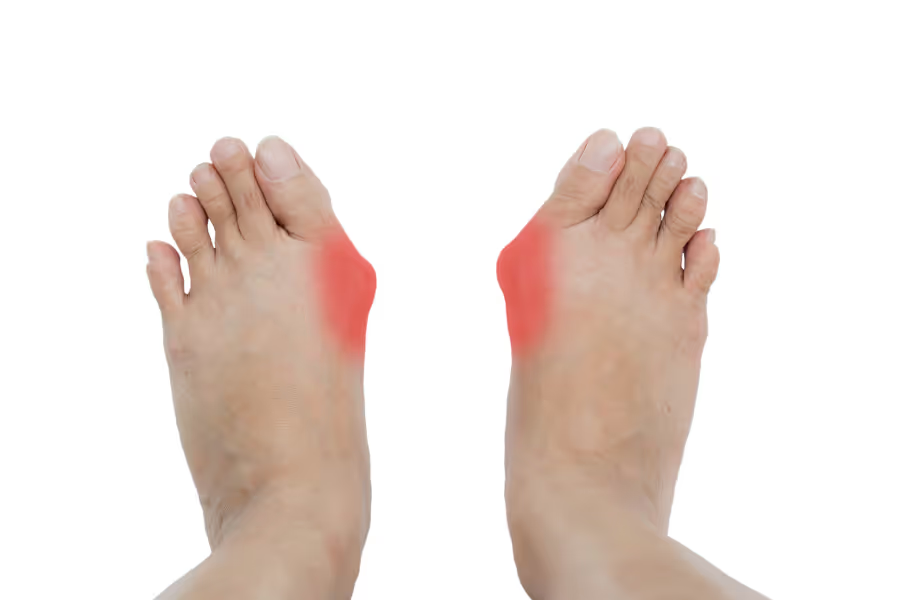
Bunion surgery aims to correct a bony bump that forms on the side of the foot at the base of the big toe, which causes the big toe to angle towards the other side of the foot. In certain cases, this causes significant pain, swelling, and impaired function in the foot. Practically speaking it makes walking uncomfortable, and many shoes unbearable.

Surgical intervention is used to remove the bony bump, help align the big toe to a natural position, regain proper foot function, and get rid of pain.

Why do people choose to have bunion surgery done privately?

Délais d'attente plus courts

Les consultations et les dates de chirurgie sont généralement prévues en semaines—et non en mois—ce qui signifie un soulagement plus rapide et un retour plus rapide au travail, au sport et aux tâches de soins.

Choix et contrôle

Capacité à choisir un chirurgien en fonction de ce qui est important pour vous (c'est-à-dire expertise spécifique, expérience, qualifications, connexion personnelle).

Certitude

Les parcours privés fournissent généralement un devis clair ainsi qu’une date/échéancier de la chirurgie, ce qui vous permet d’organiser des congés, de l’aide aux aidants et de la réadaptation. Cette certitude peut apaiser l’anxiété et aider les familles à planifier leur rétablissement.

Prévenir une détérioration supplémentaire

  • Deformity progression: Untreated bunions can worsen over time, increasing pain, crossing or crowding toes, and making later correction more complex.
  • Secondary problems: Ongoing malalignment can cause transfer metatarsalgia, hammertoes, calluses, and difficulty with balance and gait.
  • Shoe and activity limits: Earlier correction can reduce years of restricted footwear choices, reduced walking tolerance, and compensatory issues in knees/hips.
  • Surgical simplicity: Addressing a bunion before severe deformity may allow less invasive procedures and smoother recovery.
Maquette de tableau de bord
Pourquoi choisir Surgency

Pour les Canadiens qui souhaitent une chirurgie en quelques semaines, et non en quelques mois

Surgency est une ressource gratuite, offerte par un médecin canadien du système public, pour vous aider à trouver le bon chirurgien selon vos besoins.

How do I get private bunion surgery in Canada?

  1. Confirmez votre diagnostic. La plupart des patients commencent par consulter un médecin de famille ou un spécialiste qui confirme que la chirurgie est conseillée. Un chirurgien privé peut également confirmer le diagnostic si nécessaire.
  2. Faites des recherches.
    • Vous pouvez trouver des chirurgiens à Vancouver, en Colombie-Britannique; Calgary, en Alberta; Toronto, en Ontario; et Montréal, au Québec sur notre application, et consulter leurs qualifications ainsi que les tarifs.
  3. Planifiez une consultation initiale. La plupart des chirurgiens proposent des consultations en clinique et en ligne.
    • Les consultations sont généralement fixées en quelques jours ou quelques semaines.
    • Remarque : prévoyez des frais de consultation entre 150 $ et 350 $.
    • Nous vous recommandons de prendre 2 à 4 consultations avec différents chirurgiens afin de mieux comprendre vos options.
  4. Consultation. Le chirurgien examinera votre état, vos symptômes et tout traitement ou diagnostic antérieur, comme des radiographies ou des IRM.
  5. Après la consultation. Le chirurgien examinera ensuite votre dossier et vous proposera des options chirurgicales (et non chirurgicales) en fonction de vos besoins; il passera en revue les risques et les résultats attendus; et présentera les options de tarification et de planification.
  6. Planifiez la date de votre chirurgie. Une fois que vous aurez confirmé la procédure et le paiement, la clinique fixera la date de votre chirurgie – généralement dans un délai de quelques semaines.

Bunion surgery steps: what to expect

Bunion surgery usually takes 45 to 120 minutes, depending on severity of the underlying issue.

  • Anesthesia: Your foot is numbed (sometimes you’re sleepy too).
  • Small cuts: Around the big toe joint.
  • Shave bump: Remove extra bone on the side.
  • Realign bone: Make a precise cut (osteotomy), slide the bone to straighten the toe.
  • Fixation: Hold it with tiny screws/plates so it heals straight.
  • Soft tissues: Release/tighten ligaments to balance the toe.
  • Close skin and bandage.

What can I expect from the bunion surgery recovery process?

Le processus de récupération varie d'un patient à l'autre. Votre rétablissement pourrait être très différent, veuillez donc demander des conseils supplémentaires à votre chirurgien. En général, voici à quoi vous pouvez vous attendre :

Semaine 1 :

  • Goals: Pain and swelling management, wound protection, initial basic movement.
  • Activités :
    • Same day discharge, likely with a post-operative shoe or sandal.
    • Elevated rest for most of the day.
    • Concentrez-vous sur le maintien de la propreté de la zone pour éviter l'infection.
    • Limited walking or weight-bearing.

Semaines 2 à 4 :

  • Goals: Wound healing and slowly ramping up activity.
  • Activités :
    • Soins de la plaie, possiblement le retrait des points de suture.
    • Transition to regular footwear.
    • Increase walking distance and slowly resume normal daily activities.
    • Start physiotherapy, as directed.
    • Returning to work, depending on how physically demanding your job is.
    • Potentially driving if you can perform an emergency stop (i.e. slamming on the breaks).

Semaines 5 à 12 :

  • Goals: Increase mobility and strength.
  • Activités :
    • Continue to push for longer distances walking.
    • Reprise de la plupart des activités normales.
    • Returning to work where spend a lot of time on your feet.

Semaines 13 à 52 :

  • Goals: Regain full or near-full range of motion, recover your lost strength and stamina, and slowly return to normal activity levels and sports.
  • Activités :
    • La physiothérapie peut se poursuivre pendant toute la première année suivant l'opération, vous ramenant progressivement à vos niveaux d'activité d'avant la chirurgie.
    • Les exercices quotidiens ne sont plus essentiels une fois que vous avez atteint une amplitude de mouvement et une force normales, mais un exercice régulier est encouragé pour garder les muscles forts.
    • Vous pourrez reprendre des sports à faible impact comme le golf, le tennis, la natation ou le cyclisme. Pour toute activité à fort impact, veuillez consulter votre chirurgien et votre physiothérapeute.

How much does private bunion surgery cost in Canada?

Private clinics in Canada charge between $5,000 - $8,000 per foot.

In the United States, the average cost is $8,200 per foot.

Les coûts varient énormément selon l’emplacement, l’expérience du chirurgien, le type d’établissement, la complexité et les services inclus (certaines cliniques offrent tout compris, tandis que d’autres facturent séparément l’anesthésie, les suivis, etc.).

Ce qui est inclus

Most quotes for private bunion surgery cover:

  • Surgeon fee (and assistant if used).
  • Anesthesia (local with sedation or general; varies by clinic).
  • Hospital/clinic facility fees (OR time, nursing, supplies).
  • Standard implants/fixation (screws/plates) for routine cases.
  • Les soins postopératoires immédiats et les suivis précoces de routine (vérification des plaies, retrait des sutures).
  • Post‑op shoe/boot and initial rehab instructions (varies).

Ce qui n'est généralement pas inclus :

  • Pre‑op consults and advanced imaging beyond basic X‑rays.
  • Custom orthotics or special footwear after initial healing.
  • Extended physiotherapy beyond initial guidance.
  • Extra/specialty implants for complex or revision cases.
  • Unexpected overnight admission or ER visits; additional imaging for complications.
  • Medications after you go home (pain meds, antibiotics if prescribed).
  • Les frais de déplacement et d'hébergement si la chirurgie a lieu hors province.
  • Fees for managing complications or re‑operations beyond the routine global period (policy dependent).

Options d'assurance et de financement

  • Assurance maladie privée : Certains régimes peuvent couvrir une partie des coûts, comme les frais d'hospitalisation. Il est important de vérifier directement votre police d'assurance.
  • Plans de financement : De nombreuses cliniques proposent des options de paiement mensuel pour vous aider à étaler les coûts. Apprenez-en davantage sur vos options de financement ici.
  • Crédit d'impôt pour frais médicaux (CIFM): Il s'agit d'un crédit non remboursable qui réduit vos impôts lorsque vous payez de votre poche des dépenses médicales admissibles. Apprenez-en davantage sur la façon de demander le CIFM pour les chirurgies privées.

Choisir un chirurgien et une clinique

Choosing your surgeon is one of the benefits of going the private route. Here’s what to consider and the key questions to bring to your bunion surgery consultation.

Ce qu'il faut rechercher

  • Expérience et volume d'interventions
    • Ask how many bunion/forefoot procedures they perform each year, and their mix (minimally invasive/MIS vs open scarf/chevron, Lapidus fusion, revisions). Volume and familiarity matter.
  • Qualifications et formation
    • Confirmez leur permis d'exercice auprès de l'ordre provincial des médecins (par exemple, le Collège des médecins et chirurgiens de l'Ontario, le Collège des médecins et chirurgiens de la Colombie-Britannique, le Collège des médecins et chirurgiens de l'Alberta).
    • For orthopaedic surgeons: look for FRCSC certification with foot & ankle fellowship training. For podiatric surgeons: verify surgical credentials and hospital/surgical privileges in your province.
  • Spécialisation et résultats
    • Prefer surgeons focused on foot and ankle. Ask about infection, nonunion, nerve irritation, hardware removal, recurrence rates, and unplanned re‑operations.
  • Procedure selection philosophy
    • How they choose MIS vs open, distal osteotomy (chevron/scarf) vs Lapidus (first TMT fusion), bunionette or lesser toe work when needed.
    • Approach to addressing first‑ray instability, pronation, metatarsalgia, or crossover toe at the same sitting.
  • Accréditation de l'établissement
    • Choose clinics accredited national bodies such as Accreditation Canada or the Canadian Association for Accreditation of Ambulatory Surgical Facilities (CAAASF).
  • Intégration de la réadaptation
    • Foot‑savvy physiotherapy, a phased written protocol, and coordination with your local therapist—especially if you’re traveling.

Questions to ask during your bunion surgery consultation

Chirurgien et plan chirurgical

  • How many bunion surgeries do you perform yearly? What are your complication and recurrence rates? How often do you remove hardware?
  • Which procedure do you recommend for me (MIS chevron/scarf, Lapidus, Akin, bunionette correction)? Why this choice?
  • What fixation do you use (screws/plates), and is hardware removal common?
  • Will you correct related problems at the same time (second‑toe deformity, metatarsalgia, flatfoot)? How does that change recovery?
  • What anesthesia do you recommend (local with/without sedation vs regional/general) and why?
  • Where will surgery be performed (ambulatory center vs hospital)? Is it fully accredited?

Rétablissement et suivi postopératoire

  • Weight‑bearing: Surgical shoe vs boot; immediate protected weight‑bearing vs partial/non‑weight‑bearing? For how long?
  • Footwear timeline: When can I transition to wide shoes, then normal shoes? When can I drive, return to desk vs standing/manual work, and sports?
  • Swelling and scar care: Strategies, taping, toe spacers, and expected duration of swelling.
  • Pin/suture removal: If used, when and where? Is it included in the fee?
  • Red flags: What symptoms should prompt me to call or go to the ER?
  • Communication: Who is my post‑op contact (direct line/email)? Typical response times? How many follow‑ups are included?

Coûts et logistique

  • What exactly is included in my quote (surgeon, facility, anesthesia, implants, dressings, shoe/boot, imaging, follow‑ups)? What could add cost (additional osteotomies, Lapidus vs MIS, hardware upgrades, unexpected overnight stay, complications)?
  • If a complication occurs or a revision is needed, how are costs handled? Do you have a revision policy?
  • If I’m traveling from another province, which follow‑ups can be virtual? Will I receive the operative note, implant list, and rehab/footwear plan for my local providers/insurer?

Bunion surgery frequently asked questions

How do I know if bunion surgery is right for me?

Some 6% of Canadians have hallux valgus (bunions), but many do not need surgery. But your bunion may require surgery if it's causing significant pain, deformity in the big toe, immobility, or compromised quality of life.

It's advisable to seek out more conservative treatments before surgery, such as orthotics, padding, or toe spacers. However, if you've already exhausted these measures, and the pain is worsening and foot function is getting worse, then you are likely a candidate for bunion surgery.

Ai-je besoin d'une référence?

No, you do not need a referral for private bunion surgery in Canada. You can book a consultation directly with a surgeon, and they will review your condition, symptoms, and any previous treatments or diagnostics.

How do I prepare for bunion surgery?

Votre chirurgien vous donnera des conseils sur la façon de vous préparer, mais vous pouvez vous attendre à des exercices préopératoires pour aider à soulager la raideur, la faiblesse musculaire et les problèmes d'amplitude de mouvement. Si vous fumez, il vous sera conseillé d'arrêter pour améliorer les résultats de la guérison. Selon votre poids, il pourrait vous être conseillé de suivre un régime et de faire de l'exercice pour réduire les risques chirurgicaux et améliorer les résultats de la guérison.

Home prep: We recommend taking the time to rearrange your home to prepare for the first few weeks after surgery. Remove anything that presents a tripping hazard (chords, sliding rugs, loose items).

Support: Try to arrange for someone who can reach you in the event of an emergency for the first several weeks/months after surgery.

Work: If possible, you may need to request time off work to recover, especially if you need to be on your feet.

Pratique postopératoire : Vous pourriez envisager de « pratiquer » des activités quotidiennes avec une amplitude de mouvement très limitée, comme monter et sortir de la voiture, monter et sortir du lit, enfiler et enlever des chaussures, etc.

What are the risks involved with bunion surgery?

Your personal risk depends on deformity severity, procedure type (MIS vs open chevron/scarf, Lapidus fusion), bone quality, health, and rehab. Discuss specifics with your surgeon.

Courants et généralement temporaires

  • Pain, swelling, bruising; numbness around the incision
  • Stiffness of the big toe joint (improves with rehab)
  • Scar sensitivity; delayed wound healing (especially with swelling or tight shoes)
  • Shoe-fit issues for weeks to months due to swelling

Moins courants

  • Nerve irritation/injury (medial dorsal cutaneous nerve) causing numbness or tingling
  • Infection (superficial more common than deep)
  • Persistent or recurrent bunion (under‑correction) or over‑correction causing hallux varus
  • Nonunion or delayed union at an osteotomy/fusion site (higher with Lapidus, smoking, diabetes)
  • Hardware problems: screw/plate irritation, need for removal
  • Transfer metatarsalgia (pain under lesser metatarsal heads) if load shifts improperly
  • Big toe stiffness or limited push‑off; “floating toe” if lesser toes are also corrected

Rare mais important

  • Deep infection requiring further surgery
  • Blood clots (DVT/PE) are rare in forefoot surgery but possible
  • Complex regional pain syndrome (rare, chronic pain/swelling)
  • Sesamoid malalignment or avascular necrosis of the metatarsal head (rare)

Considérations spécifiques à la procédure

  • MIS techniques: smaller scars, less soft‑tissue trauma, but require experienced surgeons for precise correction; risk of under/over‑correction if cuts shift.
  • Lapidus (first TMT fusion): stronger correction for instability/pronation; longer protected weight‑bearing; higher nonunion risk if risk factors present.
  • Concomitant procedures (Akin osteotomy, bunionette, lesser toe corrections) can extend recovery and swelling duration.

What are the risks of delaying or not pursuing bunion surgery?

Risks of delaying or not having surgery (when symptoms are significant/persistent).

  • Progressive deformity with increasing pain, calluses, and shoe limitations
  • Second‑toe problems (crossover, hammertoe), transfer metatarsalgia
  • Arthritis in the big toe joint over time, making later surgery more complex
  • Skin irritation or bursitis over the bunion, occasional ulcers in severe deformities

When watchful waiting is reasonable

  • Mild/moderate bunions controlled with wide toe‑box shoes, spacers, pads, orthotics, activity modifications
  • Pain manageable without frequent limitations

Comme toujours, veuillez consulter votre médecin ou votre chirurgien.

What is the difference between a bunionectomy and minimally invasive chevron akin (MICA)? Which one should I get?

Bunionectomies involve an incision along the top or side of the foot that the surgeon uses to remove the bony bump, and realign the toe and foot muscles and ligaments.

The MICA procedure involves a smaller incision, faster recovery, and less pain and scarring.

Your surgeon will advise you what surgery suits your needs based on severity of your bunion, joint flexibility, presence of arthritis, and foot injury history.
Looking for a bunion surgeon?

Browse vetted bunion surgeons across Canada. Compare prices, qualifications, locations.

PARCOURIR LES CHIRURGIENS


Browse Accredited Private Surgeons for Bunion Surgery

Les chirurgiens de Surgency sont vérifiés :

✓ Diplôme de médecine reconnu
✓ Permis d'exercice canadien (LMCC)
✓ Permis d'exercice médical provincial actif
✓ Certification du conseil (FRCSC/ABMS)
QC
Accepte les patients résidant à l'extérieur du Québec et tous les patients pour l'allongement esthétique des membres.
Marie Gdalevitch
MD, FRCSC
Icône de localisation du chirurgien
Montréal, QC
Anglais, Français
Reçoit les adultes et les enfants

Chirurgienne orthopédiste ayant complété deux bourses de perfectionnement, profondément spécialisée en allongement des membres et en correction des difformités, avec plus de 15 ans d'expérience clinique.
C.-B.
Accepte les patients de toutes les provinces, y compris la Colombie-Britannique.
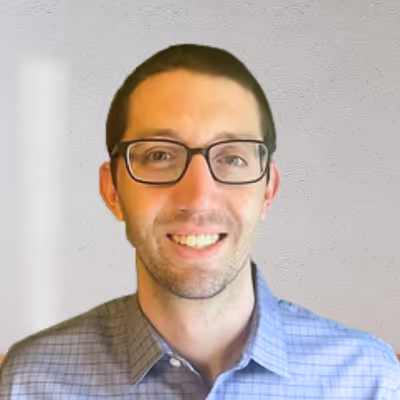
Daniel Halayko
DPM, FACFAS
Icône de localisation du chirurgien
Vancouver, C.-B.
Anglais
Accepte les patients adultes

Chirurgien du pied et de la cheville certifié par le conseil, spécialisé dans la reconstruction mini-invasive de l'avant-pied et la chirurgie reconstructive du pied et de la cheville pour la préservation des membres diabétiques, avec 8 ans d'expérience.
Alberta
Accepte les patients résidant à l'extérieur de l'Alberta
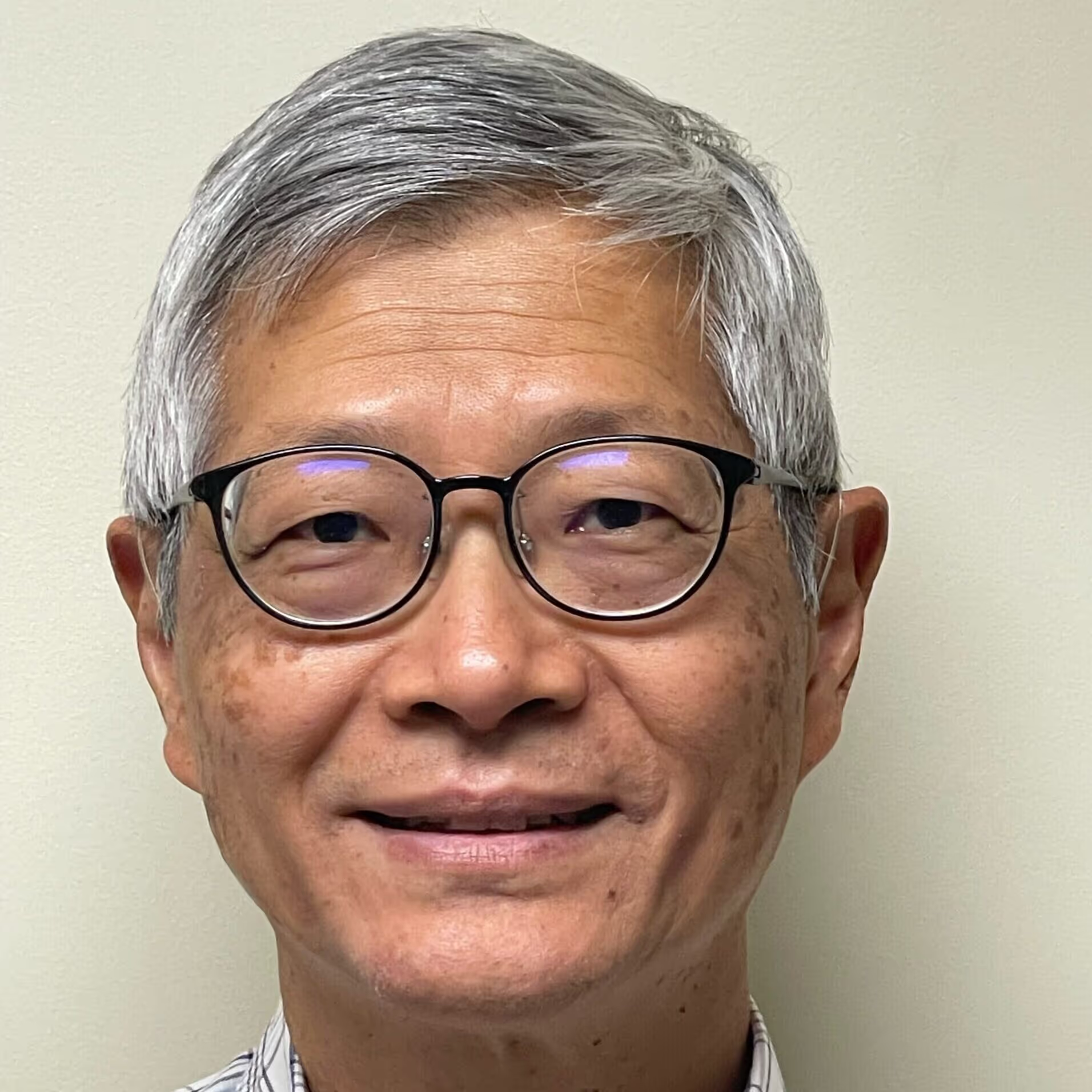
Paul Leung
MD, FRCSC
Icône de localisation du chirurgien
Edmonton, AB
Anglais
Accepte les patients adultes

Chirurgien orthopédiste très expérimenté, comptant plus de 30 ans d'expérience. Il est considéré comme un chef de file régional en chirurgie du pied et de la cheville, axé sur les déformations complexes, les blessures sportives et les affections dégénératives.