
Removes an abnormal tunnel between tissues that causes recurrent drainage, infection, or pain—helping it heal properly and reduce flare-ups. Learn more and find the right surgeon that fits your needs below, serving Canadians in major cities like Vancouver, British Columbia; Calgary, Alberta; Toronto, Ontario; and Montréal, Québec.
.avif)
À titre informatif seulement, ne constitue pas un avis médical ou juridique. Veuillez consulter votre médecin ou votre chirurgien.



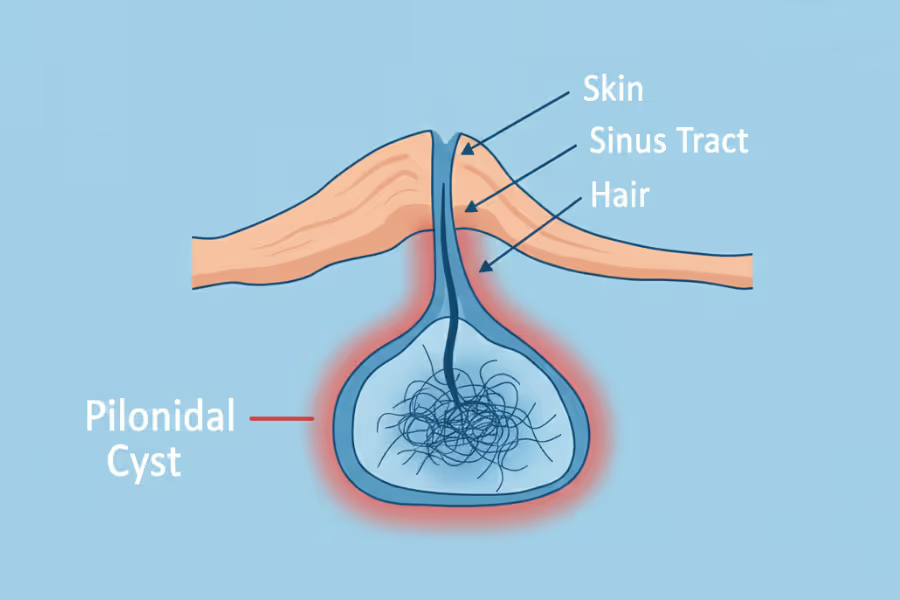
Sinus tract & fistulae excision is a surgical procedure that removes an abnormal tunnel (tract) that shouldn’t be there.
A sinus tract (not to be confused with your nasal sinus) is usually a channel that runs from a deeper pocket of chronic inflammation or infection to the skin surface, causing a persistent opening that can repeatedly drain fluid or pus.
A fistula is an abnormal connection between two body structures—for example, between the bowel/anal canal and the skin (common in perianal fistula), or between other tissues depending on the underlying cause.
In an excision, the surgeon aims to identify the tract, remove the chronically inflamed lining and any associated infected tissue, and then manage the wound so it can heal properly. Depending on the location and complexity, the surgeon may:
This surgery is different from simply treating flare-ups with antibiotics or draining an abscess. Those steps can reduce acute pain and pressure, but they may not remove the tract—so the problem can keep recurring.
Time matters when a tract or fistula is causing persistent drainage, recurrent infections/abscesses, odour, skin irritation, or ongoing pain. Private clinics can book assessment and treatment sooner—meaning less time managing dressings, antibiotics, and repeated flare-ups.
Passer au privé peut vous permettre de :
You know who will do the procedure, what the plan is, and what recovery will look like—often with clearer timelines for follow-up and wound care. A clear date also makes it easier to plan around school, work, and travel; and arrange time off.

Sinus tract and fistula surgery is often an outpatient procedure, typically taking 30–90 minutes depending on the complexity and location (e.g., pilonidal, perianal, or abdominal). Expect to be at the clinic or surgical centre for several hours including intake and recovery.

Your exact recovery plan comes from your surgeon, but here’s the general idea. Recovery is often slower than a simple cyst removal because the wound is frequently left open to heal.
Ce que vous ressentirez
Objectifs principaux
Instructions typiques
Ce que vous ressentirez
Objectifs principaux
Typical steps
Ce que vous ressentirez
Objectifs principaux
Typical steps
Appelez votre équipe soignante si vous remarquez :
Sinus tract and fistulae surgery is generally more expensive than simple cyst removal because it is technically more difficult, often requires an operating room setting (rather than a simple procedure room), and may involve general anesthesia.
At private clinics, you can typically expect: $1,800 - $4,500+
Pourquoi cette portée?
Typical range: CA$4,000 - CA$10,000+
Pourquoi le prix varie-t-il autant?
In Canada, medically necessary sinus tract & fistulae excision care can be covered in the public system; private excision is typically out-of-pocket, though some extended plans may reimburse parts—ask for an itemized invoice.
Choosing your surgeon is one of the benefits of going private. Here’s how to choose wisely for sinus tract and fistulae surgery.
À propos du chirurgien et du plan
Technique and Strategy
Infection-specific questions
Recovery and costs
Sinus tract excision is usually not the first step if the issue is a one-time infection. It is something you consider when the tract is chronic, recurrent, or refusing to heal. Unlike cysts, fistulas rarely heal permanently on their own without intervention. Consult your doctor or surgeon to better understand your personal situation.
If the area keeps flaring or coming back
If you have chronic drainage
If it is interfering with daily life
If there is diagnostic clarity
No, you do not need a referral for private sinus tract & fistulae excision in Canada. You can book a consultation directly with a surgeon, and they will review your condition, symptoms, and any previous treatments or diagnostics.
Your surgeon will give you a specific plan, especially regarding bowel preparation if the fistula is perianal.
Your situation depends on the tract’s location and cause (pilonidal vs. perianal vs. post‑surgical, Crohn’s-related, hidradenitis, etc.), how often it flares, and what imaging/exam shows. Some cases can be managed for a while, but chronic sinus tracts and fistulae often don’t fully resolve on their own—and delay can mean more cycles of infection and more complex disease. Always review your personal risks with your surgeon.
More flare-ups: swelling, pain, and drainage
Sinus tracts and fistulae often cycle between “quiet” and “active.” With delay, you may have more episodes of pain, swelling, and drainage—often with increasing disruption to work, exercise, travel, and sleep.
Higher chance of abscess and infection (and urgent visits)
A blocked fistula or tract can collect fluid and turn into an abscess, which may require urgent incision and drainage, antibiotics, or even emergency assessment. Repeated infections can also lead to repeated courses of antibiotics (and their side effects).
The tract can become more complex over time
Ongoing inflammation can lead to:
More scarring and harder surgery later
Repeated inflammation and prior drainages create scar tissue. That can:
Ongoing skin breakdown, odour, and constant wound care
Chronic drainage can irritate the surrounding skin, cause rashes and breakdown, stain clothing, and keep you in a constant routine of pads, gauze, and hygiene workarounds.
Impact on quality of life and mental load
Many people end up avoiding sitting, certain clothing, intimacy, swimming, or long days out because they can’t trust the drainage. The uncertainty (“Will it flare again this week?”) is a real burden.
Missing an underlying condition (the important one)
Not every draining opening is “just a tract.” Delaying workup can delay diagnosis or management of underlying causes such as:
Every surgery has risks. Your personal risk depends on your overall health, the tract’s location, depth, complexity, whether it’s inflamed/infected, and how closely you follow wound-care instructions. Review your specific situation with your surgeon.
Si vous avez encore des questions, n'hésitez pas à nous contacter directement.




Chirurgien général certifié FRCSC, spécialisé en chirurgie mini-invasive et sans filet pour les hernies, avec un intérêt particulier pour la reconstruction et le rajeunissement anal.

Chirurgien général certifié FRCSC avec 17 ans d'expérience, spécialisé en chirurgie mini-invasive (laparoscopique), dont la pratique est axée sur les hernies et les maladies de la vésicule biliaire.
Chirurgienne endocrinienne hautement spécialisée avec 7 ans d'expérience, offrant une gestion experte des troubles thyroïdiens et parathyroïdiens, en mettant l'accent sur les techniques mini-invasives et les soins axés sur le patient.