
Private MPFL Reconstruction Surgery

MPFL reconstruction stabilizes the kneecap by rebuilding the torn ligament that keeps it centered. Find the right surgeon who fits your needs below, serving Canadians in major cities like Vancouver, British Columbia; Edmonton, Alberta; Toronto, Ontario; and Montréal, Québec.

Le fondateur de Surgency, le Dr Sean Haffey, souriant
Révisé et approuvé par le Dr Sean Haffey
Maquette de carte de crédit

À titre informatif seulement, ne constitue pas un avis médical ou juridique. Veuillez consulter votre médecin ou votre chirurgien.

Comment fonctionne Surgency

Icône indiquant le lieu de l'intervention chirurgicale

Décidez où aller

La chirurgie privée au Canada nécessite généralement de voyager hors de sa province. La première étape consiste donc à décider où.
Icône indiquant la recherche sur la plateforme

Rechercher par spécialité

Notre application facilite la recherche de chirurgiens par spécialité et par emplacement.
Icône indiquant l'envoi d'une demande de consultation sécurisée au chirurgien

Planifiez une consultation

Prenez rendez-vous pour une consultation directement sur Surgency. C'est sécurisé, confidentiel et rapide.

What is MPFL reconstruction surgery?

MPFL reconstruction (Medial Patellofemoral Ligament reconstruction) is a surgery for the knee that stops the kneecap (patella) from dislocating. It works by replacing a torn ligament with a new, strong piece of tissue (a graft) to hold the kneecap in its proper groove.

Think of the kneecap resting in a groove at the end of your thigh bone. The MPFL acts like a strong leash on the inside of the knee, keeping the kneecap from sliding too far to the outside. If you suffer a severe twisting injury or a direct hit, the kneecap can pop out of place (dislocate), tearing this leash. Once the MPFL is torn, the kneecap often keeps sliding out easily, causing knee pain, swelling, and a feeling that your knee cannot be trusted to hold your weight.

Ce qui se passe réellement

  • Graft preparation: The surgeon uses a piece of tendon—either from your own body (like a hamstring tendon) or from a donor (allograft)—to create a new "leash."
  • Ligament reconstruction (keep it centered): Instead of just stitching the old, stretched-out ligament, the surgeon securely attaches the new tendon graft to the inside edge of your kneecap and to your thigh bone (femur) using small screws or anchors.

Why do it? When clinical exams and MRI findings show a torn MPFL and you suffer from recurrent kneecap dislocations, surgery restores stability. This prevents further damage to the cartilage behind the kneecap and lets you confidently return to sports and daily life.

Why do Canadians choose to have MPFL surgery done privately?

Délais d'attente plus courts

Public wait lists for orthopaedic consults, MRIs, and OR time can be long—especially for knee instability that isn't considered an absolute emergency. Private centres can sometimes line up assessment and surgery in weeks rather than months. This cuts down the time spent living in fear of your knee giving out, relying on bulky braces, or missing out on sports and active living.

Choix et contrôle

Passer au privé peut vous permettre de :

  • Pick your surgeon (an orthopaedic sports medicine specialist) based on patellar instability experience and case volume.
  • Schedule around school semesters, sports seasons, or work.
  • Get a clear plan regarding what type of graft (your own tendon vs. donor) is best for your specific knee.

Tranquillité d'esprit

Tu sais qui opère, quand ça se passe et quelle technique chirurgicale ils vont utiliser. Des dates prévisibles facilitent la planification de congés, de voyages et la physiothérapie post-opératoire cruciale.

Prévenir une détérioration supplémentaire

  • Joint protection: Every time the kneecap dislocates, it scrapes against the thigh bone. Over time, this chips away the smooth cartilage, leading to early arthritis behind the kneecap.
  • Function: Ongoing instability leads to muscle wasting (atrophy) in the thigh because you subconsciously avoid using the leg fully.
  • Performance and wellbeing: Faster relief means getting back to the activities you love, protecting your mental health and physical fitness.

Soins intégrés

Les voies privées peuvent offrir une imagerie simplifiée, des outils chirurgicaux avancés et des plans coordonnés d’anesthésie/douleur/physio — avec des suivis virtuels si vous habitez loin.
Maquette de tableau de bord
Pourquoi choisir Surgency

Pour les Canadiens qui souhaitent une chirurgie en quelques semaines, et non en quelques mois

Surgency est une ressource gratuite, offerte par un médecin canadien du système public, pour vous aider à trouver le bon chirurgien selon vos besoins.

  1. Confirmez votre diagnostic. La plupart des patients commencent par consulter un médecin de famille ou un spécialiste qui confirme que la chirurgie est conseillée. Un chirurgien privé peut également confirmer le diagnostic si nécessaire.
  2. Faites des recherches.
    • Vous pouvez trouver des chirurgiens à Vancouver, en Colombie-Britannique; Calgary, en Alberta; Toronto, en Ontario; et Montréal, au Québec sur notre application, et consulter leurs qualifications ainsi que les tarifs.
  3. Planifiez une consultation initiale. La plupart des chirurgiens proposent des consultations en clinique et en ligne.
    • Les consultations sont généralement fixées en quelques jours ou quelques semaines.
    • Remarque : prévoyez des frais de consultation entre 150 $ et 350 $.
    • Nous vous recommandons de prendre 2 à 4 consultations avec différents chirurgiens afin de mieux comprendre vos options.
  4. Consultation. Le chirurgien examinera votre état, vos symptômes et tout traitement ou diagnostic antérieur, comme des radiographies ou des IRM.
  5. Après la consultation. Le chirurgien examinera ensuite votre dossier et vous proposera des options chirurgicales (et non chirurgicales) en fonction de vos besoins; il passera en revue les risques et les résultats attendus; et présentera les options de tarification et de planification.
  6. Planifiez la date de votre chirurgie. Une fois que vous aurez confirmé la procédure et le paiement, la clinique fixera la date de votre chirurgie – généralement dans un délai de quelques semaines.

MPFL surgery: what to expect

Typical MPFL reconstruction often takes about 1 to 1.5 hours of operating time. Add time at the centre for check‑in, anaesthesia, and recovery (usually a few extra hours). Cases that involve other procedures (like moving the bone where the patellar tendon attaches) will take longer.

Étapes de base

1. Enregistrement et confirmation

You meet the team, confirm the correct knee, review imaging, and go over the plan. Safety checks are done (including marking the leg).

2. Anesthésie

Usually general anaesthesia (you’re fully asleep). The team often uses a regional nerve block to numb the leg and help control pain after you wake up.

3. Positionnement et préparation

You’re positioned on your back. The leg is cleaned and draped sterilely. A tourniquet is often used on the thigh to minimize bleeding.

4. Small incisions and exposure

The surgeon makes small incisions on the inside of the kneecap and the inner thigh. They may also use an arthroscope (a small camera) to look inside the knee joint and clean up any loose cartilage.

5. Graft preparation

If using your own tissue, a small strip of your hamstring tendon is harvested. If using a donor graft, it is prepared to the correct length and thickness.

6. Implant placement (the reconstruction)

The surgeon drills small sockets into the inner edge of the kneecap and the thigh bone. The graft is anchored securely into these holes using small screws or buttons, creating the new ligament.

7. Rinse and check tracking

The surgeon bends and straightens your knee to ensure the kneecap glides smoothly in its groove and the new ligament has perfect tension (not too tight, not too loose).

8. Gros plan

Layers of tissue and skin are closed with stitches or staples. A sterile dressing is applied, and your leg is placed in a locked, hinged knee brace.

9. Réveil et instructions

You recover in the post‑anaesthesia care unit, receive wound‑care, brace, and crutch instructions. Almost all patients go home the same day.
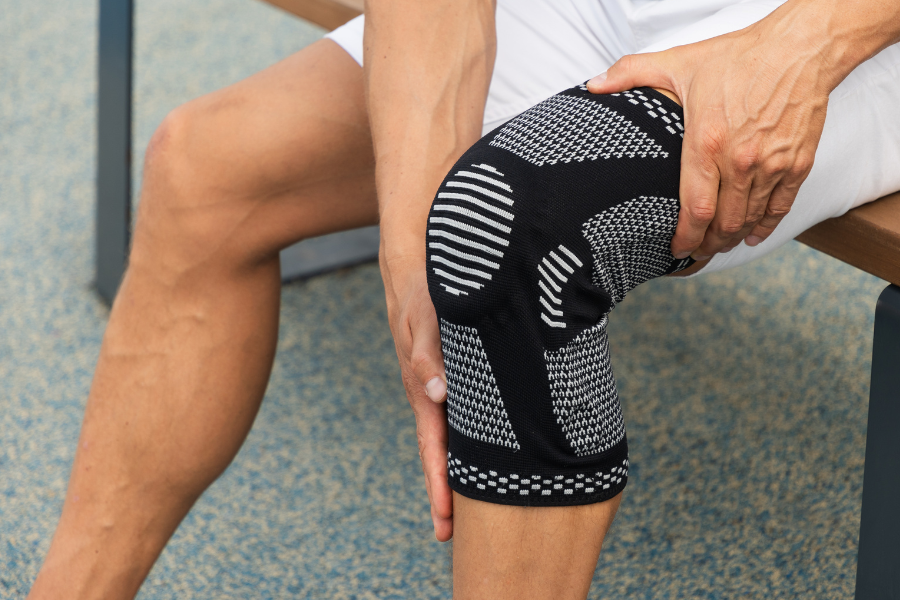
Muscular male legs with a knee brace to protect MPFL still recovering from surgery

What can I expect from the MPFL reconstruction surgery recovery process?

Chaque genou est différent — suivez le plan de votre chirurgien. Un progrès constant et intelligent avec un physiothérapeute vaut mieux que de trop pousser.

Semaine 1

Reality check:
Knee swelling, stiffness, and aching are common. The nerve block will wear off in a day or two, which can cause a temporary spike in pain.
Goals: Control pain and swelling, protect the new graft, and walk safely with crutches.
Activities: Keep the leg elevated above your heart and ice frequently. You will wear a hinged knee brace locked straight. Follow your surgeon's specific rules on whether you can put weight on the leg.

Semaines 2 à 4

Still annoying but improving.
Goals: Reduce swelling, wake up the thigh muscles (quadriceps), and slowly regain bending.
Activities: Your surgeon will usually unlock your brace to allow a safe amount of bending. Start prescribed physio. Focus heavily on straight-leg raises to strengthen the quads. You may transition to one crutch or no crutches as cleared. Stitches are removed if needed.

Semaines 5 à 8

The work phase.
Goals: Walk without a limp, improve bending (range of motion), and build muscle safely.
Activities: The bulky surgical brace is often swapped for a lighter sleeve brace. You can usually start using an upright stationary bike. Continue closed-chain strengthening (like gentle leg presses) with your physio. Avoid deep squats or pivoting.

Semaines 9 à 12

Confidence building.
Goals: Near‑normal daily activity; gradual fitness recovery.
Activities: Progress strengthening and mobility. The knee should feel much more stable, though you are still building the muscle lost during recovery. Light jogging may begin toward the end of this phase if cleared.

Mois 3–6+

Back to most normal life.
Goals: Return to usual routines; work/sport‑specific training.
Activities: Add impact, jumping, and agility drills only with explicit clearance from your surgeon and physio. Full return to cutting and pivoting sports (like soccer or basketball) usually happens around the 6 to 9-month mark.

Conseils utiles

  • Wake up the quads: The quadriceps muscles "shut down" after knee surgery. Forcing them to work early on is the key to a good recovery.
  • La glace est votre amie : Utilisez-le régulièrement après la physio pour calmer le genou.
  • Plan digestif : Les médicaments contre la douleur peuvent provoquer la constipation — hydratez-vous et utilisez des fibres ou des ramollisseurs de selles si nécessaire.
  • Stick to the brace rules: The new ligament takes months to fully anchor to the bone. Cheating on the brace can stretch it out.

Signes d'alerte — appelez votre équipe soignante

  • Fever, spreading redness, or foul/yellow drainage from the incisions.
  • Douleur au mollet, gonflement ou sensibilité (signes d’un caillot sanguin potentiel).
  • Sudden, severe worsening of knee pain or a feeling that the kneecap dislocated again.
  • Douleur thoracique ou essoufflement soudain.

How much does private MPFL reconstruction surgery cost in Canada?

Exact prices depend on the complexity of the case, the type of graft used (donor tissue usually adds cost), the specific hardware (anchors/screws), and where you have it done. Always ask for a written, itemized quote.

Coût au Canada (privé)

Typical range: $10,000 - $24,000+
Note: If additional procedures are needed (like realigning the shin bone—a tibial tubercle osteotomy), the cost will be significantly higher.

Coût aux États-Unis

Fourchette typique : 20 000 $ CA - 45 000 $ CA+

Ce qui est habituellement inclus

  • Frais de chirurgien et services d’anesthésie.
  • The surgical implants/hardware (screws, anchors) and donor graft (if applicable).
  • Temps d’établissement/salle d’opération accrédité, soins infirmiers et jetables standards.
  • Imagerie intra-opératoire de base et fournitures de routine.
  • Soins de récupération immédiats (URPA) et visites de suivi précoces.

Ce qui n'est souvent pas inclus

  • Les consultations initiales et l’imagerie préopératoire (IRM, radiographies) sont réalisées à l’extérieur de la clinique.
  • Custom post-operative hinged knee braces (these are required and can be expensive, though often covered by private benefits).
  • Extra procedures discovered during surgery (like fixing torn cartilage).
  • Prescriptions after discharge (pain, nausea, blood thinners).
  • Physiothérapie post-opératoire au-delà des premières visites.
  • Voyages et hébergement si tu es hors province ou dans un autre État.

Conseils pour comparer les devis

Ask if it’s a global bundle and request line items for: surgeon, facility, anaesthesia, implants/grafts (device cost), imaging, follow‑ups, and what triggers extra charges (e.g., if they need to clean up damaged cartilage while they are in the knee).

Choisir un chirurgien et une clinique

Choosing your surgeon is a major benefit of pursuing private surgery. Here’s how to choose wisely for an MPFL (Medial Patellofemoral Ligament) reconstruction.

Ce qu'il faut rechercher

Experience and volume (patellar instability–specific)

Ask how many MPFL reconstructions they perform each year.
MPFL surgery has a steep learning curve and is highly “precision-dependent” because:

  • the new ligament must be tensioned perfectly—too tight causes severe cartilage wear (arthritis), and too loose means the kneecap will dislocate again.
  • outcomes depend on accurate placement of the bone tunnels.
  • it requires a deep understanding of knee mechanics to ensure no other underlying issues (like bone alignment) are causing the dislocations.

Demandez aussi à propos de leur gamme de cas :

  • Isolated MPFL reconstruction vs. cases requiring tibial tubercle osteotomy (TTO) (moving the bone where the patellar tendon attaches).
  • Autograft (using your own hamstring tendon) vs. Allograft (using donor tissue).

Qualifications et formation

  • Vérifiez le permis d'exercice auprès de votre ordre professionnel provincial (CPSO Ontario, CPSBC C.-B., CPSA Alberta, CMQ Québec, etc.).
  • Look for FRCSC-certified orthopaedic surgeons with fellowship training in sports medicine or complex knee surgery.
  • Bonus: Surgeons who regularly treat athletes or participate in sports medicine societies usually have high-volume experience with ligament reconstructions.

Pour un guide plus approfondi, lisez : Comment comprendre les qualifications de chirurgien au Canada

Résultats et sécurité (demandez des chiffres réels)

Request recent data, ideally for MPFL cases specifically:

  • Taux d’infection
  • Re-dislocation rate (how often the surgery fails and the kneecap pops out again).
  • Post-operative stiffness (loss of bending ability).
  • Kneecap fracture rate (a rare but serious risk when drilling into the patella).
  • Patient-reported outcomes: Return to sports timelines and subjective knee confidence scores.

Indications claires et alternatives

Make sure they confirm you’re a good candidate for MPFL reconstruction.
A careful surgeon should explicitly assess:

  • whether your anatomy shows trochlear dysplasia (a shallow kneecap groove) or an abnormal Q-angle, which might mean you need more than just a ligament replacement.
  • whether there is any loose cartilage in the joint (osteochondral defects) from past dislocations.
  • whether you have truly failed conservative care (bracing and dedicated physiotherapy).

They should also compare MPFL surgery to:

  • Continued non-operative care with a specialized patellar tracking brace and heavy quad strengthening.

Plan chirurgical et stratégie de greffe

Posez la question :

  • Will you use my own tendon (autograft) or donor tissue (allograft), and why?
  • How will you attach the graft to the kneecap (screws vs. anchors)?
  • If you find loose cartilage behind the kneecap, what is your plan to fix it?

Imaging and planning (must be thorough)
Good programs use imaging to confirm candidacy:

  • MRI to see the torn MPFL, check for cartilage damage, and measure joint mechanics.
  • X-rays (including a "sunrise view") to look at kneecap alignment and arthritis.

Accréditation des installations et systèmes de sécurité

Choisissez des centres accrédités (par exemple, Accréditation Canada / CAAASF) avec :

  • modern arthroscopic (camera) and fluoroscopy (X-ray) equipment.
  • experienced anaesthesia teams (who can provide regional nerve blocks for leg pain).
  • Une voie de transfert claire vers un hôpital si nécessaire.

Rehab integration (ligament reconstruction requires strict protocols)

Vous voulez un plan écrit pour :

  • brace use (when it needs to be locked straight vs. unlocked).
  • weight-bearing status (crutch timeline).
  • physiotherapy timeline (when to start bending the knee and activating the quads safely).

Transparent pricing (hardware and grafts can be major line items)

Demandez un devis détaillé incluant :

  • Honoraires de chirurgien
  • Frais d’installation ou de salle d’opération
  • Anesthésie
  • implant/hardware cost (screws, anchors).
  • graft cost (if using expensive donor tissue).
  • Imagerie/fluoroscopie
  • follow-ups (and whether virtual follow-ups are included).

Clarifiez les options complémentaires :

  • fixing torn cartilage during the same surgery.
  • cost of the required post-op hinged knee brace.

Questions to ask at your MPFL reconstruction consultation

Le chirurgien et le plan de traitement

  • How many MPFL reconstructions do you perform yearly?
  • Am I a candidate for an isolated MPFL reconstruction, or do my bones need realigning too (like a TTO)?
  • Do you recommend my own tendon or a donor graft for my lifestyle?

Technique et sécurité

  • How do you ensure the new ligament isn't tensioned too tightly?
  • What are your rates of re-dislocation, infection, and joint stiffness?
  • If you find cartilage damage behind my kneecap during the scope, how will you handle it?

Récupération et après-soin

  • Will I need a locked hinged brace? For how long?
  • When can I drive, return to work, and get back to pivoting sports?
  • Quels symptômes devraient déclencher un appel urgent (douleur au mollet, gonflement sévère)?

Coûts et logistique

  • What exactly is included in my quote (especially the graft and screws)?
  • What could increase the cost (extra procedures, custom bracing)?
  • Comment sont gérés les suivis si je vis hors province?

Signals of a high-quality MPFL program

  • Performs patellar stabilization surgeries regularly and explains your specific knee mechanics clearly.
  • Shares complication rates openly and sets realistic expectations about the long rehab.
  • Fonctionne dans un établissement accrédité avec une expérience en anesthésie.
  • Provides a written recovery plan and coordinates physiotherapy/virtual follow-ups.
  • Offers transparent, itemized pricing—including the graft/implants and clear "what if we find cartilage damage" terms.

MPFL reconstruction surgery frequently asked questions

How do I know if MPFL reconstruction surgery is right for me?

MPFL reconstruction is a specific solution for chronic kneecap instability. It is right for patients who need to restore trust in their knee and prevent further joint damage after repeated dislocations.

Signs MPFL reconstruction might be right for you

  • Recurrent dislocations: Your kneecap has fully popped out of place multiple times, or it constantly feels like it’s about to slide out (subluxation).
  • Loss of confidence: You avoid sports, dancing, or even walking on uneven ground because you cannot trust your knee.
  • Failed conservative treatment: You have tried wearing a stabilizing brace and completing months of physiotherapy, but the instability remains.
  • The problem is ligament-driven: Imaging shows a torn or chronically stretched MPFL, but your overall leg bone alignment is relatively normal.

Quand ce n’est peut-être pas la bonne option (ou que d’autres traitements sont meilleurs)

  • First-time dislocation: If your kneecap dislocates for the first time, it can often heal properly with a period of bracing and dedicated physio. Surgery is rarely the first step.
  • Severe bone misalignment: If the groove your kneecap sits in is incredibly shallow, or your shin bone is rotated outward, replacing the ligament alone will likely fail. You may need a more complex bone-cutting surgery.
  • Severe arthritis: If the cartilage behind your kneecap is completely worn away (bone-on-bone), an MPFL reconstruction will not cure your pain.

Quand se faire évaluer plus tôt

  • A "locked" knee: You cannot straighten or bend the knee, which usually means a piece of broken bone or cartilage is jammed in the joint hinge.
  • Multiple daily dislocations: If the kneecap is popping out during basic daily tasks like walking or turning around in the kitchen.

Ai-je besoin d'une référence?

No, you do not need a referral for a private MPFL reconstruction in Canada. You can book a consultation directly with a surgeon, and they will review your options and diagnostics.

What are the risks if I delay or don't get MPFL surgery?

Your situation depends on how often the kneecap dislocates, your activity level, and whether there is existing damage inside the joint.

Principaux risques de retard (lorsque les symptômes sont importants)

Progressive cartilage damage (Patellofemoral Arthritis)

  • Every time the kneecap dislocates, it violently scrapes across the thigh bone. Over time, this grinds away the smooth cartilage. If you wait until the cartilage is completely destroyed (bone-on-bone), fixing the ligament will not relieve your pain.

Osteochondral fractures (Loose bodies)

  • During a dislocation, a chunk of bone and cartilage can sheer off. These "loose bodies" float around the knee, causing the joint to lock up or catch, which requires surgery to remove or repair.

Compensatory knee and muscle problems

  • Avoiding activities to protect the knee leads to severe wasting (atrophy) of the quadriceps.
  • Altered walking mechanics can accelerate wear-and-tear in your hips, lower back, or the opposite knee.
  • A chronic loss of confidence in the knee heavily impacts physical fitness and mental wellbeing.

Quand l'observation attentive peut être raisonnable

  • It was a first-time dislocation without any loose bone chips on the MRI.
  • You are willing to permanently give up high-risk, pivoting sports (like soccer, basketball, or skiing).
  • You can manage the instability with a specialized kneecap-tracking brace and are committed to maintaining excellent quad strength.

Quand ne pas retarder (demander une évaluation rapide)

  • A "locked" or "catching" knee: You suddenly cannot straighten or bend the knee smoothly, suggesting a loose piece of cartilage is jammed in the hinge.
  • Constant subluxation: The kneecap feels like it is sliding out of place with basic daily activities, like walking downstairs or turning around.
  • Severe swelling: Repeated, massive swelling after minor twisting motions.

What are the risks involved with MPFL surgery?

Your personal risk depends on your anatomy, the type of graft used, and your general health. Discuss your specific risks with your surgeon.

Courants et généralement temporaires

  • Knee pain and swelling: Very common for the first several weeks. The knee will feel tight, heavy, and full of fluid.
  • Quadriceps shutdown: The thigh muscle often "goes to sleep" after knee surgery. It takes hard work in physio to get it firing normally again.
  • Numbness around the incisions: Small skin nerves are often cut. You may have a permanent small patch of numb skin on the outside of your knee, which isn't a functional problem.

Moins courants

  • Joint stiffness (Arthrofibrosis): If you do not follow the physiotherapy plan to bend the knee when allowed, scar tissue can build up, resulting in a permanent loss of motion.
  • Infection: Risk is generally low but serious, potentially requiring antibiotics or another surgery to wash out the joint.
  • Blood clots (DVT): Reduced mobility increases clot risk. You will likely be given a blood-thinning protocol (like aspirin or injections) to prevent this.

Procedure-specific considerations (MPFL Reconstruction)

  • Re-dislocation: The graft could stretch or tear over time, especially if you have an underlying bone misalignment that wasn't addressed.
  • Over-tightening: If the surgeon makes the new ligament too tight, it pulls the kneecap aggressively against the thigh bone. This causes chronic pain and leads to early arthritis.
  • Kneecap (Patella) Fracture: Drilling tunnels into the kneecap to secure the graft slightly weakens the bone. A direct fall during recovery can cause the kneecap to break.

Rare mais important

  • Saphenous nerve injury: A specific nerve branch runs near the surgical area. Injury can cause lasting numbness or nerve pain down the inner shin.
  • Hardware irritation: The screws or anchors may cause a painful bump under the skin and occasionally need to be removed once the graft is fully healed.

Comment réduire les risques

  • Obey the brace rules: The new graft is fragile. Unlocking the brace too early or walking without it can stretch the ligament and ruin the surgery.
  • Commit to physiotherapy: Doing your daily exercises is the only way to prevent severe stiffness and muscle wasting.
  • Stop nicotine: Essential for the tendon-to-bone healing process.

How do I prepare for MPFL surgery?

Les instructions de votre chirurgien sont prioritaires — suivez son plan s'il diffère.

Préparation et optimisation de la santé

Learn "knee-smart" moves

  • Work with a physio to "wake up" your quadriceps (thigh muscles) before surgery. Strong quads make postoperative recovery much faster.
  • Practise straight-leg raises and focus on reducing any current swelling in the knee.
  • Strengthen your hips, core, and unaffected leg, as you will rely heavily on them while using crutches.

Arrête la nicotine

  • Crucial for grafts: The new tendon needs to bond securely inside the bone tunnels. Nicotine chokes off blood supply and drastically increases the chance of the graft failing to heal or getting infected. Stop 4+ weeks before surgery.

Revue des médicaments

  • Partagez toutes les prescriptions, médicaments en vente libre et suppléments.
  • Pause blood thinners and certain anti‑inflammatories as directed to control surgical bleeding.

Préparation à domicile

Disposition sécuritaire

  • Clear clutter/rugs to prevent tripping while using crutches.
  • Set up a “recovery zone” on the main floor with essentials within arm's reach so you don't have to carry items while on crutches.

Bed and leg support

  • Plan to elevate your leg constantly. Have firm pillows ready to prop up your calf/ankle (do not put a pillow directly behind the knee, as it can cause a permanent bend).

Installation du bain

  • A shower chair is highly recommended since you will be unsteady and cannot put full weight on a wet, slippery floor.
  • Get a waterproof cast cover or large garbage bags/tape to keep the surgical dressings bone dry.

Clothing (Important for Knee Braces)

  • Extremely baggy shorts or wide-leg sweatpants: Your leg will be wrapped in thick bandages and placed in a large, bulky hinged knee brace from upper thigh to ankle. Normal pants will not fit over it.

Aliments, médicaments et préparation le jour de la chirurgie

Préparation des repas

  • Standing at a stove while balancing on crutches is exhausting and dangerous. Pre-cook and freeze meals, or stock up on easy-to-heat foods.

Plan contre la constipation

  • Les antidouleurs ralentissent l’intestin; Ayez des ramollisseurs et de l’hydratation à la main.

Préparation de la peau

  • Utilisez le lavage antiseptique comme recommandé (habituellement la veille et le matin même).
  • Do not shave your knee/leg yourself to avoid micro-cuts, which can force the surgeon to cancel the operation due to infection risk.

Ce qu'il faut apporter

  • Carte/pièce d’identité médicale, liste de médicaments et imagerie.
  • Your fitted hinged knee brace (if provided to you beforehand) and crutches.
  • Very loose, easy-to-put-on clothing for the ride home.

Pratiquez à l'avance

  • Adjust your crutches to your height and practice walking on flat ground and stairs (remember: "Up with the good leg, down with the bad leg").

Signes d'alerte à connaître

  • Douleur au mollet : Douleur, gonflement ou chaleur dans le mollet de votre jambe chirurgicale (possible caillot sanguin).
  • Problèmes de blessures : Rougeur qui s’étend, écoulement désagréable ou gonflement soudain des articulations.
  • Douleur thoracique ou essoufflement : Nécessite des soins d’urgence immédiats.
  • Severe, unmanageable pain: Pain that completely breaks through your medication and prevents you from resting.

J'ai encore des questions

Si vous avez encore des questions, n'hésitez pas à nous contacter directement.

Veuillez noter : Surgency n’est pas une clinique en soi. Nous ne pouvons pas non plus vous aider en situation d’urgence, ni fournir des conseils médicaux personnalisés — cela dépend de vous et votre chirurgien. Si vous présentez des symptômes aigus ou sévères, veuillez vous présenter à votre service d’urgence local ou à un centre de soins urgents.

Browse Accredited Private Surgeons for MPFL Reconstruction Surgery

Les chirurgiens de Surgency sont vérifiés :

✓ Diplôme de médecine reconnu
✓ Permis d'exercice canadien (LMCC)
✓ Permis d'exercice médical provincial actif
✓ Certification du conseil (FRCSC/ABMS)
C.-B.
Accepte les patients de l'extérieur de la C.-B.
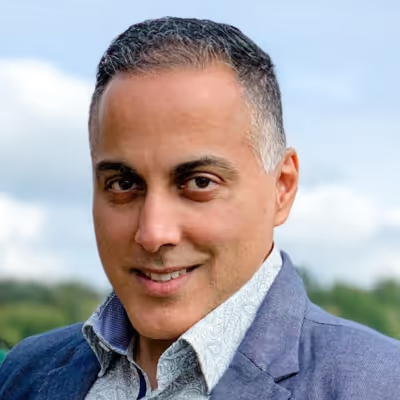
Abeer Syal
MD, FRCSC
Icône de localisation du chirurgien
Vancouver, C.-B.
Anglais, hindi, pendjabi
Accepte les patients adultes

Chirurgien orthopédiste ayant une formation postdoctorale—16 ans d'expérience—spécialisé en médecine sportive et en préservation articulaire, avec une expertise en reconstruction du genou et de l'épaule.

QC
Accepte les patients qui résident à l'extérieur du Québec
Alain Cirkovic
MD, FRCSC
Icône de localisation du chirurgien
Montréal, QC
Anglais, Français
Accepte les patients adultes

Chirurgien orthopédiste certifié par le FRCSC, comptant plus de 23 ans d'expérience en remplacement et reconstruction de la hanche et du genou, avec plus de 10 000 chirurgies réalisées à ce jour.
QC
Accepte les patients qui résident à l'extérieur du Québec
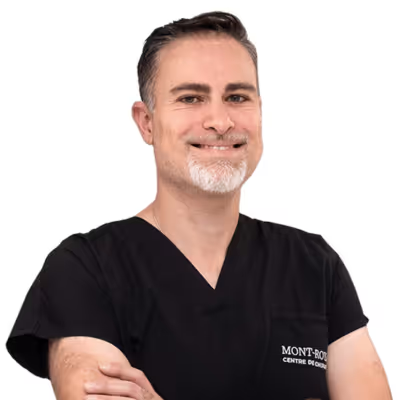
Dani Massie
MD, FRCSC
Icône de localisation du chirurgien
Montréal, QC
Anglais, Français
Accepte les patients adultes

Chirurgien orthopédiste expérimenté, reconnu pour son approche axée sur le patient et sa polyvalence technique, allant de la réparation des tissus mous (médecine sportive) aux remplacements articulaires complets (genou, épaule, hanche).

QC
Accepte les patients qui résident à l'extérieur du Québec
Marie-Lyne Nault
MD, PhD, FRCSC
Icône de localisation du chirurgien
Montréal, QC
Anglais, Français
Reçoit les adultes et les enfants

Chirurgienne orthopédiste formée à Harvard, spécialisée en médecine sportive pédiatrique et en chirurgie de la cheville. Elle est chercheuse principale au CHU Sainte-Justine et professeure à l'Université McGill.
QC
Accepte les patients résidant à l'extérieur du Québec.
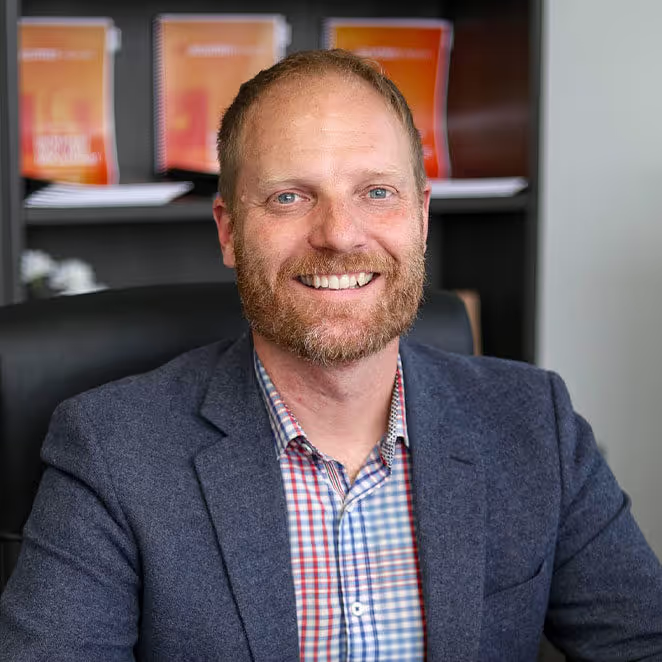
Matthieu Boivin
MD, FRCSC
Icône de localisation du chirurgien
Montréal, QC
Anglais, Français
Accepte les patients adultes

Chirurgien orthopédiste certifié par le FRCSC, expert en chirurgie robotique, en reconstruction articulaire et en médecine sportive.

Alberta
Accepte les patients de toutes les provinces, y compris l'Alberta
Curtis Myden
MD, FRCSC
Icône de localisation du chirurgien
Edmonton, AB
Anglais
Accepte les patients adultes

Chirurgien orthopédique et ancien olympien, spécialisé en médecine sportive et en reconstruction du genou et de l'épaule.

Alberta
Accepte les patients de toutes les provinces
Jesse Slade-Shantz
MD, FRCSC
Icône de localisation du chirurgien
Vancouver, BC; Kelowna, BC; Calgary, AB; Edmonton, AB
Anglais
Accepte les patients adultes

Chirurgien orthopédiste comptant 14 ans d'expérience, spécialisé dans les chirurgies arthroscopiques et ouvertes de l'épaule, du genou, du coude et des affections liées au sport.