


Private Direct Vision Internal Urethrotomy (DVIU)

Direct vision internal urethrotomy (DVIU) is a minimally invasive technique that uses a tiny scope and blade to cut through scar tissue inside a narrowed urethra, temporarily improving urine flow and easing straining. Find the right urologist who fits your needs below, serving Canadians in major cities like Vancouver, British Columbia; Edmonton, Alberta; Toronto, Ontario; and Montréal, Québec.
Le fondateur de Surgency, le Dr Sean Haffey, souriant
Révisé et approuvé par le Dr Sean Haffey
Maquette de carte de crédit

À titre informatif seulement, ne constitue pas un avis médical ou juridique. Veuillez consulter votre médecin ou votre chirurgien.

Comment fonctionne Surgency

Icône indiquant le lieu de l'intervention chirurgicale

Décidez où aller

La chirurgie privée au Canada nécessite généralement de voyager hors de sa province. La première étape consiste donc à décider où.
Icône indiquant la recherche sur la plateforme

Rechercher par spécialité

Notre application facilite la recherche de chirurgiens par spécialité et par emplacement.
Icône indiquant l'envoi d'une demande de consultation sécurisée au chirurgien

Planifiez une consultation

Prenez rendez-vous pour une consultation directement sur Surgency. C'est sécurisé, confidentiel et rapide.

What is direct vision internal urethrotomy?

Direct vision internal urethrotomy (DVIU) is a procedure to temporarily open a narrowed urethra—the tube that carries urine from your bladder out of your body. When scar tissue forms inside this tube (a urethral stricture), the passage gets tight, so urine has to force its way through a small gap. This can cause a weak stream, straining, taking a long time to urinate, or feeling like you never fully empty.

In a DVIU, the urologist uses a thin camera (a scope) that goes in through the penis into the urethra. Under direct vision on a screen, they find the tight, scarred segment. A tiny blade or laser on the scope is then used to carefully cut through the scar from the inside, opening the channel so urine can flow more freely again.

DVIU does not remove all the scar; it simply slices it to widen the space. It is usually considered a less invasive option compared to full urethroplasty, mainly used for shorter strictures or as a first step before talking about bigger reconstruction.

Why do Canadians get direct vision internal urethrotomy done privately?

Délais d'attente plus courts

  • Public wait lists for urology consults, cystoscopy, imaging, and OR time can be long.
  • Private centres can often get you assessed and booked for DVIU within weeks, not months.
  • That means less time living with weak stream, straining, and constant bathroom trips.

More choice and control

  • You can choose a urologist who regularly performs DVIUs and manages urethral strictures.
  • You can pick the clinic location and schedule the procedure around exams, work blocks, sport seasons, or family events.
  • There’s usually more room to discuss whether DVIU is the right “first step” versus going straight to urethroplasty, plus your anaesthesia preferences.

Tranquillité d'esprit

  • You know who is doing the procedure, what they plan to do, and when it will happen.
  • Clear timelines and an itemized quote make it easier to organize time off, travel, and support at home.
  • Direct messaging and faster sharing of scope images and reports reduce the “waiting in the dark” feeling.

Trying a less invasive option sooner

  • For some short strictures, DVIU can offer quicker symptom relief without a big reconstruction right away.
  • Doing it in a private setting may reduce repeated ER/clinic visits for retention scares or worsening flow while you wait in the public system.
Maquette de tableau de bord
Pourquoi choisir Surgency

Pour les Canadiens qui souhaitent une chirurgie en quelques semaines, et non en quelques mois

Surgency est une ressource gratuite, offerte par un médecin canadien du système public, pour vous aider à trouver le bon chirurgien selon vos besoins.

How do I get private DVIU in Canada?

  1. Confirmez votre diagnostic. La plupart des patients commencent par consulter un médecin de famille ou un spécialiste qui confirme que la chirurgie est conseillée. Un chirurgien privé peut également confirmer le diagnostic si nécessaire.
  2. Faites des recherches.
    • Vous pouvez trouver des chirurgiens à Vancouver, en Colombie-Britannique; Calgary, en Alberta; Toronto, en Ontario; et Montréal, au Québec sur notre application, et consulter leurs qualifications ainsi que les tarifs.
  3. Planifiez une consultation initiale. La plupart des chirurgiens proposent des consultations en clinique et en ligne.
    • Les consultations sont généralement fixées en quelques jours ou quelques semaines.
    • Remarque : prévoyez des frais de consultation entre 150 $ et 350 $.
    • Nous vous recommandons de prendre 2 à 4 consultations avec différents chirurgiens afin de mieux comprendre vos options.
  4. Consultation. Le chirurgien examinera votre état, vos symptômes et tout traitement ou diagnostic antérieur, comme des radiographies ou des IRM.
  5. Après la consultation. Le chirurgien examinera ensuite votre dossier et vous proposera des options chirurgicales (et non chirurgicales) en fonction de vos besoins; il passera en revue les risques et les résultats attendus; et présentera les options de tarification et de planification.
  6. Planifiez la date de votre chirurgie. Une fois que vous aurez confirmé la procédure et le paiement, la clinique fixera la date de votre chirurgie – généralement dans un délai de quelques semaines.

Direct vision internal urethrotomy: what to expect

Timings can vary a bit by clinic and by how complex your stricture is, but here’s the general idea.

How long does DVIU take?

  • The actual procedure is usually quick, often around 15–30 minutes of operating time.
  • You’ll still spend a few hours at the centre total for check‑in, anaesthesia, and recovery before going home.

Étapes de base (ce qui se passe réellement)

1. Check‑in and planning: You arrive, change into a gown, and meet the nurse, anaesthesia team, and urologist. They review your history, flow tests, and any imaging, then confirm where your stricture is and that DVIU is the plan.

2. Anaesthesia: Most people get general anaesthesia, so you’re fully asleep and don’t feel anything. Some centres may use a lighter anaesthetic with sedation, depending on your situation.

3. Position and prep: You lie on a padded table. The genital area is cleaned with antiseptic and covered with sterile drapes. Local freezing gel or fluid may be used inside the urethra.

4. Scope into the urethra: The surgeon gently passes a thin camera (cystoscope) into the urethra through the tip of the penis. They watch a screen to guide the scope down the pee tube until they see the narrow, scarred segment.

5. Cutting the stricture: Using a tiny blade or laser attached to the scope, they cut through the scar tissue from the inside under direct vision. The goal is to open up the tight ring so the channel is wider and urine can pass more easily.

6. Checking and catheter: They re‑check that the scope and fluid pass more freely through the area. In many cases, a urinary catheter is left in for a short time to keep the channel open while the lining starts to heal.

7. Wake‑up and early instructions: You wake up in recovery while nurses monitor you. Once you’re stable, you get simple instructions about the catheter (if you have one), pain meds, drinking fluids, and when to call for help. Then you go home the same day with a ride.

À quoi s'attendre pendant la période de récupération?

Everyone’s different, so your urologist’s plan always comes first. DVIU is smaller than a full urethroplasty, but it’s still real surgery on your urinary tract, so expect some discomfort for a bit.

Day 1-3

What it feels like:

  • Sensation de brûlure ou de picotement lorsque vous urinez.
  • A bit of blood in the urine (pink/red)
  • Achy feeling along the urethra or in the tip of the penis

Main goals:

  • Control burning and discomfort
  • Drink enough so your urine isn’t super concentrated (that burns more)

You’ll usually be told to:

  • Take pain meds as directed
  • Boire beaucoup d'eau
  • Avoid heavy lifting, hard exercise, or “holding it” too long

Days 3–14

Things often start to settle:

  • Urinating may still sting a bit but should slowly improve
  • You might notice your stream feels stronger or less “stop‑start” than before

You can usually do:

  • Light daily activities and desk/school work if you feel up to it
  • Gentle walking
  • Quick showers (no long hot baths unless your doctor says it’s okay)

Still avoid: hard workouts, heavy lifting, and sexual activity until your urologist clears you.

Weeks 2-5

  • Irritation should keep improving
  • You and your urologist will pay attention to how your flow feels and whether symptoms are creeping back
  • You might have follow‑up tests like uroflow (flow test) or a scope later on

Red flags – call your team or go to urgent care

  • Fever, chills, or feeling really unwell
  • Urine that turns very dark red with clots, or you suddenly can’t urinate at all
  • Severe pain that doesn’t improve with meds
  • Trouble emptying your bladder or strong pressure low in your belly

Recovery from DVIU is mostly about giving the urethra time to calm down, keeping urine flowing, and showing up for follow‑ups so your urologist can see how well it worked.

How much does DVIU surgery cost in Canada?

Costs for DVIU can vary a lot, so always ask each clinic for a written, itemized quote. Here’s a general overview.

DVIU is usually cheaper than full urethroplasty, but it’s still a specialist procedure in an OR.

  • Many Canadian private centres charge roughly CA$4,000–CA$8,000 for a DVIU.
  • Le nombre exact dépend de :
    • Clinic vs hospital partnership
    • Anaesthesia type
    • Whether extra time or additional procedures are needed

Combien cela coûte-t-il en moyenne aux États-Unis?

In the U.S., prices are usually higher once hospital and anaesthesia fees are added. Total charges can range roughly between CA$4,500–CA$9,000.

Qu'est-ce qui est généralement inclus dans le coût?

  • Surgeon fee (and assistant, if used)
  • Anaesthesia and monitoring (often general or deep sedation)
  • Accredited facility/OR fees, nursing staff, and standard disposables
  • Use of the cystoscope and instruments, plus catheter placement if needed
  • Immediate post‑op recovery care at the centre
  • At least one routine follow‑up visit to review symptoms and early results

Qu'est-ce qui n'est généralement pas inclus?

  • Initial consult visit(s)
  • Pre‑op tests: cystoscopy, uroflow, imaging (e.g., urethrogram), and lab work
  • Temps supplémentaire en salle d'opération au-delà du bloc réservé ou un séjour d'une nuit imprévu
  • Prescriptions after surgery (pain meds, antibiotics, stool softeners)
  • Later imaging or flow tests beyond the standard follow‑up plan
  • Travel and accommodation if you’re coming from another province, territory, or country

Conseils pour comparer les devis

  • Ask for line items: surgeon fee, facility fee, anaesthesia, and any special equipment.
  • Confirmez :
    • Combien de suivis sont inclus
    • Whether catheter removal and post‑op tests are part of the package
    • What happens to pricing if the procedure is more complex than expected or needs to be changed mid‑surgery.

Choisir un chirurgien et une clinique

Choisir votre chirurgien est l’un des avantages d’opter pour la voie privée. Voici comment choisir judicieusement.

Ce qu'il faut rechercher

Expérience et volume d'interventions

  • Ask how many DVIUs and urethral stricture cases they handle each year.
  • Ask if they also do urethroplasty, not just DVIU and dilations. Surgeons who see the full spectrum are in a better position to make decisions about when DVIU makes sense vs when it doesn’t.
  • A steady volume and a clear same‑day pathway usually mean smoother care.

Qualifications et formation

  • Confirm they’re licensed with your provincial college (CPSO, CPSBC, CPSA, CMQ, etc.).
  • Look for an FRCSC‑certified urologist, ideally with extra focus in reconstructive urology or urethral surgery.
  • For an in-depth overview on Surgeon Credential that matter, see our Guide.

Indications and plan

  • They should clearly explain why DVIU is being offered for your stricture (short? first‑time? location?).
  • Ask how they’ve reviewed your case: cystoscopy, imaging (e.g., urethrogram), flow tests.
  • A good urologist will also talk honestly about what happens if DVIU doesn’t last (repeat DVIU vs urethroplasty).

Résultats et sécurité

Ask for recent information like:

  • How often symptoms come back after DVIU for your kind of stricture
  • How often patients need another procedure (repeat DVIU, dilation, or urethroplasty)
  • Any notable complication or infection rates

They should be comfortable discussing numbers and trade‑offs, not just saying “it’ll be fine.”

Préparation et suivi postopératoire

Look for a clear, written plan that itemizes:

  • Tests préopératoires (cystoscopie, uroflow, imagerie, analyses sanguines)
  • Whether you’ll have a catheter afterwards and for how long
  • When you’ll be seen again and if you’ll have repeat flow tests or scopes
  • How to reach the team if you’re worried (phone/email, response times)

Qualité de l'établissement

  • Prefer an accredited surgical centre or hospital (Accreditation CanadaCAAASF, or provincial equivalent).
  • Ask about anaesthesia coverage, emergency backup, and what happens if something unexpected happens during the procedure.

Transparence des prix (pour les soins privés)

  • Demandez un détaillé quote:
    • Les honoraires du chirurgien
    • Frais d’installation
    • Anesthésie
    • Catheter/scope supplies
    • Follow‑ups and any included post‑op tests
  • Clarify what could add extra cost (extra time, repeat scope, additional procedures).

Good questions to ask in your DVIU consult

  • How many DVIUs and urethral stricture cases do you manage each year?
  • Why is DVIU a good option for my stricture, and what are the chances I’ll need another procedure later?
  • What does my imaging/cystoscopy show exactly?
  • What kind of anaesthesia do you use, and what’s the pain‑control plan?
  • Will I go home the same day? When can I return to school/desk work, and later to heavy work/sport?
  • What follow‑ups and tests are included, and what’s not part of the package?
  • Who do I contact after surgery if I’m worried, and how quickly do you usually respond?

A strong DVIU program is open about results, clear about the plan, easy to reach with questions, and totally transparent about what you’re paying for.

Direct vision internal urethrotomy frequently asked questions

How do I know if DVIU is right for me?

Figuring out if DVIU is right for you starts with what your urethra actually looks like on tests, not just how annoying your stream feels. Your urologist will help you decide based on your symptoms, imaging, and goals.

DVIU might be right for you if:

  • You have clear stricture‑type symptoms, like:
    • Weak or thin stream
    • Straining or taking forever to pee
    • Début et arrêt en plein milieu de la miction
    • Avoir l’impression de ne jamais être complètement vide
  • Les tests démontrent qu’il y a un rétrécissement possible, par exemple :
    • Cystoscopy (camera passed into the urethra)
    • Imaging like a retrograde urethrogram or voiding study
  • The stricture is:
    • Short and not too dense
    • In a location that usually responds to internal cutting
    • A first‑time or early problem, not a long series of failed procedures

Common reasons people have DVIU:

To get quicker relief from blockage symptoms with a less invasive procedure, as a first step before talking about full urethroplasty, or when surgery needs to be shorter/ simpler because of other health issues.

When DVIU might not be right (or not enough)

  • The stricture is long, dense, or has already come back after one or more DVIUs or dilations.
  • Your symptoms are mild and your urologist feels watchful waiting is safe for now.
  • There is an active infection or you’re not currently cleared for anaesthesia.

In short: DVIU is usually for shorter, suitable strictures when you and your urologist want a quicker, less invasive option, knowing it may not be a permanent fix.

Ai-je besoin d'une référence?

No, you do not need a referral for a private DVIU in Canada. You can book a consultation directly with a urologist, and they will review your options and diagnostics.

Comment me préparer ?

Your urologist’s instructions always come first—if their plan is different from this, follow them. DVIU is usually a short, same‑day procedure, but a bit of prep makes it smoother.

1. Organisez votre santé et vos médicaments

  • Stop nicotine if you can. Smoking/vaping slows healing and raises infection risk. Quitting 4+ weeks before surgery helps a lot.
  • Itemize your meds. Write down everything you take: prescriptions, Advil/ibuprofen, aspirin, vitamins, and herbal supplements. Give this list to your team. They may ask you to pause blood thinners, some anti‑inflammatories, or certain herbals that increase bleeding—only if your doctor says so.
  • General health: Aim for decent sleep, good hydration, and simple balanced meals with some protein.
  • Pre‑op tests: Expect things like bloodwork, urine tests, and sometimes imaging (like a urethrogram) or cystoscopy.

2. Installer la « zone de récupération » de votre maison

  • Have loose joggers/shorts and comfortable underwear ready. You may have some burning when you pee and possibly a short‑term catheter.
  • In the bathroom, keep gentle soap, clean towels, and a small bin or bag for any dressings or catheter supplies.
  • Pick a place to rest where you can easily reach water, your phone + charger, and meds without getting up constantly.

3. Planifier le soutien et la logistique

  • Ride home: You cannot drive after anaesthesia or strong sedation, so arrange a drive.
  • Help at home: It’s ideal to have someone around the first evening in case you feel dizzy, sore, or anxious about peeing.
  • School/work: Plan for at least a light day or two. Desk/school work is usually okay fairly soon, but heavy physical jobs may need a bit more time.
  • Travelling: If you’re coming from out of town, ask which follow‑ups can be virtual and how long you should stay nearby after the procedure.

4. Connaître votre plan pour la journée de la chirurgie

  • Fasting: Follow the anaesthesia rules exactly—usually no food after a set time (often midnight), and only clear fluids up to a cut‑off if allowed.
  • Skin prep: Shower the night before and the morning of surgery. No lotions or powders in the genital area. Don’t shave; your team will handle any hair if needed.
  • What to bring: Health card/ID, medication list, glasses/contact case if you use them, and loose, easy‑on clothes for going home.

5. Prepare for discomfort

  • Pain meds: If possible, fill any prescriptions before surgery and have acetaminophen (and any other approved meds) at home. Take them on schedule at first instead of waiting until things really hurt.
  • Fluids: Plan to drink plenty of water after surgery—dilute urine burns less as it passes over the treated area.
  • Bowel plan: Pain meds and stress can cause constipation. Have a fibre supplement or stool softener ready so you’re not straining on the toilet (that pressure is not your friend right after a urethral procedure).

Being organized about your health, home setup, and ride/home help makes the DVIU experience less stressful and gives you more headspace to focus on healing and follow‑up.

Quels sont les risques associés?

Your personal risk with DVIU depends on your health, where the stricture is, how long and dense it is, what tools are used (blade vs laser), and how closely you follow after‑care. Your urologist will help you understand the risks for your personal situation.

Courants et généralement temporaires

Ceux-ci sont inconfortables, mais attendus pour beaucoup de gens :

  • Burning or stinging when you pee for a few days
  • A bit of blood in the urine (pink/red) or tiny clots at first
  • Achy or sore feeling along the urethra or at the tip of the penis
  • Nausea, grogginess, or headache from anaesthesia; mild constipation from pain meds
  • Feeling like you need to pee more often while the area is irritated

Risques moins courants

Ça arrive moins souvent, mais tu devrais en être informé :

  • Urinary infection (burning that worsens, cloudy or smelly pee, fever)
  • Stronger bleeding in the urine that lasts longer than expected
  • Irritated nerves causing brief “electric shock” sensations or extra sensitivity along the urethra
  • Scar tissue forming again (partial recurrence of the stricture) so your stream slowly weakens over time

Questions spécifiques à la procédure

Because DVIU cuts the scar from the inside rather than removing it:

  • The stricture can come back, especially if it is longer or dense; some people need repeat DVIUs, dilations, or eventual urethroplasty
  • If DVIU is repeated many times, it can sometimes make later reconstruction a bit more complex
  • Some people notice a change in how their stream looks (direction/spray) even when flow is overall better

Risques rares mais importants

These are rare, but more serious:

  • Significant bleeding or clot in the bladder that might need a return to hospital for irrigation or another procedure
  • Injury to nearby structures in the urethra, which can affect how well it seals or how straight the channel is
  • Blood clots in the legs or lungs (DVT/PE) — uncommon for a short procedure, but possible after any surgery if you are very inactive

Comment réduire votre risque

You can’t make risk zero, but you can tilt things your way:

  • Stop nicotine before surgery and follow all pre‑op medication and fasting instructions
  • Drink plenty of fluids afterwards so your urine is pale (less stingy)
  • Avoid heavy lifting, straining, or “testing” your new flow with power pees early on
  • Take antibiotics and pain meds exactly as prescribed
  • Show up to scheduled follow‑ups so your urologist can catch any early recurrence

Red flags: fever or chills, pee that turns very dark red with clots, suddenly not being able to pee, severe pain that isn’t helped by meds, or chest/calf pain or shortness of breath. If these show up, contact your team or go to urgent care/ER.

DVIU is a well‑known, less invasive option for certain strictures. In experienced hands, most side effects are mild and short‑lived, but it’s important to understand the chance that the narrowing can return.

Quels sont les risques de retarder ou de ne pas subir la chirurgie?

Whether delaying DVIU is risky for you depends on how bad your symptoms are, what your tests show (length and location of the stricture), your goals (comfort, avoiding catheters, long‑term plan), and how well simpler things are working. Go over details with your urologist.

Main risks of delaying or not having DVIU

(lorsque les symptômes ou tests sont importants)

Symptômes et limitations progressifs

If the urethral narrowing stays or worsens, you may notice:

  • A weaker or split stream, more straining, and taking forever to pee
  • More bathroom trips, including at night
  • Growing anxiety about being too far from a toilet “just in case”

Some people eventually hit urinary retention (can’t pee at all) and need emergency catheters.

Élongation de la vessie et des reins

When urine can’t flow out properly:

  • The bladder has to push harder, and its walls can get thicker and less stretchy over time
  • Left long enough and severe enough, pressure can back up toward the kidneys and affect their function
  • Incomplete emptying makes recurrent urinary infections more likely

Problème plus difficile à traiter ultérieurement

An untreated stricture over months or years can:

  • Become longer and denser, making any future surgery (including urethroplasty) more complex
  • Respond less well to “quick” options like DVIU or dilation
  • Create long‑term abnormal pee habits that are harder to fully fix, even once the tube is opened

Impact sur la qualité de vie.

Living with a significant stricture can mean:

  • Planning your day around washrooms and avoiding long trips
  • Embarrassment about taking ages at the urinal or having a noisy/stop‑start stream
  • Broken sleep from night‑time trips and constant low‑level worry about getting stuck

Over time, that can wear down your mood, energy, and confidence.

Quand l'observation attentive peut être raisonnable

Delaying DVIU (or any procedure) may be okay if:

  • Your symptoms are mild, and you can pee without major straining or retention
  • Tests show a short, stable stricture that isn’t clearly worsening
  • You and your urologist have a clear monitoring plan (symptoms, flow tests, maybe imaging), and you’re genuinely comfortable with the trade‑offs

Alors qu’il n’est généralement pas sage de continuer à retarder

You and your urologist should talk seriously about DVIU or another procedure if:

  • You’ve had repeated retention scares or actual retention needing catheters
  • You keep getting urinary infections or bladder/kidney changes on tests
  • Peeing is a daily battle that limits school, work, travel, or sleep
  • Flow tests or scopes show the stricture is clearly getting longer or tighter

DVIU isn’t the answer for every stricture, and it’s not always permanent. But if a proven narrowing is repeatedly causing blockage, infections, or emergencies, dealing with it sooner—whether by DVIU or a more definite surgery—can protect your bladder and kidneys and make everyday life a lot easier.

J'ai encore des questions

Si vous avez encore des questions, n'hésitez pas à nous contacter directement.

Vous cherchez un urologue privé?

Parcourez les urologues agréés partout au Canada. Comparez les prix, les qualifications et les emplacements.

PARCOURIR LES CHIRURGIENS

Browse Accredited Private Surgeons for Direct Vision Internal Urethrotomy (DVIU)

Les chirurgiens de Surgency sont vérifiés :

✓ Diplôme de médecine reconnu
✓ Permis d'exercice canadien (LMCC)
✓ Permis d'exercice médical provincial actif
✓ Certification du conseil (FRCSC/ABMS)
QC
Accepte les patients de toutes les provinces, y compris le Québec
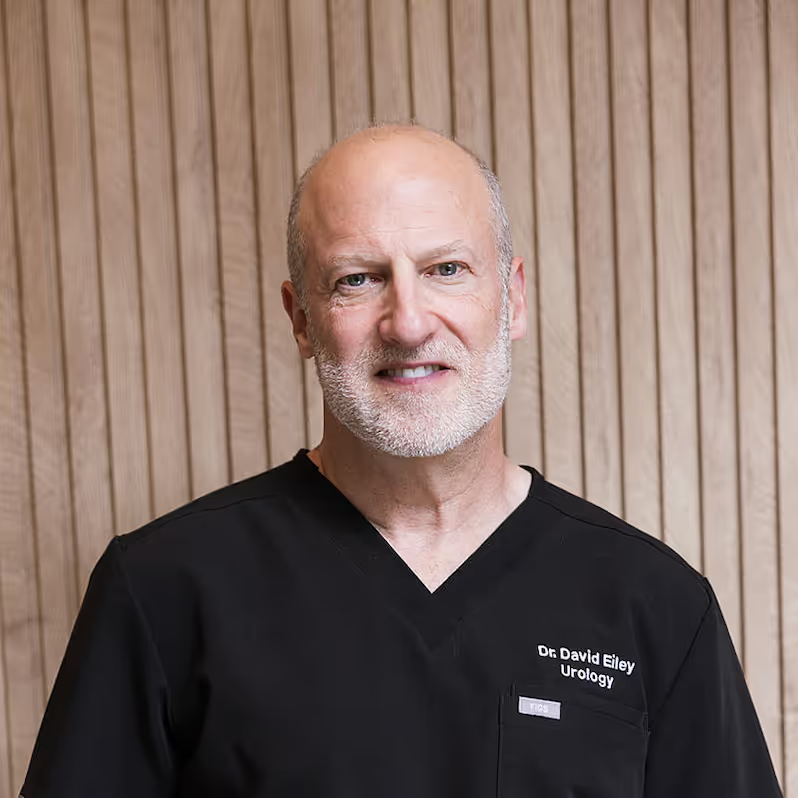
Photo de profil du chirurgien David Eiley
David Eiley
MD, FRCSC
Icône de localisation du chirurgien
Montréal, QC
Anglais, Français
Accepte les patients adultes

Urologue certifié FRCSC, avec 25 ans d'expérience et plus de 10 000 procédures réalisées. Expérimenté dans le traitement des maladies de la prostate, de l'incontinence urinaire, de la dysfonction érectile, ainsi que des affections de la vessie et des testicules.

QC
Accepte les patients de toutes les provinces
Daniel Liberman
MD, MSc, FRCSC
Icône de localisation du chirurgien
Montréal, QC
Anglais, Français
Accepte les patients adultes

Urologue à Montréal, spécialisé dans les dérivations urinaires, la continence et l'incontinence pour la vessie neurogène, ainsi que la réparation des fistules urinaires compliquées.