

.avif)

À titre informatif seulement, ne constitue pas un avis médical ou juridique. Veuillez consulter votre médecin ou votre chirurgien.



Bladder “lift” surgery is an operation that supports a sagging bladder so urine control is easier. The bladder sits above the vagina. When the tissues that hold it up (fascia and ligaments) get stretched or weakened, part of the bladder can bulge down (called a cystocele), causing leaks, pressure, or a heavy feeling. In a bladder lift, a surgeon reaches the vaginal side of the bladder and tightens or reinforces those support tissues, sometimes adding a strip of surgical material (mesh or your own tissue) like a sling to hold the bladder and urethra in a better position.
The goal isn’t to change the bladder itself, but to restore the “hammock” it rests on so the urethra stays closed when you cough, laugh, or exercise. Different techniques exist—native tissue repair, mid‑urethral sling, or colporrhaphy—and your anatomy and symptoms guide the choice. It’s focused on structure: re‑support the bladder so the urine pathway works more like it’s supposed to.

Operating time takes about 30–90 minutes, depending on the type (anterior repair/colporrhaphy, mid‑urethral sling, or laparoscopic/robotic sacrocolpopexy). Plan on a few extra hours for check‑in, anesthesia, and recovery before you go home (some cases stay overnight).
Étapes de base
Check-in and planning
Anesthésie
Positionnement et préparation
Accès
Correction du problème
Rinçage et vérification
Fermeture
Réveil et consignes

Patients often inquire about ‘bladder lift surgery.’ What they tend to mean is that they want a solution for their ‘bulge’ symptoms or sometimes visible vaginal bulging.
The term is an oversimplification of a complicated problem and require expert assessment and interpretation to determine what the correct treatment might be and what the options are.
Your consultation is about assessing your options: non-surgical and surgical. An in-person consultation may be required to properly assess for surgery. The objective for the consultation—whether by phone or in-person—is for you to better understand the problem and potential options.
At Protea Pelvic Floor Clinic Dr. Murphy offers (free of charge) telephone interviews to assess whether we can offer less invasive treatment or if an in person assessment is required to assess for surgery, and then exactly what procedures are indicated. Visit Dr. Murphy's profile for more information.

Every body is different—follow your surgeon’s plan. Taking instructions seriously usually means better results. Many clinics offer virtual follow-ups and pelvic-floor physio.
In general, here's what to expect
Semaine 1
Semaines 2 à 4
Semaines 5 à 8
Semaines 9 à 12
Month 3+
Fever, worsening pelvic pain, foul discharge, heavy bleeding (soaking pads), painful/swollen calf, chest pain/shortness of breath, inability to pee, or rapidly growing vaginal bulge—call your care team.
In Canada, private clinics charge between $5,000 and $20,000.
In the United States, the cost of bladder lift surgery is CA$7,100 - $35,000.
The costs vary considerably for bladder lift surgery depending on the province/clinic, anesthesia, and procedure type (anterior repair, mid‑urethral sling, sacrocolpopexy)—always request a written, itemized quote.
Choisir votre chirurgien est l'un des plus grands avantages d'opter pour le privé — utilisez-le à votre avantage.
Expérience et volume d'interventions
Qualifications et formation
Résultats et sécurité
Indications et alternatives
Plan chirurgical et techniques
Imagerie et planification
Accréditation de l'établissement
Intégration de la réadaptation
A “bladder lift” is surgery to re-support a sagging bladder or urethra so leaks and pelvic pressure improve.
What to ask your surgeon
Bottom lineIf leaks or prolapse are messing with life despite good non‑surgical care—and your exam pinpoints a fixable support problem—a bladder lift could help. A urogynecologist or pelvic‑floor–focused urologist can confirm fit and tailor the plan to your goals.
No, you do not need a referral for a private bladder lift surgery in Canada. You can book a consultation directly with a urogynecologist, and they will review your options and diagnostics.
Les instructions de votre chirurgien sont prioritaires — suivez son plan s'il diffère.
Your individual risk depends on your health, pelvic anatomy, the exact operation (anterior repair, mid‑urethral sling, sacrocolpopexy), anesthesia, and how closely you follow after‑care. Discuss your personal risks with your surgeon.
Your situation depends on how bad your leaks/bulge feel, pelvic exam findings (POP‑Q stage, urethral support), your daily demands, and how well non‑surgical care works (pelvic‑floor physio, pessary, lifestyle changes). Discuss specifics with your surgeon.
Symptômes progressifs et impact sur la vie quotidienne
Bladder and pelvic changes
Skin and vaginal issues
Bowel and sexual function effects
Traitement plus difficile ultérieurement
Medication and coping downsides
Si vous avez encore des questions, n'hésitez pas à nous contacter directement.

Browse vetted urogynecologists across Canada. Compare prices, qualifications, locations.
PARCOURIR LES CHIRURGIENS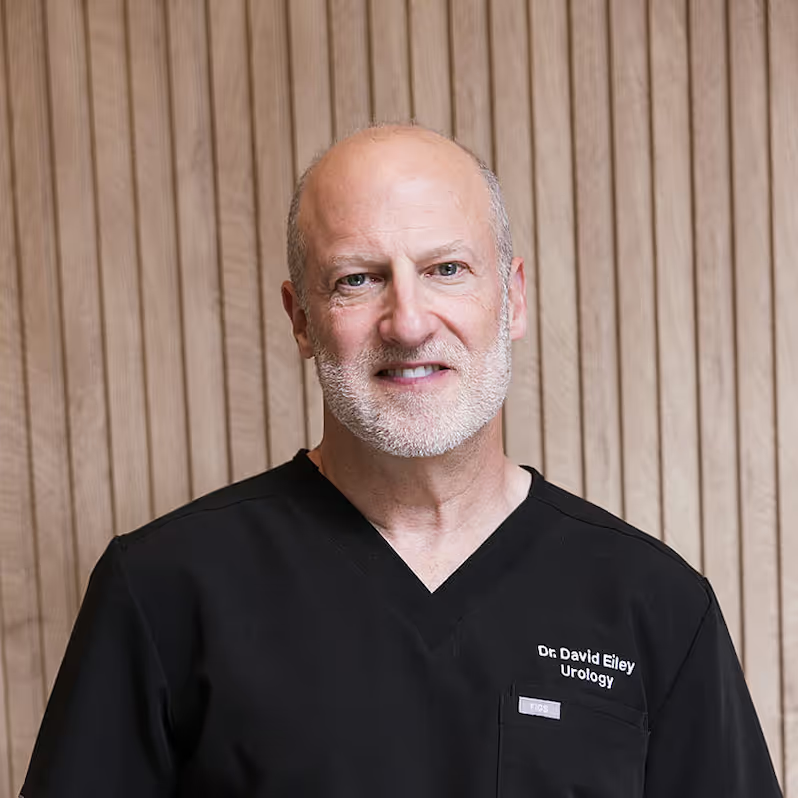



Urologue certifié FRCSC, avec 25 ans d'expérience et plus de 10 000 procédures réalisées. Expérimenté dans le traitement des maladies de la prostate, de l'incontinence urinaire, de la dysfonction érectile, ainsi que des affections de la vessie et des testicules.

Urogynécologue possédant 30 ans d'expérience en leadership clinique et médical, et reconnu comme un chirurgien hautement expérimenté ayant enseigné la chirurgie urogynécologique à des résidents et des boursiers.

Urologue de premier plan spécialisée en médecine pelvienne féminine et chirurgie reconstructive. Ses domaines d'expertise comprennent le prolapsus des organes pelviens, l'incontinence urinaire (masculine et féminine), les troubles mictionnels et l'HBP.