


.png)


What is eyelid surgery, and why do people typically choose to do it?
Eyelid surgery (blepharoplasty) is a procedure that removes or repositions excess skin, fat, and muscle from the upper and/or lower eyelids. It's one of the most commonly performed facial cosmetic procedures and can be done for cosmetic reasons (you look more tired than you feel) or functional reasons (drooping skin is blocking your vision).
Think of the eyelids as some of the thinnest, most active skin on the body — they fold and unfold thousands of times a day. With age, sun exposure, and genetics, the skin loses elasticity, the small fat pads behind the eye start to bulge forward, and the supporting muscles weaken. The result: hooded upper lids, deep upper-lid creases, puffy lower-lid bags, and fine vertical wrinkles.
What actually happens
Depending on which area is being treated, the surgeon makes carefully placed incisions — hidden in the natural crease of the upper eyelid, just under the lashes of the lower lid, or on the inside (pink side) of the lower lid — and removes or repositions excess skin, muscle, and fat. The incisions are closed with very fine sutures.
Types of blepharoplasty
- Upper blepharoplasty: Removes excess skin and a small strip of muscle from the upper eyelid, with or without a small amount of fat. Best for hooded, heavy upper lids. The most commonly requested version.
- Lower blepharoplasty: Removes or repositions fat (the cause of "bags") and tightens loose skin on the lower lid. Often combined with skin resurfacing.
- Transconjunctival blepharoplasty: A scarless lower-lid approach, done from the inside of the eyelid. Best for younger patients with fat bags but minimal loose skin.
- Asian blepharoplasty ("double-eyelid surgery"): A specialized upper-lid procedure that creates or refines a supratarsal crease. This is a different technique than standard Western blepharoplasty and should be done by a surgeon experienced specifically with East Asian eyelid anatomy.
- Functional blepharoplasty: Performed when the upper-lid skin is so heavy it blocks part of the visual field. Documented with visual-field testing, this version may be partially covered by provincial health plans (see below).
- Combined approaches: Often paired with brow lift, fat grafting, laser resurfacing, or canthopexy/canthoplasty (procedures that support the lower-lid corner).
Why do it?
Many patients say they look chronically tired, sad, or angry even when they feel rested — and that no amount of sleep, skincare, or under-eye cream changes it. Eyelid surgery is the most reliable way to refresh that area. For patients with significant upper-lid hooding, it can also restore peripheral vision and reduce eye strain from constantly raising the brows to see.
How we estimate surgical costs: Ranges are estimates drawn from our network of 100+ private clinics and surgeons, and they're intentionally broad. Two people seeking the same procedure can receive very different quotes depending on province, surgeon, facility fees, and case complexity. Published prices aren't always comparable either—some are complete bundles, others exclude consultation, imaging, or follow-up. Only the clinic can give you an exact, itemized quote.
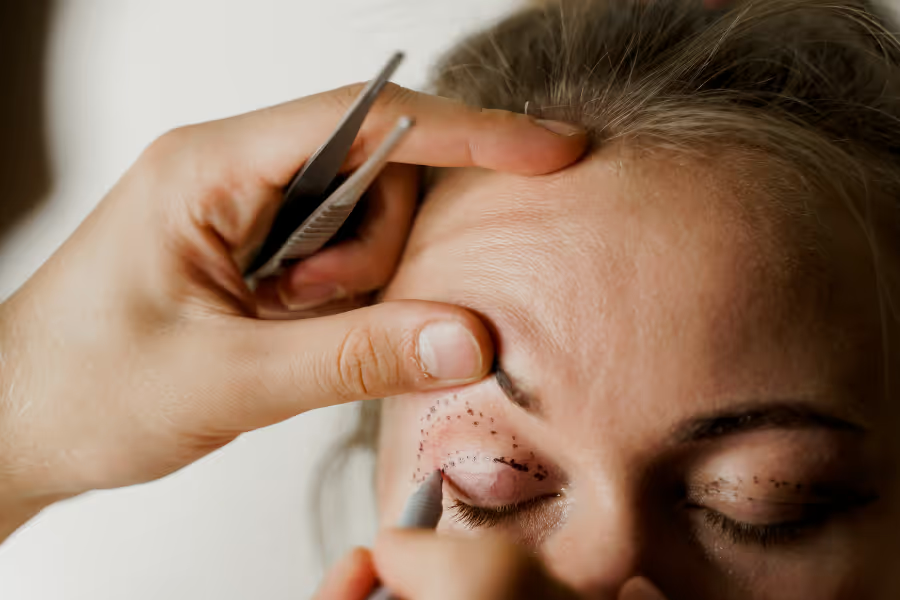
How long does eyelid surgery take?
Upper blepharoplasty alone typically takes about 45–75 minutes. Lower blepharoplasty alone is similar; combined upper and lower surgery typically takes 1.5–2.5 hours. Add time at the centre for check-in, anaesthesia, and recovery.
Basic steps
1. Check-in and confirmation
You meet the team, review your surgical plan, and confirm incision markings drawn on you while sitting upright (this matters—eyelid skin sits differently when you're lying down).
2. Anaesthesia
Most upper blepharoplasties are done under local anaesthesia with light oral or IV sedation. Combined upper + lower or more extensive cases may use deeper sedation or general anaesthesia.
3. Position and prep
You're positioned on your back. Protective eye shields or lubricating drops are placed, and the surgical area is cleaned and draped sterilely.
4. Local anaesthetic
The surgeon injects local anaesthetic into the eyelid. This is usually the most uncomfortable moment and lasts only seconds.
5. Upper-lid steps (if treated)
The surgeon makes a fine incision in the natural crease of the upper lid, removes a precisely measured strip of excess skin, trims a sliver of muscle if needed, and conservatively removes or repositions fat. The incision is closed with very fine sutures.
6. Lower-lid steps (if treated)
For patients with fat bags but good skin: a transconjunctival incision (inside the lid) is used to remove or reposition fat—leaving no visible scar.
For patients with loose skin: a subciliary incision (just under the lashes) is used to lift the skin, remove or reposition fat, and trim excess skin. The lower-lid corner may be supported with canthopexy or canthoplasty stitches to prevent downward pulling.
7. Symmetry check
The surgeon checks symmetry at multiple points and adjusts as needed.
8. Closure
Very fine sutures close the incisions. Cool compresses are placed.
9. Wake-up and instructions
You recover briefly in the post-anaesthesia area. Most patients go home the same day.
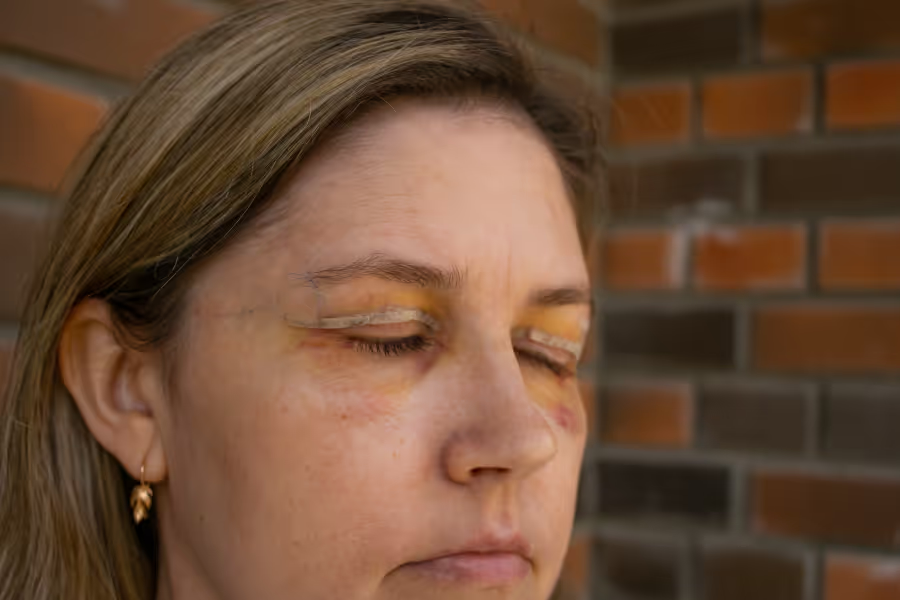
What to expect from the recovery process—eyelid surgery recovery time
This is generalized information. Every body heals differently—follow your surgeon's plan.
Most people are presentable in 10–14 days and back to most normal activities by 2 weeks. Final, refined results emerge over 2–3 months.
Days 1–3
Reality check:
You'll have swelling, bruising (often dramatic on the lower lids), and watery, blurry vision. Most patients sleep with their head elevated and apply cool compresses every 1–2 hours.
Goals: Manage swelling, protect the eyes, rest.
Activities: Cool compresses 10–20 minutes per hour while awake; sleep with head elevated on 2–3 pillows or a wedge; lubricating eye drops as directed; avoid bending over, heavy lifting, and screens for long stretches.
Days 4–7
Bruising peaking, then beginning to fade.
Goals: Reduce swelling, return to light routines.
Activities: Sutures (if non-dissolving) typically removed at 5–7 days. Many patients return to desk work by day 7–10 if comfortable being seen. Continue head elevation, cool compresses, and lubricating drops. Light walking is encouraged.
Weeks 2–3
Most visible bruising gone; subtle swelling lingers.
Goals: Return to most daily activities; protect from sun.
Activities: Most patients are presentable in public. Sunglasses + sunscreen on the lids during the day. Light cardio is usually OK. Continue eye lubrication if dry.
Weeks 3–6
Building toward final result.
Goals: Resume full exercise; gentle scar care.
Activities: Most patients return to gym workouts and most physical activities. Scars are pink but well-camouflaged in the upper-lid crease and along the lash line. Continue sun protection—fresh scars darken with sun exposure.
Months 2–6
Final result emerges.
Goals: Allow scars to mature and final shape to settle.
Activities: No restrictions. Scars continue to fade for up to a year. Mild dryness or asymmetry usually resolves over weeks to months.
Helpful tips
- Cool compresses, often: First 48–72 hours are when they make the biggest difference.
- Sleep with your head elevated: Reduces swelling and bruising significantly.
- Eye lubrication: Dryness is common for several weeks. Use preservative-free artificial tears liberally.
- No contact lenses for at least 2 weeks (longer if drying).
- Sunglasses + sunscreen: Sun is the enemy of fresh eyelid scars.
- Don't rub your eyes for several weeks—the eyelid sutures are delicate.
- Stop smoking and vaping: Nicotine impairs wound healing. Stop at least 4 weeks before and after.
Warning signs after eyelid surgery—when to call your care team
Most recoveries are uneventful, but the eye is delicate and some warning signs need same-day attention. Call your surgeon or seek care immediately if you notice any of the following:
- Sudden, severe, increasing pain in or behind the eye—especially if combined with bulging, hard swelling, or vision change. This can signal a retrobulbar hematoma (a rare bleeding emergency that can threaten vision and requires urgent treatment).
- Sudden vision loss, double vision, or a curtain across your vision—call 911 or go to the ER.
- Inability to close your eye several days after surgery, with worsening dryness, redness, or pain (corneal exposure risk).
- One eyelid suddenly becoming much more swollen, hard, or painful than the other.
- Spreading redness, warmth, foul-smelling drainage, or fever above 38.5 °C (101 °F)—signs of infection.
- Wound problems: Edges of the incision opening up, or sudden heavy bleeding.
- Lower lid pulled downward (ectropion) showing the pink inner surface, with worsening tearing or eye irritation.
- Severe nausea, vomiting, or inability to keep fluids down for more than 24 hours.
- Signs of allergic reaction to medication: Rash, hives, swelling of the face/throat, or trouble breathing.
When in doubt, call. With eye surgery especially, your surgical team would always rather hear from you early than late.
What is Surgency?
As a family doctor in the public system, I believe transparency is a form of care. I created Surgency to help my patients struggling on long waitlists who wanted to understand all their options for timely medical attention.
Surgency is a free resource designed to empower and educate—helping you understand private pathways and find accredited surgeons within Canada. I hope Surgency brings you clarity.
Dr. Sean Haffey

How to choose a surgeon and clinic
The eyelid is the most delicate area in cosmetic surgery, with very little room for error. Choosing the right specialist matters more here than almost anywhere else.
What to look for
Experience and volume (eyelid-specific)
Ask how many eyelid surgeries they perform each year—not just "facial procedures" in general.
Blepharoplasty is technique-sensitive because:
- Removing even 1–2 mm too much skin can leave the eye unable to fully close (lagophthalmos)
- Over-resecting lower-lid fat creates a hollow, skeletonized appearance that's very hard to reverse
- Incorrect lower-lid technique can pull the lid downward (ectropion or scleral show)
- Asian eyelid anatomy is anatomically different and requires specialized training
Also ask about their case mix:
- Upper vs. lower vs. combined cases
- Transconjunctival vs. transcutaneous lower lids
- Functional (vision-blocking) cases
- Asian / double-eyelid surgery (if relevant to you)
- Revision blepharoplasty (correcting another surgeon's result)
Right type of specialist
Three types of surgeons commonly perform blepharoplasty in Canada:
- Oculoplastic surgeons (ophthalmologists with extra fellowship training in eyelid and orbital surgery): often the most specialized for the eyelid itself, especially for functional or complex cases
- Plastic surgeons (FRCSC): broad facial expertise, often combine eyelid surgery with brow lifts, facelifts, and other facial work
- Facial plastic surgeons (FRCSC, ENT-trained): facial-focused; commonly perform blepharoplasty alongside rhinoplasty and facelift
Any of these can be excellent—the question is volume, results, and fit.
Credentials and training
- Verify licensure with your provincial college (CPSO Ontario, CPSBC BC, CPSA Alberta, CMQ Québec, etc.)
- Look for FRCSC certification in plastic surgery, ophthalmology (with oculoplastic fellowship), or otolaryngology (head & neck/facial plastic surgery)
- Be cautious of "cosmetic surgeons" without one of those Royal College credentials; in Canada, any licensed physician can advertise as a "cosmetic surgeon"
- Bonus: surgeons who teach blepharoplasty, publish outcomes, or are members of the Canadian Society of Plastic Surgeons (CSPS), Canadian Society of Oculoplastic Surgery, or the Aesthetic Society
For a more in-depth guide read, How to Understand Surgeon Credentials in Canada
Outcomes and safety (ask for real numbers)
Request recent data, ideally for blepharoplasty specifically:
- Infection rate
- Hematoma rate
- Lower-lid malposition rate (ectropion, scleral show)
- Dry eye / lagophthalmos rate
- Revision rate (how often a touch-up is needed) and what triggers it
- Patient satisfaction and typical return-to-work timelines
Clear indications and alternatives
A careful surgeon should explicitly assess:
- whether your concern is mainly upper lid, mainly lower lid, or both
- whether brow position is contributing (a heavy brow can mimic upper-lid hooding—fixing the lid alone won't help)
- your eye dryness baseline and any history of LASIK, contact-lens problems, or thyroid eye disease (these change the surgical plan)
- whether non-surgical options (filler for tear-trough hollows, neuromodulators, skin tightening) might be enough
- whether a functional component justifies pursuing partial public coverage first
Surgical plan
Ask:
- Which areas do you recommend treating, and why?
- Will you remove skin only, or also reposition or remove fat?
- For the lower lid: transconjunctival or skin incision—and why?
- Will you support the lower-lid corner with canthopexy/canthoplasty?
- Where exactly will the incisions be?
Facility accreditation and safety systems
Choose accredited centres (e.g., Accreditation Canada or CAAASF) with:
- a dedicated, certified anaesthesiologist for sedation or general cases
- emergency equipment and clear hospital transfer protocols
- specific protocols for retrobulbar hematoma (the rare but vision-threatening eyelid emergency)
Recovery integration
You want a written plan for:
- cool-compress and head-elevation routine
- eye lubrication
- contact lens timing
- pain control plan
- return-to-work and exercise milestones
- scar care (silicone, sun protection)
- when virtual follow-ups are appropriate
Transparent pricing
Request an itemized quote including:
- surgeon fee
- facility/OR fee
- anaesthesia
- follow-ups
- revision policy
Questions to ask at your blepharoplasty consultation
Surgeon and plan
- How many blepharoplasties do you perform yearly?
- How many cases like mine (upper, lower, combined, Asian, functional, revision)?
- Should we treat upper, lower, or both—and is my brow contributing?
- Will I remove skin, fat, or both? Reposition or remove?
- Do I need any supporting procedures (canthopexy, brow lift)?
Technique and safety
- What are your rates of: lower-lid malposition, dry eye, infection, and revision?
- What's your protocol for retrobulbar hematoma?
- What's your plan if I develop a complication?
Recovery and after-care
- When will I be presentable in public?
- When can I return to desk work, driving, contact lenses, the gym, and screens?
- What symptoms should prompt an urgent call?
- What's included in follow-up care, and for how long?
Costs and logistics
- What exactly is included in my quote?
- What could increase the cost?
- What is your revision policy if I'm not happy with the result?
- How are follow-ups handled if I live out of province?
Signals of a high-quality blepharoplasty program
- Performs eyelid surgery regularly (not occasionally) and explains technique choices clearly
- FRCSC-certified plastic surgeon, oculoplastic surgeon, or facial plastic surgeon working in an accredited facility with a certified anaesthesiologist
- Honest about brow contribution and non-surgical alternatives—willing to say "surgery isn't the right answer" when true
- Shares complication and revision rates openly and sets realistic expectations
- Provides a written recovery plan, eye-care protocol, and clear warning-sign list
- Offers transparent, itemized pricing—including the revision policy
If you're currently interested in private surgical pathways within Canada, you can click here for a list of providers.

Frequently asked questions
How do I know this surgery is right for me?
Blepharoplasty can be a powerful, high-satisfaction procedure for the right candidate, but is not right for everyone. This is a deeply personal decision and should not be taken lightly.
This is general information, please consult with your health provider.
Signs eyelid surgery might be right for you
- Your upper-lid skin is interfering with vision: Heavy skin pushing down on the lashes, eye fatigue from constantly raising your brows, or visual-field loss documented on testing.
- You have realistic expectations: Eyelid surgery refreshes the eye area, but doesn't change eye colour or shape, doesn't lift the brow, and doesn't eliminate dark circles caused by pigmentation or thin skin.
- You're a non-smoker (or willing to quit): Smoking impairs healing.
- You're in good general health with controlled medical conditions.
When it might not be the right option (yet)
- Significant brow drooping: A heavy brow can mimic hooded upper lids—fixing the lid alone in this case can make the brow look even lower. A brow lift may be needed first or in combination.
- Severe dry eye: Pre-existing dry eye can worsen after blepharoplasty. Optimization or treatment first is often safer.
- Active thyroid eye disease (Graves'), uncontrolled: Should be stable for a year or more before considering elective eyelid surgery.
- Significant unmanaged blood-pressure or bleeding-disorder issues: Increases the risk of retrobulbar hematoma.
- Active eye infection or recent eye surgery (e.g., LASIK): Wait until cleared by your eye doctor.
- Body dysmorphia or unrealistic expectations: A careful surgeon will pause if expectations don't match what surgery can deliver.
Do I need a referral?
Yes and no—you can reach out to any of the private surgeons listed on Surgency without a referral. Their intake teams are happy to answer questions, explain what they treat, share pricing ranges, and walk you through next steps.
However, to book a formal consultation with the surgeon, you'll typically need a referral from your family doctor or nurse practitioner. Don't have one? Many of the clinics can help coordinate a virtual GP appointment to get the referral paperwork sorted. All surgeons listed on Surgency offer virtual initial consultations, so you don't need to travel until you and the surgeon have agreed on a plan.
Before your consultation, expect the clinic to request relevant medical records and recent diagnostic imaging (X-ray, MRI, CT, ultrasound, lab work, etc.). Having these ready speeds up the process and lets the surgeon give you specific guidance on your very first call.
How do I prepare for surgery?
Your surgeon's instructions come first—follow their plan if it differs.
Prehab and health optimization
Eye health check
- Update your eye exam if it's been more than a year.
- Treat any dry eye, blepharitis, or active eye irritation before surgery.
- If you've had recent LASIK or another eye procedure, get cleared by your eye doctor first.
Quit nicotine—this is critical
- Stop smoking, vaping, and nicotine pouches at least 4 weeks before and after surgery. Nicotine constricts blood vessels and impairs eyelid wound healing.
Medication review
- Share all prescriptions, OTC meds, and supplements.
- Pause blood thinners, anti-inflammatories (NSAIDs like ibuprofen), and certain herbal supplements (fish oil, vitamin E, ginkgo, garlic) as directed—usually 1–2 weeks before surgery. These increase the risk of bleeding around the eye.
Optimize medical conditions
- Blood pressure: well-controlled BP lowers the risk of retrobulbar hematoma.
- Diabetes: tight blood-sugar control improves healing.
Home prep
Set up a recovery zone
- A recliner or bed with plenty of pillows is ideal—you'll sleep with your head elevated for 1–2 weeks.
- Keep cool-compress materials ready: a few flexible gel packs (kept in the fridge, not freezer) or clean washcloths.
- Stock preservative-free artificial tears, lubricating eye gel for night, and any prescribed eye drops.
- Have sunglasses ready for the trip home and the first weeks.
Reduce screen and reading time
- Plan a few days where you don't need to read or look at screens for long stretches.
Clothing
- Loose, button-up tops or zip-up hoodies—no pulling shirts over your head for the first few days.
- Avoid clothing that needs to go over your face.
Help at home
- Arrange for an adult to stay with you for at least the first 24 hours.
- Plan for help with cooking, childcare, and errands for the first few days.
- You won't be able to drive yourself home, and you may not feel safe driving for several days because of swelling and watery vision.
Food, meds, and surgery-day prep
Stock easy meals
- Soft, easy-to-prepare foods: soups, smoothies, eggs, yogurt.
- Hydrate well in the days before.
- Avoid heavily salted foods for a week before and after—salt worsens facial swelling.
Skin prep
- Use the antiseptic wash as directed (usually night before and morning of). Avoid getting it in your eyes.
- Don't wear eye makeup, contact lenses, or eyelash extensions to the procedure.
What to bring
- Health card/ID, medication list, and a list of allergies.
- Sunglasses for the ride home (your eyes will be sensitive to light).
- A loose, button-up top.
- Glasses (if you wear them)—no contacts.
- CPAP machine if you have sleep apnea.
Day-before checklist
- No food after midnight if having sedation/general (or as instructed).
- Confirm your ride home—you cannot drive yourself.
- Confirm your support person is ready for the first 24 hours.
- Charge your phone and put it within reach.
How much does Surgency cost?
Surgency is free for patients, funded for by surgeons.
Surgeons—who meet our listing criteria—pay a flat fee to list on the Surgency platform. To maintain objectivity, there are no commissions, referral fees, nor any ranking or recommending one surgeon over another.
Surgency is patient-first. Our goal is to make the process of finding a private surgeon as simple as possible. You choose who to contact. Learn more in our Advertising Policy.
What are the risks involved with surgery?
Your personal risk depends on your anatomy, eye health, medical history, and the technique used. This is generalized information, discuss your specific risks with your surgeon.
Common and usually temporary
- Swelling and bruising: Significant for the first 1–2 weeks; full resolution can take 6–8 weeks.
- Watery, blurry vision: Common for the first 1–2 weeks.
- Dryness, grittiness, or burning: Especially in the first weeks; usually resolves with lubrication.
- Light sensitivity: Common; sunglasses help.
- Tight feeling in the upper lids or pulling on the lower lids: Improves over weeks.
- Numbness or altered sensation in the lid skin; usually resolves within months.
Less common
- Hematoma (blood collection in the eyelid): May need drainage if large.
- Wound healing problems: Slow healing or opening of the incision.
- Visible or asymmetric scars: Most blepharoplasty scars are very well hidden, but a small number remain noticeable.
- Infection: Treated with antibiotics; rarely requires drainage.
- Asymmetry: Small differences are common; significant asymmetry may need touch-up.
- Persistent dryness or eye irritation: May need ongoing eye-drop management.
Procedure-specific considerations
- Lagophthalmos (inability to fully close the eye): Usually temporary, resolving in days to weeks. Persistent lagophthalmos can cause corneal exposure and may need treatment or revision.
- Lower-lid malposition (ectropion or scleral show): The lower lid pulls downward, showing the white below the iris or the pink inner surface. May need revision and/or a canthopexy.
- Hollow or skeletonized appearance: From over-resection of fat. Often requires fat grafting to correct.
- Asymmetric lid creases: Especially in upper or Asian blepharoplasty.
- Persistent fat bags or skin laxity: Under-correction. May need a touch-up.
- Need for revision: A small percentage of patients want or need a touch-up.
Uncommon but important
- Retrobulbar hematoma: A rare bleeding emergency where blood collects behind the eye, raising pressure and threatening vision. Symptoms: sudden severe pain, hard swelling, vision loss. Requires immediate treatment.
- Vision loss: Extremely rare—most often related to retrobulbar hematoma.
- Diplopia (double vision): Usually temporary from anaesthetic; persistent double vision is rare.
- Anaesthesia complications: Rare, but discussed by your anaesthesiologist.
How you can lower risk
- Stop nicotine completely for at least 4 weeks before and after surgery.
- Treat dry eye and blepharitis before surgery.
- Control blood pressure before surgery.
- Pause blood thinners and supplements as directed.
- Choose an experienced, board-certified specialist in an accredited facility.
- Sleep with head elevated and use cool compresses in the first days.
- Use lubricating drops liberally.
- Don't rub your eyes for several weeks.
- Keep all follow-up appointments—early detection of problems makes them easier to manage.
- Be honest about your medical history, including supplements and recreational drug use.
How long do eyelid surgery results last?
Eyelid surgery is one of the longest-lasting procedures in cosmetic surgery. Most patients enjoy their results for 10–15 years or more, and many never need a touch-up.
This is general information only, consult with your surgeon for your unique circumstances.
- Upper blepharoplasty: The skin and muscle removed are gone for good. New laxity slowly redevelops over the next decade or two as your skin continues to age, but it almost never returns to where it started. Many patients are happy with their result for life.
- Lower blepharoplasty: Fat that's removed or repositioned is essentially permanent. Loose skin can slowly redevelop with age, sun exposure, and weight changes.
- Asian (double-eyelid) surgery: The crease itself is generally permanent once it's set, though small revisions for asymmetry are not unusual.
What can change the result over time
- Aging and gravity: Continue regardless of surgery. The brow may descend, the midface may flatten, and skin elasticity slowly decreases.
- Sun exposure: The single biggest preventable factor. Sunglasses and SPF protect both your scars and your long-term result.
- Smoking: Accelerates skin aging around the eyes.
- Significant weight changes: Can affect lower-lid fullness.
What to expect long term
Some patients eventually pair their original blepharoplasty with a brow lift, fillers, or skin resurfacing as the rest of the face continues to age—but most don't need another surgery on the eyelids themselves. A small number of patients choose a minor touch-up years down the road for asymmetry or a small amount of returning skin laxity.
I still have questions
If you still have questions, please feel free to contact us directly.
Please note: Surgency is not a clinic itself. Nor can we help with emergency situations, or provide personalized medical advice—that is between you and your surgeon. If you are experiencing acute or severe symptoms, please present to your local emergency department or urgent care centre.


.avif)