

This page is a practical guide for individuals exploring private orthopedic surgical care in Toronto, Ontario. You'll find an overview of public wait times, regulatory considerations, and a list of accredited surgeons practicing in Ontario.
Note: Ontario residents cannot pay privately for surgery within Ontario. For more orthopedic options, view options in Montréal, QC; Vancouver, BC; Calgary, AB; Edmonton, AB.






A leader in complex spinal reconstruction, serving as Chief of Spine Surgery at Hamilton Health Sciences, recognized for expertise in minimally invasive techniques and management of spinal deformities & oncology.

Fellowship-trained orthopedic sports medicine surgeon in Toronto, ON. Hip, knee & shoulder arthroscopy, cartilage repair. Serves as Lead Team Physician for major professional sports organizations.
It depends on the procedure and setting. For purely elective, non-essential surgeries (such as cosmetic and ophthalmology), Ontario residents can pay out of pocket for surgery within Ontario.
But for essential surgeries (e.g. hip replacements, knee arthroscopy, ACL reconstruction, etc.), the answer is no. That is why all Ontarians who seek private surgery go out-of-province.
Yes and no—you can reach out to any of the private surgeons listed on Surgency without a referral. Their intake teams are happy to answer questions, explain what they treat, share pricing ranges, and walk you through next steps.
However, to book a formal consultation with the surgeon, you'll typically need a referral from your family doctor or nurse practitioner. Don't have one? Many of the clinics can help coordinate a virtual GP appointment to get the referral paperwork sorted. All surgeons listed on Surgency offer virtual initial consultations, so you don't need to travel until you and the surgeon have agreed on a plan.
Before your consultation, expect the clinic to request relevant medical records and recent diagnostic imaging (X-ray, MRI, CT, ultrasound, lab work, etc.). Having these ready speeds up the process and lets the surgeon give you specific guidance on your very first call.
This is general information, please seek professional tax guidance.
Generally, private surgeries performed in Canada are paid for out-of-pocket or via private insurance/ employer benefits.
Provincial plans (like OHIP, MSP, or AHCIP) typically do not cover procedures at private clinics, though some exceptions exist for WCB (Workers' Compensation) claims or specific inter-provincial programs.
Private insurance
Standard extended health benefits (e.g. Sun Life, Manulife) typically do not cover the cost of the surgery itself. However, they often cover related costs such as:
Health spending account
If your employer provides a Health Spending Account (HSA) or "flex account," you can often use these funds to pay for the surgery. Unlike standard benefits, HSAs are usually flexible enough to cover CRA-eligible medical expenses, including private facility fees.
Tax Credits (Federal & Provincial)
You may be able to get some financial relief at tax time.
Please consult a tax professional before claiming any private surgery fees on your taxes.
Surgency is free for patients, funded by surgeons/surgical providers.
Surgeons and providers—who meet our listing criteria—pay a flat fee to list on the Surgency platform. To maintain objectivity, there are no commissions, referral fees, nor any ranking or recommending one surgeon over another.
Surgency is patient-first. Our goal is to make the process of finding a private surgeon as simple as possible. You choose who to contact. Learn more in our Advertising Policy.
The costs for orthopedic surgery are substantial.
They vary considerably depending on the procedure, your underlying health conditions, the experience of the surgeon, type of anesthesia, etc., and can cost anywhere from $5,000 to $50,000+.
For an overview on private surgery costs, see our Resources on Private Surgery Costs.
Private surgeons typically charge a consultation fee because a surgical consult involves clinical work before, during, and after the appointment.
Most consultation costs range between $200 - $400, however they can be up to 10% of the overall surgery costs. In many cases this fee will get rolled into the total cost of the surgery itself—ask the surgeon.
A surgical consultation isn’t a “meet and greet.” It’s a formal medical assessment where the surgeon may:
Private clinics also cover operating costs that public hospitals don’t fund in the same way, including:
The consultation fee helps support these resources and the infrastructure required to provide timely, organized care outside publicly funded hospital operations.
As a family doctor in the public system, I believe transparency is a form of care. I created Surgency to help my patients struggling on long waitlists who wanted to understand all their options for timely medical attention.
Surgency is a free resource designed to empower and educate—helping you understand private pathways and find accredited surgeons within Canada. I hope Surgency brings you clarity.
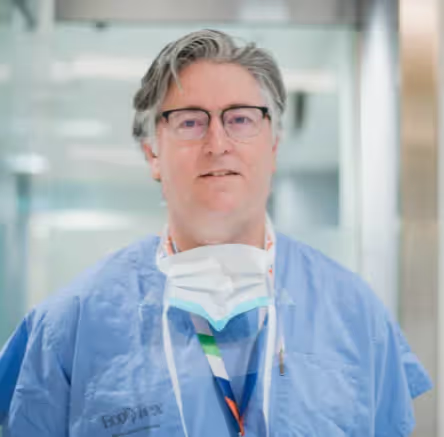
Dr. Sean Haffey

Orthopedic surgeons specialize in conditions affecting the musculoskeletal system—bones, joints, ligaments, tendons, and muscles. Common concerns that bring patients to an orthopedic specialist include:
It may be time to see an orthopedic surgeon if:
An estimated 600,000 surgeries are performed in Ontario each year, with over 250,000 Ontarians on wait lists. Tens of thousands of which are waiting on orthopedic surgeries.
All medically necessary orthopedic surgeries are delivered through the publicly funded Ontario Health Insurance Plan (OHIP), because private surgical options in Ontario are restricted. Ontario surgeons may not accept payment for medically necessary surgeries from Ontario residents.
Unlike most provinces, Ontario explicitly prohibits its surgeons from 'opting out' of OHIP, which would allow them to see Ontario residents within the province. Accordingly, anyone interested in private pay surgery must travel out-of-province for any medically necessary procedure.
Private pay for purely elective surgeries (e.g., cosmetic procedures, LASIK) is permitted under current regulations.
Current regulations: Ontario maintains some of the stricter regulations around private surgery in Canada. The Commitment to the Future of Medicare Act (CFMA) prohibits physicians from charging patients for OHIP-insured services, and enforcement has historically been rigorous. Unlike BC, QC, AB, Ontario has seen less legal challenge to these restrictions, and the private surgical landscape remains more constrained.
Wait times depend on urgency, imaging, and OR capacity.
If you’re over 60 with degenerative arthritis, you may be triaged differently than a younger patient with a locked knee or acute ligament injury. The fastest path usually comes from: clear diagnosis + complete imaging + documented failed conservative care.
In the Canadian medical system, wait times are divided into two distinct stages:
Ontario tracks b
In Ontario, surgical wait times are not determined on a first-come, first-served basis. Instead, they are managed through a standardized provincial system called the Wait Time Information System (WTIS), overseen by Ontario Health.
When a surgeon recommends you for surgery, they assign a Priority Level (1–4) based on clinical criteria. This priority level determines your target wait time—the maximum recommended time between your decision to proceed with surgery and the procedure itself.
Priority levels are not assigned automatically—they are clinical decisions made by your surgeon. However, surgeons must follow Ontario's "Access to Care" guidelines, which consider three main factors:
1. Disease Progression
2. Severity of Symptoms
3. Adverse Risk of Delay
In Ontario, there are an estimated 40,000 people waiting for orthopedic surgeries. In general, Ontario is one of the faster provinces at processing surgical wait lists, but the wait is still long for many.
For hip replacements, 78% of patients treated within target time. Priority 4 patients are seen within 16 weeks; Priority 3 patients are seen within 12 weeks; Priority 2 patients are seen within 11 weeks.
For knee replacements, 79% of patients are treated within target time. Priority 4 patients are seen within 17 weeks; Priority 3 patients are seen within 12 weeks; Priority 2 patients are seen within 10 weeks.
Note: the above estimates do not include the Wait 1 period, which adds an additional 9-11 weeks for hip replacements and 5-14 weeks for knee replacements.